There’s something oddly human about looking at a clock and wondering where a handful of minutes went. Not an hour. Not a year. Just a little pocket of time that slipped quietly past us while we were pouring coffee, replying to a message, or staring out a window for longer than we’d admit. 23 Minutes feels small untill you realize how much can happen inside it. A thought changes. A call arrives. Someone somewhere laughs, cries, or begins again.
If the current time is 12:43:02 AM, then traveling gently backward by 23 minutes ago brings us to 12:20:02 AM. That simple movement across a clock face becomes a tiny lesson in relative time, time arithmetic, and the strange poetry of moments passing by.
On Wednesday, July 29, 2026, the calculation becomes beautifully exact. The answer to what time it was 23 minutes ago is 12:20:02 AM, Wednesday, July 29, 2026, calculated from 12:43:02 AM, Wednesday, 29 July 2026. Funny how a small subtraction can carry so much meaning. Time is weird like that, isnt it?
Whether you’re using a time calculator, checking an exact timestamp, or simply satisfying your curiosity before bed, understanding how time moves backward and forward can make everyday calculations remarkably easy.
| Time Calculation | Result |
|---|---|
| Current Time | 12:43:02 AM |
| 23 Minutes Ago | 12:20:02 AM |
| Time Difference | 23 Minutes |
| Current Date | Wednesday, July 29, 2026 |
| Previous Timestamp | 12:20:02 AM, Wednesday, July 29, 2026 |
| Current Timestamp | 12:43:02 AM, Wednesday, July 29, 2026 |
| 23 Minutes From Now | 1:06:02 AM |
| 23 Hours Ago | 1:43:02 AM, Tuesday, July 28, 2026 |
| 23 Hours From Now | 11:43:02 PM, Wednesday, July 29, 2026 |
| 23 Days Ago | Monday, July 6, 2026 |
| 23 Days From Today | Friday, August 21, 2026 |
| 23 Weeks Ago | Wednesday, February 18, 2026 |
| 23 Weeks From Today | Wednesday, January 6, 2027 |
| 23 Months Ago | June 29, 2024 |
| 23 Months From Today | June 29, 2028 |
| 23 Years Ago | July 29, 2003 |
| 23 Years From Today | July 29, 2049 |
What Does 23 Minutes Ago From Now Really Mean?
When someone asks, “What time was it 23 minutes ago?” they’re really asking for a form of Past Time Computation. We don’t usually think of it that way while rubbing sleepy eyes at midnight, but that’s precisely what’s happening.
Subtracting twenty-three minutes from the present creates what’s known as a Minute-Based Time Calculation. It belongs to a broader family of Temporal Expressions that help us understand where we are relative to moments that have already happened or haven’t arrived just yet.
In our example:
- Current Time: 12:43:02 AM
- Time Difference: 23 Minutes
- Previous Time Calculation: 12:20:02 AM
- Date: Wednesday, July 29, 2026
Simple? Very. Useful? More than people realise sometimes.
The little thing people forget is that time calculations aren’t only for mathematicians or software developers. They’re quietly hiding inside alarms, appointments, recipes, fitness timers, and those late-night messages saying, “I’ll be there in twenty minutes,” which usually means twenty-eight if we’re being honest.
23 Minutes Ago From Now and the Beauty of Relative Time
There’s a softness to Relative Time calculations. They’re always asking where we stand between moments.
Think about it. Twenty-three minutes ago you may have been reading something entirely different. Twenty-three minutes from now you’ll probably be somewhere else mentally, even if you’re sitting in the same chair. Time dosen’t ask permission before moving along.
A proper Time Offset Calculation works like this:
- Identify the present timestamp.
- Determine the required duration.
- Apply time subtraction for past values.
- Apply time addition for future values.
- Verify whether the date changes across midnight.
That’s all a time ago calculator really does behind its elegant little interface.
For example:
- 12:43:02 AM minus 23 Minutes equals 12:20:02 AM
- The calendar date remains unchanged because the subtraction doesn’t cross into the previous day.
- Therefore, both timestamps remain on Wednesday, July 29, 2026.
It’s neat, though perhaps a bit magical too.
Why 23 Minutes Ago From Now Matters in Everyday Life

You’d be surprised how often people perform calendar calculations without realizing it.
Maybe you’ve wondered:
- What time did I send that email?
- How long ago did my meeting begin?
- When should I take the next dose of medication?
- How much time remains before midnight?
- Did my workout actually last twenty-three minutes?
These are all examples of Time Duration Calculation and elapsed time calculation.
Students use them. Parents use them. Programmers practically swim through them every day. Even bakers do. Leave cookies in the oven twenty-three minutes too long and suddenly everyone’s politely pretending they’re not burnt.
Human beings have always measured moments. We’ve merely become better at asking clocks complicated questions.
Understanding the Exact Timestamp Calculation
The phrase exact time carries more weight than it first appears.
An exact timestamp calculator doesn’t simply display numbers it preserves chronological accuracy. Consider our timestamps:
- 12:20:02 AM, Wednesday, July 29, 2026
- 12:43:02 AM, Wednesday, 29 July 2026
The difference is precisely 23 Minutes.
Notice how both date formats communicate identical information despite slight stylistic variations. Timestamp systems often support multiple regional formats while preserving temporal precision.
This process involves:
- Timestamp Conversion
- Clock Time Calculation
- Calendar Date Calculation
- Time Interval Calculation
- Chronological Calculations
Tiny details matter here. Computers can be wonderfully unforgiving when they’re asked whether twenty-three minutes means twenty-three minutes and three seconds. Apparently close enough isn’t close enough when mathematics is involved.
Exploring 23 Minutes Ago From Now Through Time Arithmetic
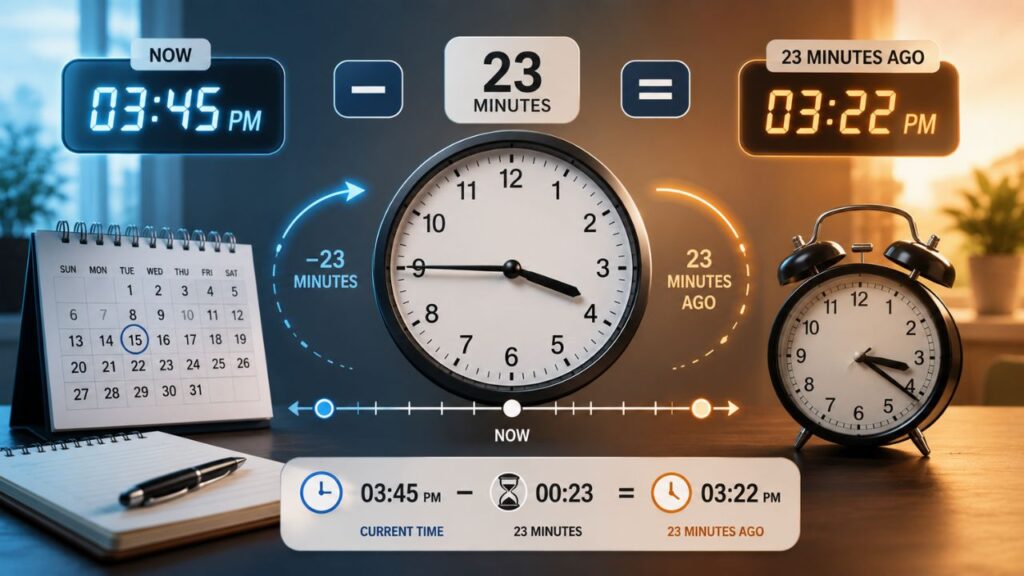
Time arithmetic sounds intimidating untill someone shows you how ordinary it really is.
Imagine you’re calculating:
- 23 minutes from now
- 23 hours ago
- 23 days ago
- 23 weeks ago
- 23 months ago
- 23 years ago
Each follows the same underlying principle.
For past calculations:
- Subtract the duration.
- Verify date transitions.
- Preserve timestamp accuracy.
For future calculations:
- Add the duration.
- Check for month or year changes.
- Validate calendar consistency.
That’s where Future Time Computation becomes particularly useful.
Our brains aren’t naturally designed for complicated calendar mathematics. Ask someone what date it will be 23 Months from today, and you’ll often get thoughtful silence followed by someone opening their phone calculator.
Thankfully, time calculators exist for exactly that reason.
Beyond Minutes: The Larger Family of Time Calculations
The question of what time was it 23 minutes ago belongs to an entire ecosystem of calculations.
Some common examples include:
- 23 hours ago
- 23 hours from now
- 23 days ago
- 23 days from today
- 23 weeks ago
- 23 weeks from today
- 23 months ago
- 23 months from today
- 23 years ago
- 23 years from today
Each requires a slightly different form of calendar arithmetic.
Hours remain relatively straightforward unless midnight decides to make things interesting. Days must account for varying month lengths. Months introduce leap years and differing calendar structures. Years become little adventures all their own.
Time behaves consistently, but calendars occasionally enjoy keeping us humble.
The Hidden Mathematics Behind Time Calculators
Modern date and time calculators quietly perform remarkable work behind the scenes.
They process:
- Date Calculation
- Previous Date Calculation
- Future Date Calculation
- Time Adjustment Calculation
- Temporal Calculations
- Calendar Time Computation
- Time Duration Finder
Suppose someone asks:
Calculate 23 minute time difference from 12:43:02 AM.
The calculator immediately determines:
- Starting timestamp.
- Required subtraction value.
- Remaining minute count.
- Date preservation requirements.
- Final timestamp formatting.
Result?
12:20:02 AM, Wednesday, July 29, 2026.
Fast enough that most of us spend longer blinking than the calculation itself requires.
23 Minutes Ago From Now in Digital Life

We’re surrounded by timestamps every single day.
Your smartphone records them. Banking systems depend upon them. Navigation apps measure them relentlessly. Streaming services quietly note when you paused a film twenty-three minutes ago because apparently even algorithms are curious creatures.
The importance of date and time conversion continues growing as our digital lives become increasingly interconnected.
Applications rely upon:
- Time Difference
- Current Timestamp
- Temporal Arithmetic
- Past Time Finder
- Future Time Estimation
- Elapsed Minutes Calculator
Without accurate timestamps, modern systems simply stop making sense.
That sounds dramatic, perhaps, but it’s true. Remove timekeeping from technology and suddenly calendars become decorative suggestions rather than useful tools.
Practical Examples Using 23 Minutes Ago From Now
Let’s imagine several situations where this calculation becomes useful.
A student finishes studying at 12:43:02 AM and wonders when they began their final review session.
Answer: 12:20:02 AM.
A support technician needs to identify when a system alert occurred exactly twenty-three minutes earlier.
Again, the answer remains unchanged.
A content creator notices an upload completed twenty-three minutes before midnight discussions began. Small timestamp differences suddenly become meaningful pieces of a much larger puzzle.
These examples demonstrate why time subtraction calculator tools remain surprisingly valuable despite their apparent simplicity.
Sometimes knowing when something happened matters almost as much as knowing what happened.
How to Calculate Time Without a Calculator
While calculators are wonderfully convenient, manual calculations remain useful.
Here’s a straightforward approach:
- Begin with the current timestamp.
- Subtract the minute duration.
- Verify whether crossing midnight occurred.
- Confirm whether the date changes.
- Format the final result appropriately.
For our calculation:
- Starting point: 12:43:02 AM
- Subtract: 23 minutes
- Remaining value: 12:20:02 AM
- Date remains: Wednesday, July 29, 2026
No complicated formulas required. Just careful arithmetic and a touch of patience.
Mind you, patience occasionally disappears when someone’s waiting for coffee to finish brewing. Time does feel slower when caffeine is involved.
Making Time Calculations More Meaningful
There’s something wonderfully grounding about paying attention to time.
Twenty-three minutes can contain a conversation worth remembering. Twenty-three hours can change an entire week. Twenty-three days may introduce a new habit, while 23 Years can reshape an entire life story.
Numbers become moments rather quickly when humans are involved.
Understanding concepts like:
- Time and Date Reference
- Relative Date Calculator
- Minutes Before Current Time
- Hours Calculation
- Days Calculation
- Weeks Calculation
- Months Calculation
- Years Calculation
helps transform abstract measurements into practical knowledge.
Time isn’t merely counted it’s experienced.
Frequently Asked Questions
what time was it 23 minutes ago
It was exactly 23 minutes before the current time. Simply subtract 23 minutes from the present time to find the answer.
23 minutes ago
“23 minutes ago” refers to a point in time that occurred 23 minutes before now. It is commonly used in time and date calculations.
23 minutes from now
“23 minutes from now” means a time that will occur 23 minutes after the current moment. Add 23 minutes to the present time to calculate it.
23 minutes ago from now
This phrase means the same as “23 minutes ago” the time exactly 23 minutes before the current time.
what time was 23 minutes ago
To determine what time it was 23 minutes ago, subtract 23 minutes from the current time. This provides the exact past timestamp.
Conclusion
The answer to 23 Minutes Ago From Now is beautifully precise: 12:20:02 AM, Wednesday, July 29, 2026, when calculated from 12:43:02 AM, Wednesday, 29 July 2026. Behind this simple subtraction lies an entire world of time duration calculation, timestamp calculation, and calendar computations that quietly support our everyday lives.
Whether you’re exploring 23 minutes from now, calculating 23 days from today, or wondering about 23 years from today, understanding how relative time works makes these questions remarkably approachable.
Perhaps that’s the nicest thing about clocks they’re always willing to answer our questions, provided we know how to ask them. Twenty-three minutes may not seem like very much at first glance, but time has a funny habit of making small things feel wonderfully important.
If this guide helped you better understand time calculations, consider sharing your favorite example of a memorable timestamp or how you use date and time calculations in everyday life. Sometimes the smallest moments are the ones most worth keeping track of.
Read more blog