There is something oddly satisfying about looking at a clock and realizing that a moment from less than an hour ago has already become “the past.” Maybe you were answering a message, waiting for a call, preparing breakfast, or simply wondering where the last few minutes went. Whatever happened, 50 minutes ago from now is close enough to remember clearly, but far enough away that the clock has already moved on.
Time can feel emotional in a funny little way. Parents often notice this when welcoming a baby girl, because one moment they’re waiting, and the next they are looking at a newborn wondering how everything changed so quickly. In everyday life, the same feeling appears on a much smaller scale. Fifty minutes can disappear while we are busy, yet calculating those 50 minutes precisely can tell us exactly when that earlier moment happened.
This guide explains what time was it 50 minutes ago from now, how to perform the calculation manually, how a previous time calculator works, and why knowing the exact time 50 minutes ago can actually be useful. It also explores the related calculations for hours, days, weeks, months, and even years. Time is simple, yes, but it likes to hide little traps in the corners.
| Current Time | 50 Minutes Ago |
|---|---|
| 2:47:48 AM | 1:57:48 AM |
| Date | Thursday, August 27, 2026 |
| Calculation | 2:47:48 AM − 50 minutes = 1:57:48 AM |
What Is 50 Minutes Ago From Now?
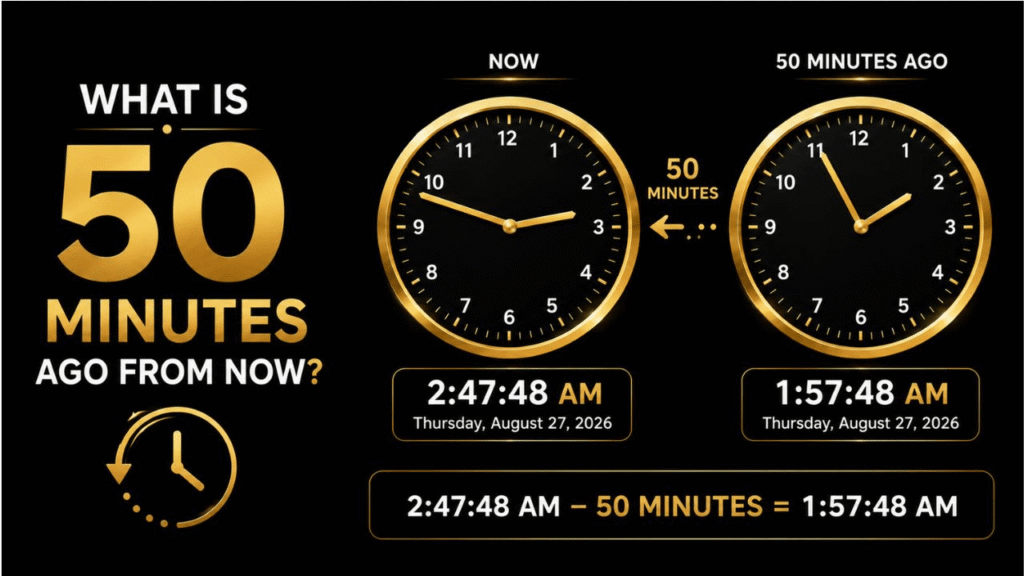
50 minutes ago from now means taking the current time and moving backward by a time interval of exactly 50 minutes. In plain language, it is the time before now by fifty minutes.
For example, if the current time is 2:47:48 AM, subtracting 50 minutes gives 1:57:48 AM. The seconds stay the same because only the minutes are being changed, which makes this time calculation rather pleasantly straightforward.
The basic equation is:
2:47:48 AM − 50 minutes = 1:57:48 AM
So, using the supplied example, the answer is 1:57:48 AM on Thursday, August 27, 2026. That is the previous time, not a future moment, and the elapsed time between the two clock readings is exactly 50 minutes.
What Time Was It 50 Minutes Ago From Now?
If the current time is 2:47:48 AM on Thursday, August 27, 2026, then the time 50 minutes ago was:
1:57:48 AM, Thursday, August 27, 2026
The calculation is simple:
2:47:48 AM − 50 minutes = 1:57:48 AM
Nothing mysterious is happening behind the clock. We are simply performing time subtraction. Since 2:47 AM is later than 1:57 AM on the same morning, there is no need to move backward to the previous date.
This also answers common searches such as what time was 50 minutes ago, what was the time 50 minutes ago, and what time was it 50 minutes ago from now. In this example, all three questions point toward the same answer: 1:57:48 AM.
How to Calculate 50 Minutes Ago
To calculate 50 minutes ago, start with the present clock time and subtract 50 from the minute portion. It sounds almost too easy, and usually it is, but crossing an hour can make the calculation slightly more interesting.
Suppose the clock shows 2:47 AM. Subtracting 50 minutes works like this:
- Start at 2:47 AM.
- Move backward 47 minutes to reach 2:00 AM.
- You still need to subtract 3 minutes.
- Move back 3 more minutes.
- You arrive at 1:57 AM.
When seconds are included, the same idea applies without touching them:
2:47:48 AM → 1:57:48 AM
The time difference is therefore 50 minutes exactly. A tiny calculation, but useful when accuracy matters.
A Quick Way to Understand the Time Difference
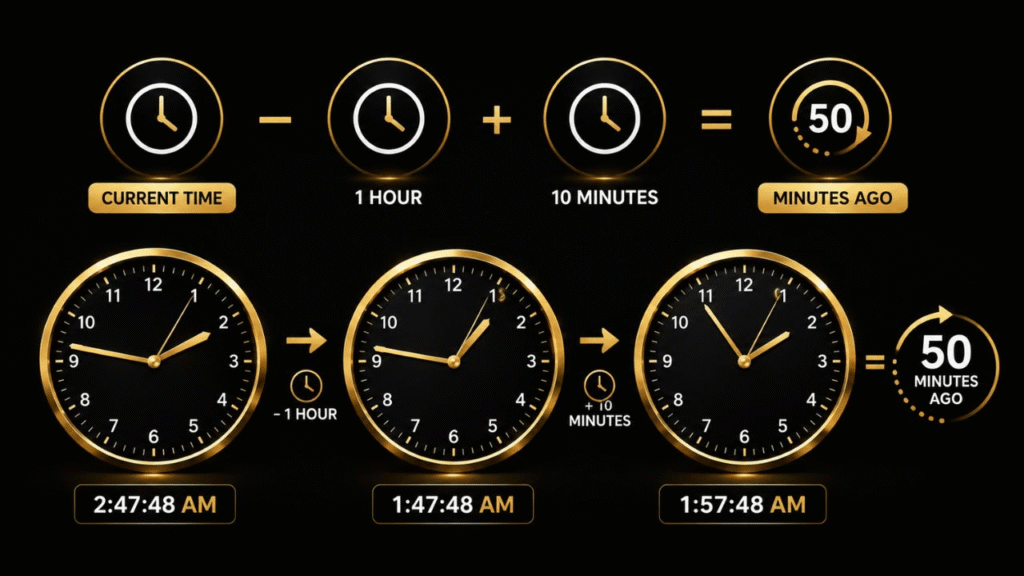
People sometimes make time calculations harder than they need to be. If you want to know 50 minutes before now, think of an hour as 60 minutes. Fifty minutes is only 10 minutes short of a full hour.
So another mental shortcut is:
Current time − 1 hour + 10 minutes
For 2:47:48 AM:
2:47:48 AM − 1 hour = 1:47:48 AM
Then:
1:47:48 AM + 10 minutes = 1:57:48 AM
That produces the same answer, just through a different little doorway. This method is especially handy when you are doing current time calculation in your head without opening a calculator.
Why Knowing 50 Minutes Ago Can Be Useful
At first glance, knowing a previous clock time may seem like one of those facts nobody needs. But daily life has a habit of turning tiny details into useful information.
You may need to remember when you sent an email, when a meeting started, when a timer ended, or when someone called you. Perhaps you started cooking 50 minutes ago and suddenly realized the oven has been doing its quiet work while you were distracted. These moments make a minutes ago calculator surprisingly practical.
For parents, students, employees, travelers, and anyone managing appointments, knowing the elapsed time can help reconstruct what happened earlier. Fifty minutes is long enough for a meeting, a workout, a commute, or a focused work session, but short enough that the earlier event may still feel fresh.
50 Minutes Ago From Now in Everyday Situations
Imagine you checked the time at 2:47:48 AM and then remembered something important happened earlier. Maybe you started reading at 1:57:48 AM. That means exactly 50 minutes had passed.
Or imagine a person says, “I sent that message 50 minutes ago.” If the reference time is 2:47:48 AM, you can immediately work backward to 1:57:48 AM.
This is where understanding 50 minutes ago from now becomes more than a search phrase. It becomes a small mental tool for organizing memories, appointments, conversations, and routines. Time is often easier to understand when we attach it to something that actually happened.
Using a Previous Time Calculator

A previous time calculator is useful when the current time includes awkward minutes or seconds, especially when you need to calculate several intervals quickly.
For a basic calculation, enter the current date and time, select the amount of time to subtract, and choose 50 minutes. The calculator then produces the earlier time.
For the supplied example:
Current date and time: Thursday, August 27, 2026, 2:47:48 AM
Time interval: 50 minutes
Calculated time: 1:57:48 AM
Temporal direction: Past
A time difference calculator can also help when the two times occur on different hours or dates. It removes the little mental gymnastics, which is useful when accuracy matters more than showing off your arithmetic skills.
What If the Calculation Crosses Midnight?
This is where people can stumble. If the current time is 12:20 AM and you subtract 50 minutes, the answer is not 11:30 AM. It is 11:30 PM on the previous day.
That date change matters.
For example, if the current time were 12:20 AM on August 27, 2026, subtracting 50 minutes would produce 11:30 PM on August 26, 2026. The time difference remains exactly 50 minutes, but the calendar date moves backward.
This is why a proper exact time calculation should consider both the clock and the date. A clock can tell you the hour, while a calendar quietly tells you which day you are actually standing in.
Understanding AM and PM in Time Subtraction
The 12-hour clock uses AM and PM to separate morning from afternoon and evening. When calculating an earlier time, crossing between these periods needs a little attention.
For the given example, both times are in AM:
2:47:48 AM → 1:57:48 AM
No AM/PM change occurs. However, if you were subtracting 50 minutes from 12:25 PM, you would reach 11:35 AM.
The arithmetic is still the same. The labels simply change when the calculation crosses the 12-hour boundary. It sounds dramatic, but the clock is mostly just being fussy about its naming system.
50 Minutes Ago and the Meaning of Elapsed Time
Elapsed time describes how much time has passed between two points. If something happened at 1:57:48 AM and the present moment is 2:47:48 AM, the elapsed time is exactly 50 minutes.
This concept appears everywhere.
A teacher may say 50 minutes have passed since class began. A runner may track a 50-minute training session. Someone waiting for a reply might notice that 50 minutes have gone by without a notification. Each situation uses the same underlying idea.
The clock does not care whether those minutes felt fast, slow, boring, or strangely emotional. Fifty minutes is still fifty minutes.
50 Minutes From Now: Looking in the Other Direction
The opposite of 50 minutes ago is 50 minutes from now. Instead of subtracting time, you add 50 minutes to the current clock reading.
If the current time is 2:47:48 AM, then:
2:47:48 AM + 50 minutes = 3:37:48 AM
So the earlier calculation looks backward, while this one looks forward. One describes a completed moment and the other describes a future moment.
This distinction is useful because searches such as minutes ago and minutes from now sound similar, but their temporal directions are completely opposite. One subtracts; the other adds.
Beyond Minutes: Hours, Days, Weeks, Months, and Years
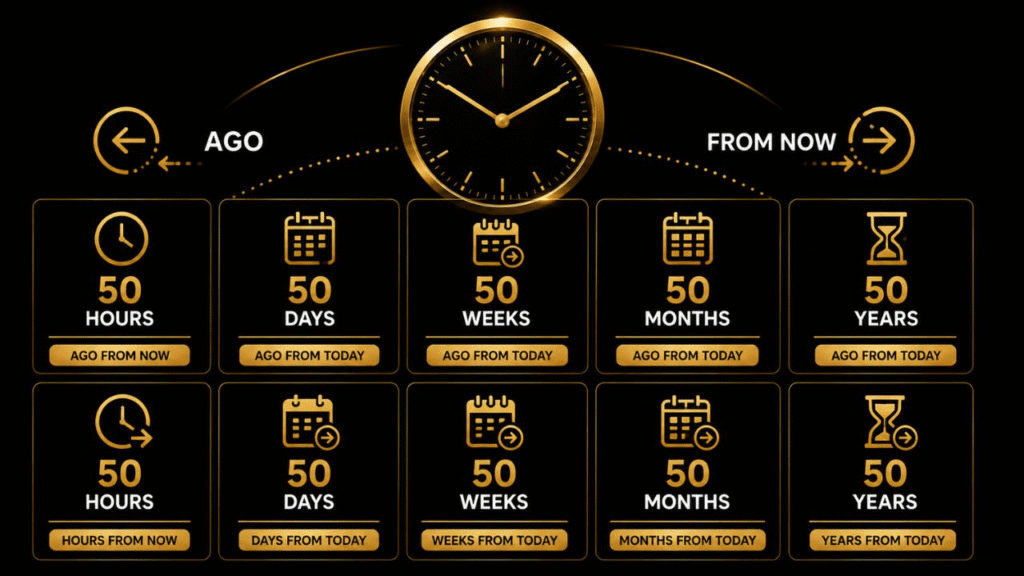
Once you understand how to calculate 50 minutes ago, the same principle can be expanded to larger units. The calculation becomes more involved, especially for months and years, because calendar lengths are not always identical.
Related searches may include:
- 50 Hours Ago From Now
- 50 Days Ago From Today
- 50 Weeks Ago From Today
- 50 Months Ago From Today
- 50 Years Ago From Today
- 50 hours from now
- 50 days from today
- 50 weeks from today
- 50 months from today
- 50 years from today
These are not interchangeable. Fifty hours is a duration measured continuously, while 50 days refers to calendar days. Fifty weeks equals 350 days, but 50 months cannot simply be treated as a fixed number of days because months have different lengths.
That little calendar irregularity is where time calculation stops being completely mechanical and starts becoming calendar arithmetic.
50 Hours Ago From Now
50 hours ago from now means moving backward by two full days plus two hours. Unlike a 50-minute calculation, this can easily cross multiple dates.
For example, if the current moment is Thursday morning, moving back 50 hours takes you to Tuesday morning, with the exact clock time adjusted by two additional hours.
The important thing is to preserve the exact starting time. If seconds are included, they normally remain unchanged unless the calculation includes seconds too.
50 Days Ago From Today
50 days ago from today is a calendar calculation rather than merely a clock calculation. You move backward 50 calendar days from the starting date.
Because different months contain different numbers of days, the safest approach is to use a calendar or date calculator when precision is required. Mental arithmetic can work, but calendars have a sneaky habit of adding February into the conversation when nobody invited it.
50 Weeks Ago From Today

50 weeks ago from today is easier to interpret because one week contains seven days.
Therefore:
50 weeks = 350 days
When you calculate 50 weeks ago, the resulting date will fall on the same weekday as the starting date, because complete weeks preserve the weekday.
That makes weekly calculations particularly convenient for recurring events, anniversaries, schedules, and planning.
50 Months Ago From Today
50 months ago from today is best handled as a calendar-month calculation. Fifty months equals four years and two months, but the exact resulting date depends on the starting day and the calendar.
For example, moving back 50 calendar months from August 2026 takes you to June 2022. The day of the month should also be preserved where possible.
This is one reason a date and time tool can be more reliable than simply converting months into an estimated number of days.
50 Years Ago From Today
50 years ago from today is the simplest large-scale calendar calculation conceptually. If the reference date is August 27, 2026, then 50 years earlier is August 27, 1976.
The clock time can remain unchanged when no other adjustment is required.
Thinking about half a century this way is slightly strange, honestly. Fifty minutes ago feels recent; fifty years ago feels like another world, even though both are described using the same little word: “ago.”
How to Avoid Mistakes When Calculating Time Ago
The easiest way to make an error is to rush. Start by writing down the complete current date and time, especially if seconds or AM/PM are important.
Then decide whether you’re adding or subtracting. For “ago,” you subtract. For “from now,” you add. It sounds obvious, yet this is exactly the sort of tiny detail people mix up while multitasking.
Also check whether the calculation crosses an hour, midnight, or another date. A time difference calculator can help when the numbers become less friendly, while simple mental math is perfectly fine for an uncomplicated 50-minute subtraction.
A Small Mental Shortcut for Busy Days
If someone asks what time was it 50 minutes ago and you don’t have a calculator nearby, remember this:
50 minutes ago = 1 hour ago + 10 minutes
So, if the clock says 4:15 PM, go back to 3:15 PM, then move forward 10 minutes. The answer becomes 3:25 PM.
It feels slightly backward the first few times, but your brain catches on quickly. Soon you’re doing the calculation almost without noticing, which is exactly what a useful shortcut should do.
Why Exact Time Still Matters in a Fast Digital World
Phones, computers, smartwatches, and online calendars have made time almost impossible to lose completely. Yet people still ask these questions because technology does not always remove uncertainty.
Maybe a notification says “50 minutes ago.” Maybe a website displays a timestamp in another time zone. Maybe someone remembers an event but not the exact moment. Understanding 50 minutes ago from now gives you the basic arithmetic needed to verify what the clock is telling you.
And there is something satisfying about knowing how the answer works instead of simply accepting a number from a screen. A calculator gives the result; understanding gives you the reason.
Read more blog: 48 Minutes Ago From Now
Frequently Asked Questions
What time was it 50 minutes ago?
If the current time is 2:47:48 AM, then 50 minutes ago it was 1:57:48 AM.
What time was 50 minutes ago?
Using the supplied example, the time 50 minutes earlier was 1:57:48 AM on Thursday, August 27, 2026.
How do I calculate 50 minutes ago?
Take the current clock time and subtract 50 minutes. If the subtraction crosses midnight, also move the date back by one day.
What is 50 minutes before now?
50 minutes before now is simply the current time minus a 50-minute interval, with the date adjusted when necessary.
Can I calculate 50 minutes ago without a calculator?
Yes. Subtract 60 minutes and then add 10 minutes. This mental shortcut works surprisingly well when the clock isn’t being complicated.
Is 50 minutes the same as one hour?
No. One hour contains 60 minutes, so 50 minutes is 10 minutes shorter than one hour.
What is the exact time 50 minutes ago?
For the provided reference time of 2:47:48 AM, the exact earlier time is 1:57:48 AM.
Conclusion
Calculating 50 minutes ago from now is a small task, but it teaches a surprisingly useful lesson: time becomes clearer when we break it into pieces.
Using the supplied example, the current time is 2:47:48 AM on Thursday, August 27, 2026. Subtracting 50 minutes gives 1:57:48 AM on Thursday, August 27, 2026. The complete calculation is:
2:47:48 AM − 50 minutes = 1:57:48 AM
From there, the same thinking can be applied to 50 minutes from now, hours, days, weeks, months, and years. The numbers change, but the basic idea remains beautifully uncomplicated: identify where you are, decide which direction you’re moving, and count carefully.
Maybe that’s why these tiny time questions remain useful. We spend our lives moving between “just now,” “50 minutes ago,” and “sometime later,” often without noticing the transition. A clock keeps moving even when we stop to think about it. And sometimes, pausing for a moment to understand where we were 50 minutes ago is a small reminder that every ordinary minute is quietly becoming part of our story.