There is something quietly fascinating about looking at a date that has not arrived yet. A calendar can make the future feel strangely close: one ordinary Saturday can suddenly become a milestone nine months away. If you are wondering 9 months from today, the answer is Saturday, May 29, 2027.
Starting from Saturday, August 29, 2026, we can move forward month by month until we reach May 29, 2027. It sounds simple, and mostly it is, but calendar mathematics has a few little traps hiding in the corners. Months do not all have the same number of days, after all.
Knowing the exact future date can be useful for planning birthdays, vacations, appointments, pregnancies, projects, subscriptions, school schedules, financial deadlines, or simply satisfying that oddly specific question that appears in your head at 8 in the morning. This guide explains the date calculation clearly, while also exploring related time calculations and practical ways to work with future dates.
What Date Will It Be 9 Months From Today?

If today is Saturday, August 29, 2026, then adding 9 months gives:
Saturday, May 29, 2027
The calculation keeps the same day of the month because May has a 29th day. So the basic month calculation is:
August 29, 2026 + 9 months = May 29, 2027
This is a straightforward example of adding 9 months to a date. We are not adding a fixed number of days such as 270, because a calendar month is not always exactly 30 days. That small distinction matters more than people expect, specially when an exact deadline is involved.
For someone asking what date will it be 9 months from today, the useful answer is therefore Saturday, May 29, 2027, assuming the starting date is Saturday, August 29, 2026.
9 Months From Today: A Simple Month-by-Month Calculation
A good way to understand 9 months from now is to walk through the calendar rather than trying to mentally wrestle with a large number of days.
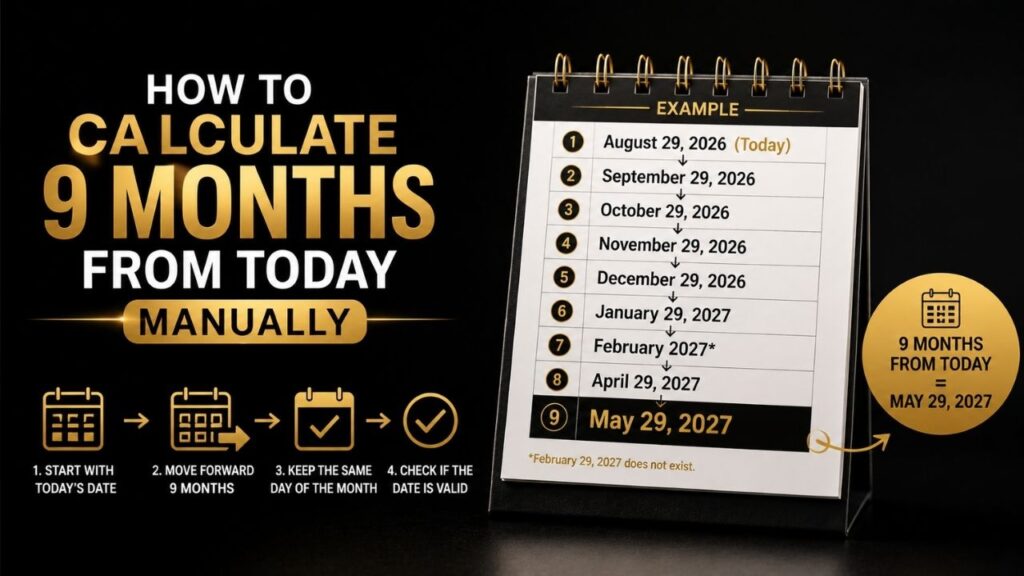
Beginning with August 29, 2026, count forward:
- 1 month later → September 29, 2026
- 2 months later → October 29, 2026
- 3 months later → November 29, 2026
- 4 months later → December 29, 2026
- 5 months later → January 29, 2027
- 6 months later → February 29, 2027
- 7 months later → March 29, 2027
- 8 months later → April 29, 2027
- 9 months later → May 29, 2027
There is one interesting wrinkle in that list: February 29, 2027 does not exist, because 2027 is not a leap year. So if you were literally calculating each intermediate calendar date, February requires special handling. The final result, however, is unaffected: the ninth month after August 29 is May 29, 2027.
That is one reason a proper date calculator can be more reliable than casually counting days on your fingers. Fingers are excellent for many things. Calendar arithmetic is not necessarily one of them.
Understanding the Exact Date 9 Months From Today
When people search for the date 9 months from today, they are often looking for an exact calendar result rather than an approximate duration.
There is an important difference between these two ideas:
- Nine calendar months means moving the month value forward by nine.
- Approximately 270 days means adding a particular number of days.
Those calculations can sometimes produce different dates because months contain 28, 29, 30, or 31 days. So a month-based date calculation should normally be performed using calendar months when the question specifically says “9 months.”
For the current example, the starting point is August 29, 2026, and the requested duration is 9 months. The resulting calendar date is May 29, 2027.
That distinction becomes especially useful when planning something that must happen on the same numerical day of a later month. A contract, recurring event, anniversary reminder, or scheduled payment may care about the calendar relationship rather than an arbitrary number of days.
How to Calculate 9 Months From Today Manually
You do not always need a sophisticated future date calculator. For a simple calculation, the calendar itself is enough.
Start with the month of the original date. Then move nine positions forward:
August → September → October → November → December → January → February → March → April → May.
Now keep the day number the same:
29 → May 29
Finally, check whether the target month actually contains that day. May does, so the calculation works neatly.
This approach is essentially a manual calendar calculation. It is particularly handy when you want to understand the answer instead of merely receiving it from a digital tool.
A tiny caution: when the starting day is near the end of a month, things can become less tidy. For example, dates involving the 29th, 30th, or 31st can encounter shorter months. That is where a reliable date calculation tool earns its keep.
Why 9 Months From Today Can Be Useful for Planning
A future date can look abstract until you attach a real purpose to it. May 29, 2027 might be just a line on a calendar today, but for someone planning an event, it can become a deadline, celebration, target, or turning point.
You might use 9 months ahead to plan:
- A long-term personal project
- A future birthday celebration
- A vacation or extended trip
- A wedding-related milestone
- A financial savings target
- A school or academic deadline
- A business launch
- A recurring appointment
- A home or renovation project
- A personal goal
The interesting thing about future planning is that nine months is long enough to accomplish something meaningful, but short enough that the date does not feel completely imaginary. You can still picture where you will be when it arrives.
Related Calculations: 9 Minutes, Hours, Days, Weeks, and Years
The phrase “9” can be attached to almost any time unit, but each calculation behaves differently. Understanding the difference prevents a surprising amount of confusion.
9 Minutes From Now
9 minutes from now is a time-of-day calculation. It depends on the exact current time, not merely today’s calendar date.
For example, if the current time were 8:10 AM, nine minutes later would be 8:19 AM. If the calculation crosses an hour, the hour changes accordingly.
9 Hours From Now
9 hours from now moves through the clock rather than the calendar month. If the starting time is 8:10 AM, nine hours later would be 5:10 PM on the same day, assuming no date boundary is crossed.
This is a classic time and date calculation, where both the clock and calendar may matter.
9 Days From Today
A calculation of 9 days from today means adding nine individual calendar days. From Saturday, August 29, 2026, that lands on Monday, September 7, 2026.
Unlike months, days are fixed units, so this calculation is usually more direct.
9 Weeks From Today
Since one week contains seven days, 9 weeks from today represents 63 days. Starting on a Saturday means the resulting weekday remains Saturday.
That makes weekly calculations rather pleasant: the weekday does not wander off somewhere.
9 Years From Today
9 years from today means moving the calendar year forward by nine. From August 29, 2026, the corresponding date would be August 29, 2035, provided the calendar date remains valid.
9 Months Ago From Today
Moving backward rather than forward gives a past date calculation. Nine months before August 29, 2026 is November 29, 2025.
The same month-based principle applies, just in reverse.
9 Minutes Ago and 9 Hours Ago
9 minutes ago from now and 9 hours ago from now require the exact current time. These are not primarily date calculations unless the subtraction crosses midnight.
For more complex cases, a time ago calculator or date and time calculator can save you from doing midnight arithmetic while half asleep.
9 Months From Today vs. 9 Months in the Future
These phrases generally describe the same concept, but their wording creates slightly different expectations.
9 months from today sounds like a precise calendar question. You begin with today’s date and move nine calendar months forward.
9 months in the future is broader and can refer to planning generally. Someone might say, “Where do you see yourself nine months in the future?” That is not necessarily asking for a calendar answer at all.
Meanwhile, 9 months later usually describes a comparison between two known points in time.
For example:
The project started in August 2026 and finished nine months later.
Here, the phrase “nine months later” establishes a relationship between the two dates.
The mathematics can be identical, but language gives each expression a slightly different personality. Dates are funny that way.
Why Calendar Months Are Different From 30-Day Periods
One of the most common mistakes in future date calculation is assuming every month contains exactly 30 days.
It doesn’t.
The Gregorian calendar uses months with different lengths:
- January — 31 days
- February — 28 days, or 29 in a leap year
- March — 31 days
- April — 30 days
- May — 31 days
- June — 30 days
- July — 31 days
- August — 31 days
- September — 30 days
- October — 31 days
- November — 30 days
- December — 31 days
That is why “nine months” and “270 days” should not automatically be treated as identical.
If someone needs an exact date 9 months from today, the safer approach is to perform a calendar-based calculation rather than multiplying nine by thirty.
Using a Date Calculator for Accuracy
A future date calculator is useful when the calculation includes unusual dates, long periods, or several units at once.
For example, you might want to calculate:
August 29, 2026 + 9 months + 12 days
Doing this manually is possible, but a date calculator can handle the calendar rules without requiring you to mentally track every month.
A good date calculation tool can also help with:
- Adding months or days
- Subtracting time periods
- Finding the difference between dates
- Calculating past dates
- Calculating upcoming dates
- Comparing two calendar dates
- Performing date conversion
- Combining dates and times
Still, tools should support understanding rather than replace it. Knowing why the answer is May 29, 2027 gives you confidence when a calculator displays the same result.
The Importance of the Starting Date

Every date calculation depends completely on its starting point. If today changes, the answer changes.
For this example, the starting date is specifically:
Saturday, August 29, 2026
The duration is:
9 months
The result is:
Saturday, May 29, 2027
If you perform the same search tomorrow, the answer will no longer be May 29, 2027. This sounds obvious, but it is an easy detail to overlook when copying dates into documents, schedules, or articles.
When recording an upcoming date, it is therefore smart to write the full date instead of only saying “nine months from today.” Future-you may not remember which “today” you meant. Future-you is busy enough already.
A Quick Reference for Time Calculations
Here is a compact way to understand related calculations from the same starting point:
| Time period | Result |
|---|---|
| 9 days from today | Monday, September 7, 2026 |
| 9 weeks from today | Saturday, October 31, 2026 |
| 9 months from today | Saturday, May 29, 2027 |
| 9 years from today | August 29, 2035 |
| 9 months ago from today | November 29, 2025 |
The minute- and hour-based results cannot be stated accurately without fixing the exact starting time, because 9 minutes from now and 9 hours from now depend on the clock as well as the date.
This is where time and date calculation becomes more nuanced. A calendar answers one part of the question; the clock answers another.
Common Mistakes When Calculating a Future Date
The most common error is counting the starting month as month one. If you begin on August 29 and immediately call August “one month,” you have shifted the calculation.
Instead:
August 29 → September 29 = 1 month
Then continue counting.
Another mistake is treating months as identical blocks of 30 days. As mentioned earlier, that can produce an incorrect result.
A third mistake is ignoring the day of the week. For May 29, 2027, the weekday is Saturday, matching the starting Saturday because nine calendar months happen to preserve that weekday in this particular case.
Finally, people sometimes confuse “9 months from today” with “the same date after 270 days.” Those are related ideas, but not always equivalent.
When an Upcoming Date Becomes a Real Milestone
There is a psychological difference between saying “nine months” and saying “May 29, 2027.”
The first feels like a duration.
The second feels like somewhere.
Once a date has a name, it becomes easier to plan around. You can circle it on a calendar, put it into a planner, create a reminder, or tell someone, “That is the day we’re aiming for.”
That is the quiet usefulness of calendar calculation. It transforms an abstract stretch of time into something visible.
For long-term goals, this can be surprisingly motivating. Instead of thinking about an enormous future, you have one particular day waiting at the other side of the calendar.
How to Use the Date in Everyday Planning
If your target is Saturday, May 29, 2027, start by writing it into your planner exactly as it appears.
Then decide what the date represents.
If it is a deadline, work backward and establish smaller milestones. If it is a celebration, consider venue, invitations, travel, and preparation. If it is a personal goal, divide the nine-month period into manageable stages.
You can also create checkpoints at one, three, six, and eight months. This turns 9 months from now from one distant destination into a sequence of smaller journeys.
A future date becomes much less intimidating when you stop staring at the whole road.
Read more blog: 50 Minutes Ago From Now
Frequently Asked Questions
9 months from today
9 months from today, Saturday, August 29, 2026, will be Saturday, May 29, 2027.
9 months ago from today
9 months ago from today, Saturday, August 29, 2026, was Saturday, November 29, 2025.
Conclusion
So, what date will it be 9 months from today?
Using Saturday, August 29, 2026 as the starting date, the answer is:
Saturday, May 29, 2027.
The calculation demonstrates a simple but useful principle: calendar months should generally be calculated as calendar months, not as an assumed number of days. When precision matters, a future date calculator or dependable date and time calculator can confirm the result.
Whether you’re planning a project, marking an important occasion, organizing a schedule, or simply wondering where the calendar will carry you, knowing the date after 9 months gives the future a little more shape.
And perhaps that’s the nicest thing about date calculations. They are not really about numbers alone. They are about giving tomorrow, next month, and next year a place to stand. Today is Saturday, August 29, 2026; nine months later, the calendar opens onto Saturday, May 29, 2027. A small calculation, yes but sometimes a small calculation is the first pin on a very large map.