Sometimes a date looks like a tiny thing, almost too small to care about, until you actually need it. You remember something happened “about five months ago,” but suddenly you need the exact Wednesday, the exact calendar date, the little square on the calendar where that memory belongs. That is where 20 weeks ago from today becomes more than a simple subtraction exercise, and honestly, dates can be sneaky like that.
If today is Wednesday, September 2, 2026, then going back exactly 20 weeks takes us to Wednesday, April 15, 2026. The calculation sounds complicated when written in words, but it is actually pretty clean: one week contains seven days, so 20 weeks contain 140 days. Subtract those 140 days from September 2, and the answer lands on April 15, 2026.
So, if you searched what date was 20 weeks ago, the direct answer is Wednesday, April 15, 2026. No mysterious calendar gymnastics required, thankfully.
The Simple Answer: 20 Weeks Ago From Today

The most useful thing to know first is the final result. Based on the given current date, the calculation is:
Today: Wednesday, September 2, 2026
Time interval: 20 weeks
Equivalent days: 140 days
Date 20 weeks ago: Wednesday, April 15, 2026
That means 20 weeks ago from today was Wednesday, April 15, 2026. The weekday stays Wednesday because moving backward by a whole number of weeks returns you to the same weekday, which is one of those oddly satisfying calendar facts.
If someone asks what was the date 20 weeks ago, you can simply tell them April 15, 2026. If they ask what day was 20 weeks ago, the answer is Wednesday. Both pieces fit together neatly, no fuss.
How the 20-Week Date Calculation Works
A 20-week date calculation can be handled using basic date arithmetic. Since every week has seven days, multiply 20 by seven:
20 × 7 = 140 days
Now the task becomes a normal calendar calculation. Instead of subtracting 20 individual weeks while staring at a calendar and losing count somewhere around week nine, you can subtract 140 days from September 2, 2026.
The result is April 15, 2026. This is the sort of exact date calculation that looks harder than it really is, mostly because months have different numbers of days and calendars love making simple things feel slightly dramatic.
There is another helpful detail here: because 20 weeks is a complete number of weeks, the weekday doesn’t change. Wednesday remains Wednesday. So Wednesday, September 2, 2026, minus 20 weeks becomes Wednesday, April 15, 2026.
20 Weeks Before Today in Plain English
When people search for 20 weeks before today, they are usually asking the same question in a slightly different outfit. They may type 20 weeks prior to today, 20 weeks earlier, or date from 20 weeks ago, but the calculation is identical.
Think of it as walking backward through a calendar. Each seven-day step takes you back exactly one week. After the first week you’re at August 26, after another you’re at August 19, and the journey keeps moving backward until the twentieth step brings you to April 15.
This way of thinking is especially useful if you don’t have a date calculator nearby. You don’t need special software to understand the logic, although a calculator certainly saves a bit of counting, and nobody should be ashamed of letting a machine count the boring bits.
Why 20 Weeks Equals 140 Days

The relationship between weeks and days is the foundation of this calculation. One week equals seven days, so:
20 weeks × 7 days = 140 days
That gives us a precise 20-week period of 140 days. It is important because “roughly five months ago” is not always the same as exactly 20 weeks ago. Months aren’t fixed at four weeks, despite the way people casually talk about them.
For example, four weeks equals 28 days, while most calendar months contain 30 or 31 days. February has fewer. So if accuracy matters, using weeks rather than casually estimating months gives you a much cleaner result.
That little distinction matters when checking schedules, records, project milestones, appointments, deadlines, or personal memories. “Around April” may be good enough for a conversation, but April 15, 2026 is much better when somebody needs the actual date.
What Date Was 20 Weeks Ago?
The question what date was 20 weeks ago has a straightforward answer for the stated reference date.
Starting with September 2, 2026, subtract 20 weeks:
September 2, 2026 − 140 days = April 15, 2026
Therefore, the 20 weeks ago date is Wednesday, April 15, 2026.
It can also be described as the date 20 weeks before today, the past date, or the calendar date from 20 weeks ago. Different wording, same destination. Dates are funny that way; they wear several names but still point to one little spot on the calendar.
What Day Was 20 Weeks Ago?
There is a useful shortcut for the question what day was 20 weeks ago. Because 20 is a whole number of weeks, subtracting those weeks does not change the weekday.
The starting day is Wednesday. Move back one week and you’re on Wednesday again. Move back ten weeks and you’re still on Wednesday. Move back twenty weeks, and yep Wednesday is still waiting there.
So:
Wednesday, September 2, 2026 → Wednesday, April 15, 2026
This is helpful when checking historical schedules. If you know an event happened on a Wednesday and you need to locate it exactly 20 weeks earlier, the weekday gives you an extra little confirmation.
A Quick Calendar Method for Finding the Date
You don’t always need a previous date calculator to perform this calculation. A physical calendar can do the job quite nicely, especially if you enjoy the slightly old-fashioned pleasure of turning pages.
Start at September 2, 2026. Move backward one week at a time. Each movement takes you seven days into the past. After five weeks, you’ve gone back 35 days; after ten weeks, 70 days; after fifteen weeks, 105 days; and after 20 weeks, 140 days.
The final date is April 15, 2026. This manual method is slower than using a digital weeks ago calculator, but it gives you a good understanding of how the calculation works rather than simply handing you an answer with no explanation.
Why Exact Dates Matter More Than We Think
People often remember time in fuzzy language. We say “a few months ago,” “last spring,” “around the beginning of the year,” or “sometime before summer.” That’s perfectly normal, but fuzzy memories become inconvenient when dates need to be documented.
Imagine someone reviewing a project and asking when a particular decision was made. Saying “about five months ago” doesn’t give much to work with. Knowing that the date was Wednesday, April 15, 2026 is far more useful.
The same goes for planners, school schedules, business records, event planning, anniversaries, subscriptions, travel histories, and personal journals. A precise past date calculation turns a vague memory into something you can actually place on a timeline.
Using a Date Calculator Without Getting Confused
A digital date calculator is usually the quickest choice when you need several calculations. You enter the starting date, choose whether you’re moving forward or backward, enter 20 weeks, and let the tool handle the calendar arithmetic.
Still, it is worth understanding what the calculator is doing behind the curtain. It isn’t performing some mysterious wizard trick. It is essentially taking the starting date and moving backward by the requested number of days or weeks while respecting the calendar.
For this example, the important values are September 2, 2026, 20 weeks, and 140 days. When all three agree on April 15, 2026, you have a reassuring little triple-check.
20 Weeks Ago From Today and Other Useful Calculations
Once you start using date calculations, one question often leads to another. Someone looking for 20 weeks ago from today might also need 20 weeks from today, or perhaps 20 days from today for a future deadline.
Other common searches include 20 minutes from now, 20 hours from now, 20 months from today, and 20 years from today. On the opposite side, people search for 20 minutes ago from now, 20 hours ago from now, 20 days ago from today, 20 months ago from today, and 20 years ago from today.
These aren’t really separate concepts. They’re members of the same time-calculation family. Whether you’re moving by minutes, hours, days, weeks, months, or years, the basic idea is always the same: choose a starting point, define the interval, then move forward or backward accurately.
20 Weeks Ago Date vs. Five Months Ago

One common mistake is treating 20 weeks and five months as if they’re automatically identical. They aren’t, and calendars quietly prove it.
Twenty weeks is exactly 140 days. Five calendar months depend on which months you’re crossing. From September 2 backward through calendar months, the resulting date isn’t determined by a simple “four weeks equals one month” rule.
That’s why 20 weeks earlier should be calculated as weeks, rather than converted casually into months. If your question specifically says 20 weeks, keep the unit as weeks until the calculation is finished. It avoids a surprisingly common little date error.
Real-Life Reasons Someone Might Search This Date
A date like April 15, 2026 can matter for many ordinary reasons. Maybe a project began around then. Maybe an appointment happened on that Wednesday. Maybe someone is reviewing a financial record or trying to remember when an online conversation took place.
Students might use a date difference calculator to understand how long a semester or assignment period lasted. Businesses may compare milestones across a 20-week period. Families may look back at calendars when organizing memories, photographs, celebrations, or old messages.
Sometimes the reason is much simpler: someone just wonders where “20 weeks ago” actually lands. That’s reason enough. Curiosity doesn’t always need a grand excuse, and calendars are perfectly good places to satisfy it.
Understanding the Previous 20 Weeks
The phrase previous 20 weeks can describe a period rather than one particular date. Starting from September 2, 2026 and moving backward 20 weeks takes you to April 15, 2026.
So the interval stretches across 140 days, connecting those two calendar points. If you’re studying activity during that period, you might look at each week individually rather than only at the beginning and ending dates.
This can be useful for productivity reviews, content planning, business reporting, personal projects, or habit tracking. Instead of thinking about an enormous stretch of time as one blurry block, dividing it into 20 smaller weekly pieces makes the timeline much easier to understand.
How to Calculate 20 Weeks Ago Without a Tool
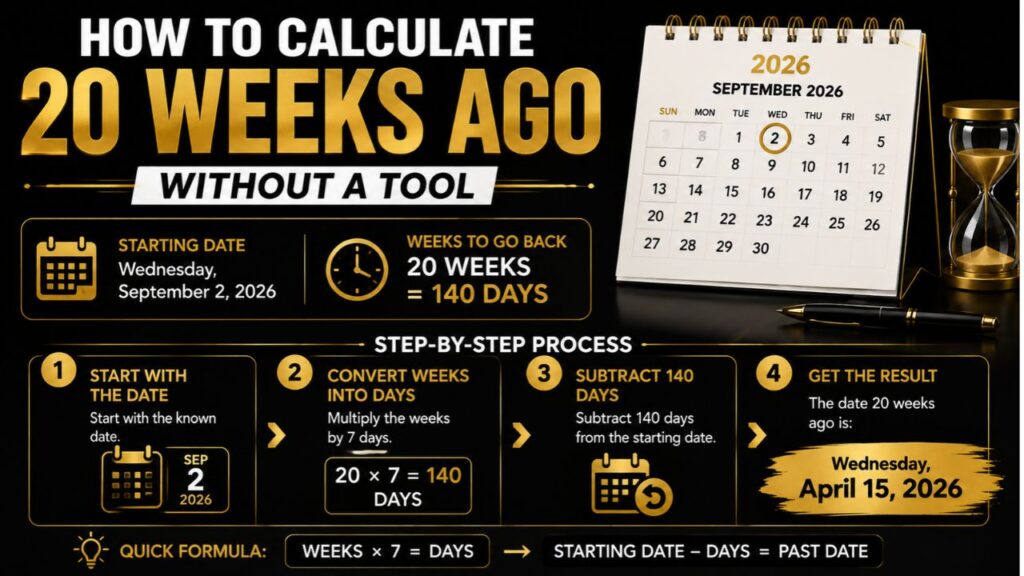
If you want to calculate 20 weeks ago manually, use this simple approach:
Start with the known date: September 2, 2026.
Convert the weeks into days:
20 × 7 = 140 days
Then subtract 140 days from the starting date. The result is April 15, 2026.
You can also move backward by calendar weeks if you prefer visual counting. Either method reaches the same answer, provided you don’t accidentally skip a week somewhere in the middle. That’s the main danger with manual counting; calendars don’t complain when you make a tiny mistake, they just quietly give you the wrong date.
A Useful Difference Between Date and Time Calculation
People sometimes use time calculation and date calculation as if they are exactly the same thing, but there is a small distinction.
Time calculations often deal with hours, minutes, and seconds. For example, someone might ask about 20 hours from now or 20 minutes ago. Date calculations generally focus on days, weeks, months, and years.
There can still be overlap, of course. Twenty weeks is a period of time, but when you’re moving it backward from a calendar date, you’re performing a date calculation. Knowing this distinction can make it easier to choose the right calculator or method for the job.
Common Mistakes When Calculating Weeks Ago
The first mistake is confusing weeks with months. As mentioned earlier, 20 weeks equals 140 days, not automatically five calendar months.
Another mistake is forgetting that the starting date matters. If today changes, the answer changes too. The phrase “20 weeks ago” only makes sense relative to a particular starting date.
A third mistake is overlooking the weekday. When moving by complete weeks, the weekday should remain the same. Here, Wednesday should lead to Wednesday. If your result says Tuesday or Thursday, it’s a useful signal that something probably went sideways in the calculation.
Finally, don’t mix up “20 weeks ago” with “20 weeks from today.” One moves backward, the other moves forward. They sound almost like twins, but they’re walking in opposite directions.
Quick Reference Table
| Calculation | Result |
|---|---|
| Current date | Wednesday, September 2, 2026 |
| Weeks backward | 20 weeks |
| Days backward | 140 days |
| Date 20 weeks ago | Wednesday, April 15, 2026 |
| Current year | 2026 |
| Calculated year | 2026 |
| Current month | September |
| Calculated month | April |
| Current weekday | Wednesday |
| Calculated weekday | Wednesday |
This compact table is handy when you need the result quickly and don’t want to read the whole explanation again. Sometimes a tiny reference table is all a person really needs, and thats perfectly fine.
Why a Weeks Ago Calculator Can Be Helpful
A weeks ago calculator becomes especially useful when you’re dealing with dates that are farther apart or when several calculations are needed. Nobody really wants to count backward through 20 weeks repeatedly, especially when the calendar is already doing enough emotional damage.
A date calculation tool can also reduce errors when you’re working with different intervals. You might calculate 7 weeks ago, 12 weeks ago, 20 weeks ago, and 30 weeks ago in the same session. Doing that manually is possible, but it gets tedious pretty quickly.
The best approach is usually a combination of both methods: understand the underlying arithmetic, then use a calculator when speed or repeated calculations matter. That gives you confidence without wasting time.
The Broader Meaning of Looking Back 20 Weeks
There is something quietly interesting about looking back exactly 20 weeks. It isn’t such a distant past that it feels ancient, but it isn’t yesterday either. A lot can happen in 140 days.
A project can start and become something real. A habit can become routine. A plan can change completely. Someone might look at an old calendar and realize that a decision they barely remember now was once a very important part of their week.
That is one reason exact dates can feel strangely personal. April 15, 2026 isn’t just a number when it represents something that happened. It becomes a little doorway into the past, and sometimes calendars preserve memories better than we expect.
Read more blog: 34 Days From Today
Frequently Asked Questions
20 weeks ago
20 weeks ago from today was Wednesday, April 15, 2026. It was exactly 140 days ago.
how long ago was 20 weeks
20 weeks is equal to 140 days. So, 20 weeks ago means going back exactly 140 days from today.
what was 20 weeks ago from today
20 weeks ago from Wednesday, September 2, 2026, was Wednesday, April 15, 2026.
Conclusion
So, let’s put the entire 20-week date calculation into one clear statement.
If the current date is Wednesday, September 2, 2026, then 20 weeks ago from today was:
Wednesday, April 15, 2026.
The calculation is based on 20 weeks × 7 days, giving 140 days. Subtracting those 140 days from September 2, 2026 produces April 15, 2026. Because the interval is exactly 20 complete weeks, both dates fall on Wednesday.
Whether you searched 20 weeks before today, date 20 weeks ago, 20 weeks prior to today, or what day was 20 weeks ago, you’re ultimately looking for the same calendar point.
And perhaps that’s the nicest thing about a precise date: it takes something vague “a while back” and gives it a place. A month, a day, a weekday, a little square on the calendar. Sometimes that small square is all we needed to make the past make sense.
If you regularly calculate dates, save the basic rule in your notes: weeks × 7 = days, then count backward or forward from the starting date. It won’t solve every calendar puzzle in the universe, but for ordinary date arithmetic, it gets you surprisingly far, and thats pretty useful.