Time has a funny little habit of slipping away when we are busy, resting, talking, working, or simply staring at a screen for no good reason. One moment it is early morning, and somehow the clock has travelled several hours ahead. That is why a simple question such as 6 Hours Ago From Now can suddenly become surprisingly useful. It sounds tiny, but knowing the precise past time can matter when checking messages, remembering an event, reviewing a work schedule, or figuring out when something actually happened.
If your Current time is 4:51:20 AM on Thursday, September 3, 2026, then going backward through a 6-hour time interval takes you across midnight. The answer is 10:51:20 PM on Wednesday, September 2, 2026. In other words, the calculation is:
4:51:20 AM − 6 hours = 10:51:20 PM, Wednesday, September 2, 2026
That small date change is where many people make mistakes. The clock moves backward, but the calendar has to move backward too. Time calculation is easy when the hours stay on the same date, but crossing Midnight makes the answer slightly more interesting.
| Calculation | Result |
|---|---|
| 6 Hours Ago From Now | 6 hours before the current time |
| Time Difference | 6 hours |
| Equivalent Minutes | 360 minutes |
| Equivalent Seconds | 21,600 seconds |
What Does 6 Hours Ago From Now Mean?

The phrase 6 hours ago from now simply means a point in the Past time that occurred exactly six hours before the moment you are considering. If someone asks, “what time was it 6 hours ago?” they are asking you to take the Current time and move the clock backward by six complete hours.
For example, if the clock currently says 4:51 AM, moving back one hour gives 3:51 AM, two hours gives 2:51 AM, and continuing until six hours have passed takes you to 10:51 PM on the previous date. It is basic time subtraction, really, although crossing midnight makes the calendar participate in the little puzzle.
This is also why the phrase “6 hours earlier” can sometimes refer to a different date. The time itself is only one part of the answer. You need both the date and time to describe the moment properly, especially when the calculation passes midnight.
6 Hours Ago From Now: The Exact Answer
Using the provided reference time, the Current time is 4:51:20 AM, and the current date is Thursday, September 3, 2026. Subtracting six hours produces the following result:
- Current time: 4:51:20 AM
- Current date: Thursday, September 3, 2026
- Time interval: 6 hours
- Calculation: 4:51:20 AM − 6 hours
- Exact time: 10:51:20 PM
- Previous date: Wednesday, September 2, 2026
- Date transition: Thursday → Wednesday
Therefore, 6 Hours Ago From Now was 10:51:20 PM on Wednesday, September 2, 2026.
Notice that the answer does not remain on Thursday. The subtraction crosses Midnight, so the Previous date becomes Wednesday. This tiny detail is easy to overlook when someone is doing the calculation quickly, and yep, it is probably the most common source of confusion.
What Time Was It 6 Hours Ago?
The question what time was it 6 hours ago is usually answered by subtracting six hours from the present clock time. You do not need complicated mathematics for this. A normal wall clock, phone, or simple calculator is enough.
Suppose the current time is 8:00 PM. Six hours earlier would be 2:00 PM. If the current time is 2:00 PM, six hours earlier would be 8:00 AM. But if the current time is 3:00 AM, six hours earlier becomes 9:00 PM on the previous date.
That last example is important because 6 hours ago is not always “earlier today.” Sometimes it belongs to yesterday, depending on the Clock time at the moment you begin. The date calculation and time calculation need to work together, not separately.
How to Calculate 6 Hours Ago
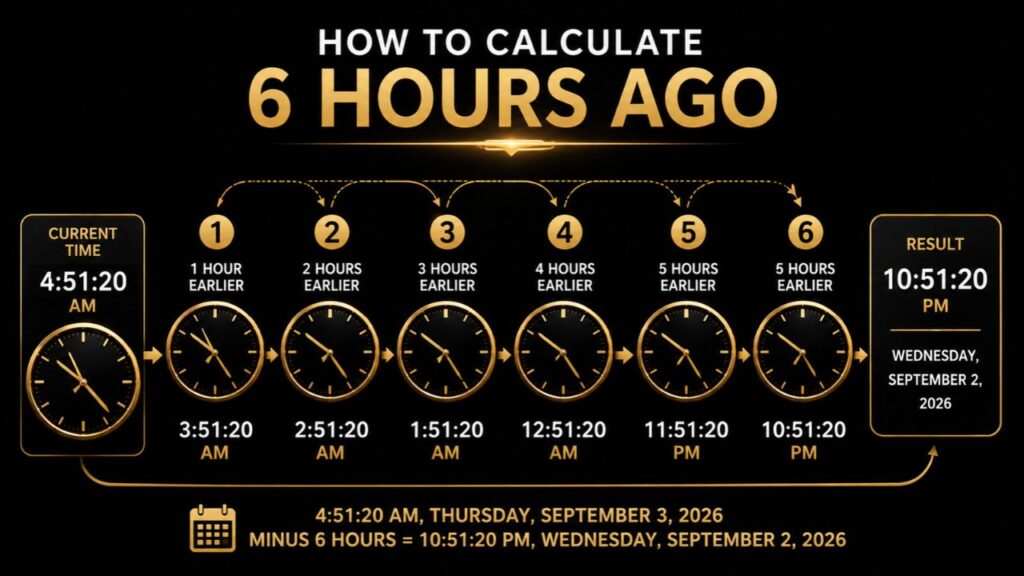
Learning how to calculate 6 hours ago manually is useful because it lets you check an answer without relying on an online tool. Start with the current hour, then subtract 6 hours. Keep the minutes and seconds unchanged unless your starting time requires a more complicated adjustment.
For the given example:
4:51:20 AM − 6 hours
Because 4:51 AM is earlier than 6:00 AM, simply subtracting the hours would move beyond the beginning of the day. Instead, imagine moving backward to midnight first and then continuing into the previous evening.
From 4:51:20 AM:
- 1 hour earlier → 3:51:20 AM
- 2 hours earlier → 2:51:20 AM
- 3 hours earlier → 1:51:20 AM
- 4 hours earlier → 12:51:20 AM
- 5 hours earlier → 11:51:20 PM
- 6 hours earlier → 10:51:20 PM
The final answer is therefore 10:51:20 PM on Wednesday, September 2, 2026.
It looks almost too simple after you see it written out, but writing each step can prevent a silly mistake when you’re tired or doing several calculations at once.
6 Hours Ago Across Midnight
The phrase 6 hours ago across midnight deserves special attention because midnight changes the date. Imagine going backward from 3:00 AM. Six hours earlier is not 9:00 AM; it is 9:00 PM on the previous day.
This happens because a clock repeats every 24 hours, while a calendar tracks individual dates. When your time difference crosses midnight, the clock resets to 12:00 AM but the date moves backward.
A useful way to think about it is this: midnight is not a wall where time disappears. It is simply the boundary between two calendar dates. If you walk backward through that boundary, you enter the Previous date.
This principle is useful for work records, online activity timestamps, communication histories, travel schedules, appointments, and even those mysterious moments when you see a message and wonder, “Wait, when exactly was that sent?”
A Simple 6-Hour Time Difference Table
A quick table can make 6-hour time difference calculations easier to understand. The exact date depends on whether the calculation crosses midnight.
| Current Time | 6 Hours Earlier |
|---|---|
| 12:00 AM | 6:00 PM previous day |
| 2:00 AM | 8:00 PM previous day |
| 4:00 AM | 10:00 PM previous day |
| 6:00 AM | 12:00 AM |
| 8:00 AM | 2:00 AM |
| 10:00 AM | 4:00 AM |
| 12:00 PM | 6:00 AM |
| 2:00 PM | 8:00 AM |
| 4:00 PM | 10:00 AM |
| 6:00 PM | 12:00 PM |
| 8:00 PM | 2:00 PM |
| 10:00 PM | 4:00 PM |
The pattern becomes quite clear once you see it. Morning times before 6:00 AM usually lead to the previous date, while later times generally remain on the same calendar day. Simple, but handy.
Why People Search “What Was the Time 6 Hours Ago?”
People rarely search what was the time 6 hours ago just because they are bored with their clock. There is usually a practical reason behind it. Someone may be checking when an email arrived, determining when a social media post was published, remembering a conversation, or trying to understand a timestamp in another system.
For example, imagine receiving a message at 4:00 AM and noticing that the sender’s activity was marked six hours earlier. You might want to know the corresponding local time. Or perhaps you began working six hours before checking your records and need to reconstruct the timeline.
These little calculations become particularly useful when several events happen close together. A precise Exact time can turn a vague memory into a reliable timeline.
Using a Past Time Calculator
A past time calculator can perform this calculation instantly. Most hours-ago tools simply take a starting date and time, subtract the requested number of hours, and return the resulting date and clock time.
An hours ago calculator is especially convenient when you need to calculate unusual intervals such as 17 hours, 29 hours, or 53 hours earlier. The longer the interval becomes, the easier it is to accidentally forget a date transition.
Still, knowing the manual method is valuable. Tools can be convenient, but understanding time subtraction means you can verify the result yourself. For something important, checking the calculation twice is not overthinking it; it is just sensible.
Current Time Minus 6 Hours: A Practical Method

The expression current time minus 6 hours is simply another way of describing the same calculation. Start with the present date and time, then move backward six hours.
If your current time is after 6:00 AM, the calculation will usually remain on the same date. If it is before 6:00 AM, the result will normally land on the previous date.
For example:
- 9:00 AM minus 6 hours = 3:00 AM
- 1:00 PM minus 6 hours = 7:00 AM
- 7:00 PM minus 6 hours = 1:00 PM
- 3:00 AM minus 6 hours = 9:00 PM previous day
The important word here is “usually” because exact calculations depend on the starting point and date. When seconds or minutes are involved, preserve them unless the subtraction crosses a unit boundary requiring adjustment.
The Difference Between 6 Hours Ago and 6 Hours From Now
People sometimes confuse 6 hours ago with 6 Hours from now, but they point in opposite directions.
“Six hours ago” means moving backward. “Six hours from now” means moving forward.
If the current time is 4:51:20 AM:
6 hours ago: 10:51:20 PM on Wednesday, September 2, 2026.
6 hours from now: 10:51:20 AM on Thursday, September 3, 2026.
One travels into the Past time, while the other moves into the future. It is basically the same distance on the clock, just in different directions, which is kind of neat when you think about it.
Other Time Calculations You May Need

Once you understand a 6-hour time difference, other calculations become much easier. The same general idea applies to minutes, hours, days, weeks, months, and years, although calendar-based calculations can require extra care.
You might encounter searches such as:
- 6 Minutes from now
- 6 Minutes ago from now
- 6 Hours from now
- 6 Days from today
- 6 Days ago from today
- 6 Weeks from today
- 6 Weeks ago from today
- 6 Months from today
- 6 Months ago from today
- 6 Years from today
- 6 Years ago from today
A future time calculation generally moves forward, while a past date calculation moves backward. A future date calculation may also involve varying month lengths, leap years, or other calendar details, so it is a little different from simply subtracting hours.
Time Calculation and Daily Life
Time calculation is not only something for mathematicians or computer systems. Ordinary life is full of moments where we mentally calculate time without even realizing it.
You may think, “I sent that message six hours earlier,” or “The meeting started two hours ago.” You may need to determine when someone left home, when a delivery arrived, or how long you slept.
Even productivity depends on this awareness. Looking at the Previous time can help you understand how long a task actually took instead of relying on your memory, which has a habit of making five minutes feel like forty and forty minutes feel like five.
A reliable sense of time also helps with planning. If something happened six hours ago, you can use that point as a reference and build a simple timeline around it.
Why Exact Time Matters
There is a major difference between saying “sometime last night” and giving an Exact time such as 10:51:20 PM. The first is approximate; the second identifies a specific moment.
Seconds may not matter for casual conversations, but they can matter for technical logs, online transactions, work systems, security records, sporting events, and digital communication. In those settings, the date and time together provide a much stronger reference.
That is why timestamps often contain hours, minutes, and seconds. A record showing 10:51:20 PM gives substantially more information than simply saying “around eleven at night.” Precision has its place, even if most of us don’t need that much of it while deciding whether it is too late for another cup of tea.
Common Mistakes When Calculating 6 Hours Ago
The first mistake is forgetting the date. Someone may correctly calculate 10:51 PM but incorrectly write Thursday instead of Wednesday. That creates a completely different timestamp.
Another mistake is confusing subtraction with addition. If you are asked to find the time 6 hours ago, you move backward, not forward. It sounds obvious, but when you’re moving quickly between several calculations, mistakes sneak in.
A third mistake is overlooking Midnight. Any calculation that passes 12:00 AM needs a date adjustment. The clock restarts at midnight, but the calendar does not stay on the same date.
Finally, some people forget minutes and seconds. If the starting point is 4:51:20 AM, then the correct result six hours earlier is 10:51:20 PM, not simply 10:00 PM or 10:51 PM. Preserve the details when precision matters.
How Time Zones Affect the Answer
A time difference calculator may produce different results if two people are working in different time zones. The phrase “six hours ago” describes a duration, but the displayed clock time depends on the local time zone.
For example, six hours before a person’s local 4:51 AM is 10:51 PM locally on the previous date. Someone in another time zone could describe that same instant using a different clock time and possibly a different date.
This is where time conversion becomes useful. If an event happened in one region and you need to understand when it happened locally somewhere else, you should first identify the relevant time zones and then convert the timestamp carefully.
For international communication, a date-and-time calculator or time-zone converter can save plenty of confusion. Otherwise, two people can be discussing the exact same moment while looking at completely different clock displays.
Why “6 Hours Ago” Is More Than a Simple Number
There is something oddly human about asking where we were six hours ago. A timestamp is mathematical, but the event attached to it is usually personal.
Six hours earlier, someone might have been asleep, beginning a workday, travelling home, sending a message, preparing breakfast, or thinking about tomorrow. The number itself is neutral, but the moment it represents can carry a surprising amount of meaning.
That is why calculating 6 hours ago from now can sometimes be part of remembering rather than merely calculating. Time becomes a bridge between what is happening now and what happened before. A tiny subtraction can suddenly tell you where one moment sits inside the larger story of a day.
A Quick Guide to Finding 6 Hours Ago
If you need to determine the time 6 hours ago, use this quick approach:
- Look at the current time.
- Keep the minutes and seconds in mind.
- Subtract 6 hours.
- Check whether the calculation passes Midnight.
- If it crosses midnight, move the date backward by one day.
- Confirm the previous date and time.
- For important records, verify the answer with a reliable calculator.
This method works for ordinary situations without needing complicated formulas. And when the answer looks strange, stop for a second and check the date. That’s usually where the hidden little mistake is sitting.
The Importance of Checking Date and Time Together
A clock tells you the hour, but a calendar tells you where that hour belongs. Neither is completely useful without the other when you are calculating past events across midnight.
In the example used throughout this article, 4:51:20 AM on Thursday, September 3, 2026 becomes 10:51:20 PM on Wednesday, September 2, 2026 after six hours are subtracted.
The date changed because the calculation travelled backward through midnight. If someone wrote only “10:51:20 PM,” the answer would be incomplete for a precise record. The Previous date is an essential part of the result.
This becomes even more important when records are reviewed later. A timestamp without a date can be confusing, especially around midnight or when several days of activity are involved.
Read more blog: 34 Days From Today
Frequently Asked Questions
6 hours ago from now
6 hours ago from now means subtracting 6 hours from the current time.
6 hours ago
The time 6 hours ago is simply the current time minus 6 hours.
what time is 6 hours ago
To find the time 6 hours ago, subtract 6 hours from the current clock time.
time 6 hours ago
“Time 6 hours ago” refers to the exact clock time that occurred 6 hours before now.
Conclusion
Understanding 6 Hours Ago From Now is ultimately about more than moving numbers around on a clock. It is about placing a moment accurately within the flow of a day. Once you understand how to subtract 6 hours, recognize Midnight, and adjust the date when necessary, these calculations become almost effortless.
For the specific example in this article, the Current time is 4:51:20 AM on Thursday, September 3, 2026. Six hours earlier was 10:51:20 PM on Wednesday, September 2, 2026. The calculation crosses midnight, which is why the answer belongs to the Previous date.
Whether you use mental arithmetic, a past time calculator, an hours ago calculator, or a date-and-time tool, the principle stays the same: move backward six hours and make sure the calendar moves with the clock when it needs to.
And perhaps that is the nicest thing about these small time questions. They remind us that every hour has a place, every timestamp tells a tiny story, and even a simple question like “what time was it six hours ago?” can reconnect the present with a moment that has already quietly disappeared behind us.