There is something oddly satisfying about knowing the exact moment that has just slipped behind us. Maybe you checked the clock, answered a message, finished a quick task, and then suddenly wondered, “Wait, what time was that?” It happens more often than we admit. A few minutes can feel tiny, but when you need an accurate timestamp, even 25 minutes ago can matter quite a lot.
If your current time is 11:31:52 PM on Monday, August 24, 2026, then the answer is wonderfully simple: 25 minutes ago from now was 11:06:52 PM on the same date. Nothing mysterious happened in between; we simply move the clock backward by a 25 minutes interval. Still, doing this mentally can become slightly annoying when seconds, midnight, or a date change gets involved, so understanding the method is useful.
This guide explores 25 minutes ago from now from several angles: the exact calculation, an easy mental method, common mistakes, related time expressions, and the everyday reasons someone may need a precise past timestamp. Time has a funny habit of making simple things look complicated, but a clear method sorts it out pretty quickly.
| Current Time | 25 Minutes Ago |
|---|---|
| 11:31:52 PM | 11:06:52 PM |
| Monday, August 24, 2026 | Monday, August 24, 2026 |
What Time Was It 25 Minutes Ago?
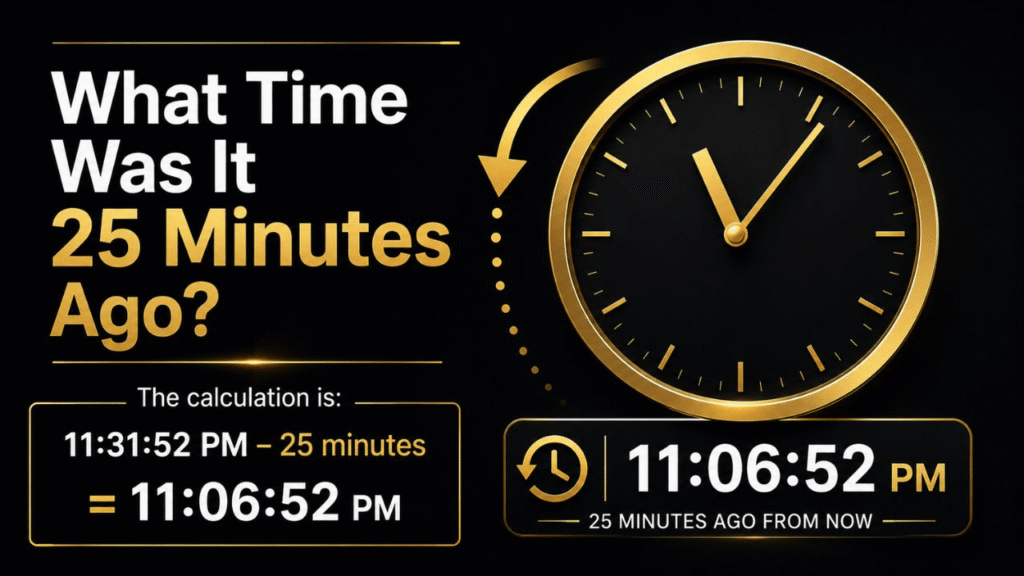
So, what time was it 25 minutes ago? Using the reference provided here, the current time is 11:31:52 PM, and the required interval is 25 minutes.
The calculation is:
11:31:52 PM − 25 minutes = 11:06:52 PM
Therefore, the exact time 25 minutes ago was 11:06:52 PM, on Monday, August 24, 2026. The seconds stay exactly the same because we’re subtracting minutes only, which is a small detail but an important one.
In plain language, if somebody asks, “What was the time 25 minutes ago?” while the clock says 11:31:52 PM, you can simply travel backward twenty-five minutes. The result lands at 11:06:52 PM, still comfortably inside the same day, so there is no need to change the date.
25 Minutes Ago From Now: The Simple Calculation
The easiest way to understand 25 minutes ago from now is to think about a clock rather than a complicated mathematical equation. Start with the present moment, identify the number of minutes you need to travel backward, and move the hour hand and minute hand accordingly. Sounds almost too easy, but thats really the whole trick.
With 11:31:52 PM as the starting point, subtracting 25 minutes from 31 minutes gives 6 minutes. The hour remains 11 because the subtraction does not cross the beginning of the hour. That leaves 11:06:52 PM as the previous time.
You can also write the process in a compact form:
- Current timestamp: 11:31:52 PM
- Time interval: 25 minutes
- Operation: subtract 25 minutes
- Calculated timestamp: 11:06:52 PM
- Date: Monday, August 24, 2026
This is a basic time calculation, but it demonstrates the same principle used by digital clocks, scheduling applications, calendars, and a time calculator.
How to Calculate 25 Minutes Ago
To calculate 25 minutes ago, begin by looking only at the minutes portion of the clock. If the minute value is greater than 25, subtraction is very straightforward. For example, 11:31 becomes 11:06 after taking away 25 minutes.
If the minute value is less than 25, however, you need to borrow one hour. Suppose the clock says 8:10 PM. You cannot simply write 8:-15 PM, obviously. Instead, borrow one hour, turning 8:10 PM into 7:70 PM, and then subtract 25 minutes. The result is 7:45 PM.
That little borrowing trick makes backward time calculation much easier:
- Start with the current clock time.
- Identify the number of minutes to subtract.
- If enough minutes are available, subtract directly.
- If not, borrow one hour.
- Check whether the calculation crosses midnight.
- Confirm the resulting date and time.
It may sound like school arithmetic wearing a wristwatch, but it works reliably.
11:31:52 PM Minus 25 Minutes

The phrase 11:31:52 PM minus 25 minutes describes exactly the calculation used in our example. Because 31 minutes is greater than 25, there is no hour borrowing required.
The seconds remain unchanged:
11:31:52 PM → 11:06:52 PM
Notice that the seconds are still 52. This is because the interval contains complete minutes rather than seconds. If the question had asked for 25 minutes and 20 seconds earlier, then the seconds would need to be adjusted too, which is where some calculations start getting sneaky.
For this particular example, the time difference is precisely 25 minutes. The date also remains unchanged, so the final answer is:
11:06:52 PM, Monday, August 24, 2026.
That is the exact time 25 minutes earlier based on the supplied reference timestamp.
What Is 25 Minutes Before Now?
The phrase 25 minutes before now has the same meaning as “25 minutes ago.” Both expressions point toward a moment in the past relative to the current timestamp.
If “now” is 11:31:52 PM, then moving backward by 25 minutes gives 11:06:52 PM. In other words, time 25 minutes ago and 25 minutes before now identify the same point on the clock.
This distinction can be useful when interpreting schedules or messages. “The meeting ended 25 minutes ago” describes elapsed time, while “the meeting ended at 11:06 PM” provides a specific timestamp. One is relative, the other is fixed. Both are useful, depending on what you’re trying to know.
Why Exact Time Matters
People sometimes assume that knowing the hour is enough. In everyday conversation, it usually is. But in work records, online activity, transportation, appointments, security logs, or communication histories, the exact time can suddenly become important.
Imagine receiving a message at 11:31 PM and wanting to know when a previous event happened. Saying “around eleven” doesn’t tell you much. Saying 11:06:52 PM gives a precise reference point. The difference is only a handful of digits, yet those digits can make a record much clearer.
There is also a psychological side to this. Humans remember events in chunks, while clocks measure them continuously. We say “a little while ago” even when the actual interval was 25 minutes, 18 minutes, or 42 minutes. A precise calculation gives that vague feeling a firm place to stand.
25 Minutes Ago and the Previous 25 Minutes
The expression previous 25 minutes can mean slightly different things depending on context. If you say an event occurred 25 minutes ago, you’re pointing to one particular moment. If you talk about the previous 25 minutes, you may mean the entire period stretching backward from now.
For example, if the current time is 11:31:52 PM, the previous 25-minute window begins at 11:06:52 PM and extends all the way to the current moment. That gives a period rather than a single timestamp.
This distinction matters in productivity, monitoring, sports, online activity, and work logs. One asks “when did it happen?” while the other asks “what happened during that period?” Tiny language difference, surprisingly big practical difference.
When the Calculation Crosses Midnight
The easiest past time calculation happens when you stay inside the same hour or day. Midnight is where things get interesting. Suppose the current time were 12:10 AM and you wanted to know what time it was 25 minutes earlier.
You would move backward across midnight:
12:10 AM − 25 minutes = 11:45 PM on the previous day.
The clock changes from AM to PM, and the calendar date moves backward by one day. This is why a reliable time and date calculator must consider both the clock and the calendar.
The same principle applies when calculating 25 hours ago from now, 25 days ago from today, or even 25 weeks ago from today. Larger intervals may change the date, month, or year, so simply looking at the clock isn’t enough.
25 Minutes From Now Is Different
It is easy to mix up “ago” and “from now,” especially when you’re typing quickly. They point in opposite directions.
25 minutes ago from now means move backward.
25 minutes from now means move forward.
If the reference time is 11:31:52 PM, then moving forward 25 minutes gives 11:56:52 PM. Moving backward gives 11:06:52 PM. Same interval, completely different destination. The little word “ago” is doing more work than it appears to.
This is also why search queries such as what time was 25 minutes ago and what time will it be in 25 minutes should never be treated as interchangeable. One belongs to the past, the other belongs to the future.
Comparing Minutes, Hours, Days, Weeks, Months, and Years

Time calculations become more interesting when the interval changes. Minutes, hours, days, weeks, months, and years don’t behave exactly alike, especially around calendar boundaries.
For example, 25 minutes ago is normally a simple clock calculation. But 25 days from today requires calendar arithmetic. 25 weeks from today represents 175 days, while 25 months from today cannot always be treated as one fixed number of days because months have different lengths.
Then there is 25 years from today, which may involve leap-year considerations when calculating exact calendar dates. A useful date calculator handles these calendar differences instead of pretending every month is identical.
The same logic works in reverse:
- 25 hours ago from now means moving backward by 25 hours.
- 25 days ago from today means moving backward 25 calendar days.
- 25 weeks ago from today means moving backward 175 days.
- 25 months ago from today requires month-by-month calendar calculation.
- 25 years ago from today requires careful year-based date calculation.
So, “25” stays constant, but the unit changes the nature of the problem quite a bit.
Why People Search “What Time Was It 25 Minutes Ago?”
Search engines see questions like what time was it 25 minutes ago every day because people often need an immediate answer rather than a lesson in arithmetic. Maybe someone noticed a timestamp, forgot when an event started, or is trying to match two activities in a schedule.
There is also a practical reason: phones and computers display time differently depending on settings. Some people use the 12-hour clock, others use 24-hour time. AM and PM can become confusing when you’re tired, especially around midnight, where the calendar is quietly changing while everybody is still calling it “tonight.”
For that reason, online time calculators are useful. They remove the small mental burden and provide a direct result, particularly when the calculation involves seconds or a date boundary.
Time Calculation in Everyday Life
You don’t need to work in a laboratory to use relative time calculations. People calculate time backward when checking when they left home, estimating when a delivery arrived, reviewing a work session, or figuring out when a friend sent a message.
A student might ask what time a study session began if it lasted 25 minutes. A worker might calculate how long ago an email arrived. A traveler might compare a departure timestamp with the current clock. Even cooking can involve these little calculations, because “put it in the oven 25 minutes ago” suddenly becomes a question with surprising urgency.
Time is everywhere, basically hiding inside ordinary decisions.
A Quick Mental Method for Busy Moments
If you don’t have a time difference calculator nearby, use the clock-face method. First, identify the current minute. Then count backward 25 spaces. If you cross the 00-minute mark, reduce the hour by one and continue from 60.
For 11:31 PM, count back 25 minutes:
31 → 30 → 29 → … → 6.
That leaves 11:06 PM. Keep the seconds at :52 when the interval is exactly 25 whole minutes. Done. No dramatic mathematical ceremony required.
Another method is to split 25 into 20 + 5. Subtract 20 minutes first, then subtract another 5. From 11:31:52 PM:
11:31:52 PM − 20 minutes = 11:11:52 PM
11:11:52 PM − 5 minutes = 11:06:52 PM
Some people find this approach more natural because smaller steps feel easier to verify.
Common Mistakes When Calculating Past Time
One common mistake is confusing subtraction with addition. If something happened 25 minutes ago, you’re traveling backward, not forward. It sounds obvious, yet rushed calculations do this surprisingly often.
Another mistake is forgetting the date when crossing midnight. A result such as 11:45 PM after starting at 12:10 AM belongs to the previous calendar day. The clock alone doesn’t tell the whole story.
People also sometimes change the seconds unnecessarily. If you’re subtracting exactly 25 minutes from 11:31:52 PM, the seconds remain 52. Changing them to 27 or 00 would represent a different interval, and thats where an otherwise correct answer quietly goes wrong.
Using a Time Calculator
A time calculator can be particularly helpful when the calculation includes several units. Instead of manually subtracting minutes, hours, and dates, you enter the starting timestamp and the desired interval.
For simple questions like current time minus 25 minutes, mental arithmetic is usually faster. But for a complicated date-time calculation, a digital tool reduces the chance of mistakes. This becomes even more useful when comparing multiple timestamps or working with records that include seconds.
The important thing is not whether you use a calculator. The important thing is knowing what the result means. A tool can calculate quickly, but understanding “ago,” “from now,” “before,” and “after” is what keeps the calculation meaningful.
The Difference Between Past Time and Future Time
Relative time language is essentially a conversation between the present and another point on the timeline. Past time looks backward, while future time looks ahead.
“25 minutes ago” points behind the current timestamp.
“25 minutes from now” points ahead.
“25 minutes earlier” usually points backward from another reference point.
“25 minutes later” points forward.
Once these relationships become familiar, many time questions stop feeling like calculations at all. They become simple movements along an invisible line, which is honestly a nicer way to think about clocks.
A Practical Example Using Today’s Timestamp
Let’s return to the reference time: 11:31:52 PM, Monday, August 24, 2026.
Someone asks, “What time was it 25 minutes ago?”
You identify the starting point: 11:31:52 PM.
You subtract the interval: 25 minutes.
You check the result: 11:06:52 PM.
You confirm the calendar date: August 24, 2026.
So the final answer is:
25 minutes ago from now = 11:06:52 PM on Monday, August 24, 2026.
That is the complete calculation. It doesn’t cross midnight, it doesn’t change the date, and it doesn’t require any complicated conversion. Sometimes the best answer is simply the correct answer, without making the clock wear a graduation cap.
Why Relative Time Is Useful for Productivity
Knowing how much time has passed can make daily planning more realistic. If you started a task 25 minutes ago, you can compare that elapsed period with your planned work session. Maybe you intended to focus for half an hour and suddenly realize you’re nearly there.
This is where time awareness connects with productivity. The clock isn’t merely telling you what hour it is; it gives you feedback about how you’re spending the day. A time interval of 25 minutes can be enough to complete a short writing task, review a document, answer messages, or simply take a proper break.
Interestingly, short intervals often feel more manageable than vague promises such as “I’ll work for a while.” Twenty-five minutes has edges. “A while” has none.
Read more blog: 45 Minutes Ago From Now
Frequently Asked Questions
25 minutes ago from now
25 minutes ago from now means subtracting 25 minutes from the current time to find the exact previous time.
25 minutes ago
25 minutes ago refers to a time that occurred exactly 25 minutes before the current time.
what time was 25 minutes ago
To find what time was 25 minutes ago, simply subtract 25 minutes from the current time.
25 minutes from now
25 minutes from now means adding 25 minutes to the current time to find the future time.
what time was it 25 min ago
It was the current time minus 25 minutes; this calculation gives the corresponding past time accurately.
Conclusion
Understanding 25 minutes ago from now is a small skill, but small skills have a habit of becoming useful everywhere. From checking timestamps to planning work, comparing events, reviewing messages, or simply satisfying curiosity, knowing how to move backward through time makes everyday decisions a little cleaner.
Using the reference timestamp in this article, the calculation is clear:
11:31:52 PM − 25 minutes = 11:06:52 PM
So, if you’re asking what time was 25 minutes ago, the answer is 11:06:52 PM on Monday, August 24, 2026.
The broader lesson is simple too. When working with relative time, identify your starting point, understand whether you’re moving backward or forward, apply the correct interval, and check the date if necessary. Whether you’re calculating 25 minutes earlier, 25 minutes before now, or comparing a past timestamp with a future time, the same basic logic keeps everything grounded.
And perhaps thats why time calculations are more interesting than they first appear. Twenty-five minutes can disappear while you’re reading a message, making tea, finishing a task, or staring out a window for reasons you can’t quite explain. Then suddenly you wonder where it went. The clock knows, of course. It always does.
If you have a favorite way to calculate time mentally, share it with others; sometimes the quickest little trick is the one someone else has been waiting to discover.