There is something oddly comforting about looking backward at a clock. We usually rush toward the next thing another meeting, another message, another cup of tea that somehow gets cold before we drink it but sometimes we simply want to know where the last few minutes went. The question What time was it 31 minutes ago from now? sounds tiny, almost too ordinary to deserve a full answer, yet it can matter when you are checking a message, remembering an appointment, comparing timestamps, or trying to reconstruct what happened earlier. And honestly, 31 minutes is long enough for a small part of the day to quietly change.
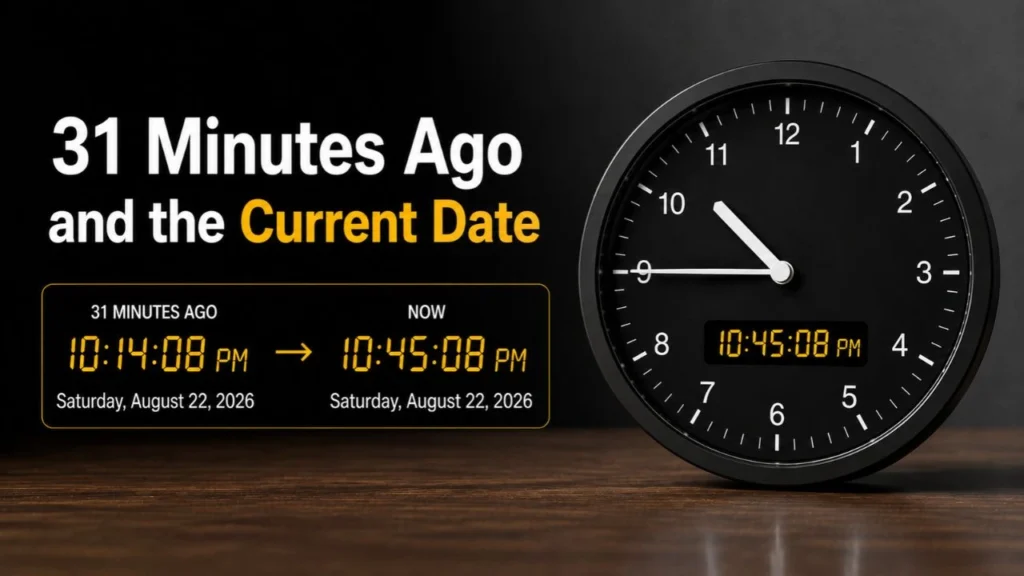
If the current time is 10:45:08 PM on Saturday, August 22, 2026, then going backward by 31 minutes brings us to 10:14:08 PM on the same day. That is the simple answer. The interesting part, however, is understanding why the calculation works, how to do it without a device, and when a tiny time difference can become surprisingly important.
The phrase 31 minutes ago is really a miniature journey through the clock. We start with the present, subtract a defined time interval, and arrive at a past time. Nothing dramatic happens on the calendar in this particular example, but the habit of understanding time clearly can save confusion later on.
| Current Time | 31 Minutes Ago |
|---|---|
| 10:45:08 PM | 10:14:08 PM |
| Saturday, August 22, 2026 | Saturday, August 22, 2026 |
What Time Was It 31 Minutes Ago From Now?

The most direct answer is wonderfully uncomplicated. If the current timestamp is 10:45:08 PM, subtract 31 minutes from the minutes portion of the clock.
10:45:08 PM
− 31 minutes
= 10:14:08 PM
So, 31 minutes ago from now was 10:14:08 PM on Saturday, August 22, 2026.
Notice that the seconds do not change. The calculation removes minutes, not seconds, so the “08” remains “08.” This tiny detail is easy to overlook, specially when someone needs an exact time rather than an approximate answer.
If you are wondering what time was it 31 minutes ago, the answer depends on the starting moment. Thirty-one minutes is always the same length of elapsed time, but the clock reading changes according to the current time. If right now is 7:20 PM, the answer is 6:49 PM. If now is 2:10 PM, the answer is 1:39 PM. The arithmetic is simple; remembering the starting point is the real trick.
How to Calculate 31 Minutes Ago Without a Calculator
You do not need a fancy app to calculate 31 minutes ago. A clock, a little attention, and perhaps one functioning brain cell before bedtime will usually do the job nicely.
Start by looking at the current time. Suppose it says 10:45 PM. Then subtract 30 minutes first. That gives 10:15 PM. Subtract one additional minute, and you reach 10:14 PM. This two-step method can feel easier than immediately doing “45 minus 31,” especially when you are distracted.
Another method is to treat 31 minutes as half an hour plus one minute. Move backward 30 minutes, then move back another minute. It is a surprisingly friendly method because 30-minute jumps are visually easy to imagine on an analog clock.
For an exact calculation, preserve the seconds. If the clock shows 10:45:08 PM, then 31 minutes earlier is 10:14:08 PM. The previous time keeps the same seconds because only the minute value has been reduced.
31 Minutes Ago From Now: A Simple Time Subtraction Method
Think of the clock as a circular road rather than a strict line. Moving backward means traveling toward earlier numbers. To find 31 minutes ago from now, simply travel 31 minute-marks in reverse.
For the example of 10:45 PM, going back 31 minutes takes you to 10:14 PM. You have not moved into another hour because 45 is greater than 31. This makes the calculation pleasantly uneventful.
But imagine the current time is 10:12 PM. Subtracting 31 minutes would cross the hour boundary. You would move back 12 minutes to 10:00 PM, then continue 19 minutes into the previous hour, arriving at 9:41 PM. This is where people occasionally make mistakes, usually because the clock does not politely announce, “Hey, you’re crossing an hour now.”
A reliable mental rule is to break the subtraction at the hour boundary. It makes time subtraction much less slippery.
What Time Was 31 Minutes Ago When the Hour Changes?

Crossing from one hour into another is the part of time calculation that deserves a little extra attention. The same principle works every time, though.
Imagine the current time is 3:10 PM. To find the time 31 minutes earlier, subtract 10 minutes first, reaching 3:00 PM. Then subtract the remaining 21 minutes. The result is 2:39 PM.
If the current time is 12:05 PM, 31 minutes earlier is 11:34 AM. Here the calculation crosses noon, which means the AM/PM label changes too.
And if the starting time is 12:05 AM, 31 minutes earlier becomes 11:34 PM on the previous calendar day. Now both the hour and date and time have changed. This is why a seemingly small 31-minute time difference can sometimes affect records, schedules, and daily logs.
Understanding the 31-Minute Time Difference
A 31-minute time difference is exactly 31 minutes, or 1,860 seconds. It is not half an hour, although it is close enough that people sometimes mentally round it without noticing.
That extra minute can matter. If a train departs at 8:00 and you arrive at 7:29, you have 31 minutes before departure. If a medication reminder, meeting, or online event has a precise timestamp, rounding could create unnecessary confusion.
The same idea applies when comparing two messages. If one message was sent at 10:14:08 PM and another at 10:45:08 PM, the elapsed time between them is precisely 31 minutes. The date remains August 22, 2026, assuming both timestamps belong to that same date.
In everyday conversation, people may simply say “about half an hour ago.” For records, though, “about half an hour” can be too vague. Exact moments have their own little importance.
Using a Time Calculator for 31 Minutes Ago
A time calculator becomes useful when the numbers become less friendly. If you need to calculate several intervals, compare timestamps, or work across midnight, an online calculator can reduce mental effort.
A minutes ago calculator generally works by taking a starting time and subtracting a specified number of minutes. For example, entering 10:45 PM and 31 minutes produces 10:14 PM.
Some tools also preserve seconds, making them useful for a precise exact time lookup. Others can calculate the time difference between two dates, which is helpful when the interval stretches across hours, days, weeks, or even months.
Still, a calculator should support understanding rather than replace it completely. Knowing the basic method means you can quickly check whether the result looks sensible.
Why Exact Time Can Matter More Than We Think
People often search for time 31 minutes ago because they are trying to reconstruct something. Maybe a message arrived unexpectedly. Maybe someone remembers leaving home “around half an hour ago.” Maybe a work application recorded an activity at a particular moment.
A timestamp can turn a fuzzy memory into something more concrete. “I saw it sometime earlier” becomes “I saw it at 10:14 PM.” That difference may seem small, but details are often what make a timeline useful.
There are also practical situations involving transportation, attendance, online communication, cooking, workouts, study sessions, and reminders. A short interval can be the difference between arriving early and arriving embarrassingly late.
31 Minutes Ago and the Current Date
When calculating 31 minutes ago, always check whether the subtraction crosses midnight. If it does, the current date needs to change.
For example, if the current timestamp is 12:10 AM on Saturday, August 22, 2026, then 31 minutes earlier was 11:39 PM on Friday, August 21, 2026.
This is one of those tiny calendar details that computers handle effortlessly but humans occasionally fumble. The clock moves backward, and suddenly yesterday has returned.
For the supplied example, however, no date change occurs. 10:45:08 PM minus 31 minutes equals 10:14:08 PM, still on Saturday, August 22, 2026.
31 Minutes Ago From Now vs. 31 Minutes From Now
The phrases “ago” and “from now” point in opposite directions. It sounds obvious, but search queries can make the distinction surprisingly important.
31 minutes ago from now means move backward. You are finding a previous time.
31 minutes from now means move forward. You are finding a future time.
If the current time is 10:45:08 PM, then 31 minutes ago is 10:14:08 PM. But 31 minutes from now is 11:16:08 PM.
The same 31-minute interval is involved in both calculations; only the direction changes. One looks into the recent past, the other into the immediate future.
Similar Time Calculations People Often Search
Once someone understands a 31-minute calculation, the same method can be used for larger or smaller intervals. Search behavior often expands naturally from minutes into longer calendar periods.
People may ask about 31 hours from now, 31 days from today, or 31 weeks from today when planning events. Others may search for 31 hours ago from now, 31 days ago from today, or 31 weeks ago from today when reviewing something that happened previously.
The same concept eventually reaches 31 months ago, 31 months from today, 31 years ago from now, or 31 years from today. At that scale, calendar rules matter more because months have different lengths and leap years can enter the picture.
Minutes are usually straightforward. Calendar arithmetic, however, has more personality than it needs.
A Quick Reference for 31 Minutes Ago

If you want a simple mental reference, these examples show how the subtraction behaves:
- 11:00 PM → 10:29 PM
- 10:45 PM → 10:14 PM
- 9:30 PM → 8:59 PM
- 8:20 PM → 7:49 PM
- 7:10 PM → 6:39 PM
- 6:05 PM → 5:34 PM
- 5:00 PM → 4:29 PM
- 3:15 PM → 2:44 PM
- 1:05 PM → 12:34 PM
- 12:10 AM → 11:39 PM on the previous day
These examples make one thing clear: the arithmetic stays the same, while the clock’s hour and sometimes the calendar date change.
How to Avoid Mistakes When Calculating Minutes Ago
The easiest way to make a mistake is to rush. Time calculations look simple, so the brain sometimes decides it does not need to pay attention which is exactly when it gets cheeky.
First, write down the starting time. Second, subtract the minutes carefully. Third, check whether you crossed an hour or midnight. Finally, confirm the AM or PM designation.
If you are comparing two timestamps, calculate the time difference independently rather than assuming the answer from memory. When accuracy matters, write the calculation down.
A date-time calculator or elapsed time calculator is particularly useful when seconds, dates, or multiple intervals are involved. Technology is quite good at tedious arithmetic, and there is no medal for doing boring subtraction the hard way.
Why People Search “What Time Was It 31 Minutes Ago?”
A search for what time was it 31 minutes ago usually has a very practical reason behind it. Someone wants an immediate answer, not a lecture about horology.
Maybe they received a message and want to know when something happened relative to another event. Maybe they are checking a work log. Maybe they are simply curious because a thought arrived in their head and refused to leave until the clock answered it.
Searches such as what time was 31 minutes ago, 31 minutes before now, 31 minutes earlier, and 31 minutes prior all express essentially the same desire: identify a moment in the recent past.
The wording changes, but the intention is remarkably human. We want to put a pin in time.
Time Calculation in Everyday Life
Understanding how to calculate minutes ago is not merely an internet-search trick. It is a small everyday skill.
You might use it while preparing food, tracking exercise, estimating travel time, reviewing a study session, or deciding whether enough time has passed for a task. Even waiting for a phone call becomes easier when you can quickly calculate an interval.
For parents, students, workers, drivers, travelers, and anyone whose day contains appointments, time awareness can reduce little pockets of uncertainty.
It also helps with communication. Saying “I sent that message 31 minutes ago” is much clearer than “I sent it a while back,” particularly when timing matters.
The Difference Between Minutes, Hours, and Calendar Time
A minute is a fixed unit, but the way we experience it is not fixed at all. Thirty-one minutes while waiting for an important call can feel enormous. Thirty-one minutes while laughing with friends can disappear like it owed you money.
From a mathematical perspective, though, 31 minutes remains 31 minutes. It equals 1,860 seconds. It does not become 30 minutes because it feels close enough.
When you move into hours, days, weeks, months, and years, calculations become more dependent on calendar structure. A month can have 28, 29, 30, or 31 days, while a year can contain 365 or 366 days.
That is why a simple time interval in minutes is often easier to calculate than a long calendar interval.
A Practical Mental Shortcut

Here is a useful shortcut for the next time you need current time minus 31 minutes.
Subtract 30 minutes first.
Then subtract one more minute.
That is all.
For example:
10:45 PM → 10:15 PM → 10:14 PM.
If seconds are included:
10:45:08 PM → 10:15:08 PM → 10:14:08 PM.
This approach is fast, memorable, and less likely to produce a strange answer. If you cross an hour, simply continue backward from the previous hour.
For example:
10:12 PM → 10:00 PM → 9:41 PM.
Once you practice it a few times, calculate previous time questions become almost automatic.
When a Time Calculator Is the Better Choice
Mental arithmetic is wonderful until the calculation starts involving multiple dates and timestamps. Then a time calculator earns its keep.
Use a tool when you need to compare exact timestamps, calculate several intervals, account for seconds, or determine an elapsed period across midnight. It can also help when converting between time zones, where the clock itself may shift while the underlying moment remains the same.
An online time calculator is especially convenient for repeated calculations. Enter the starting value, choose the direction, specify the interval, and check the result.
Still, always make sure the time zone and date are correct. A perfectly calculated wrong starting time is still, sadly, a wrong answer.
Read more blog: 39 Minutes Ago From Now
Frequently Asked Questions
what time was it 31 minutes ago
31 minutes ago means subtracting 31 minutes from the current time to find the exact earlier time.
what time was 31 minutes ago
To find the time 31 minutes ago, simply subtract 31 minutes from the current time.
time 31 minutes ago
The time 31 minutes ago is the previous clock time after subtracting 31 minutes from now.
31 days ago
31 days ago means the date exactly 31 days before today, calculated by moving backward 31 days on the calendar.
what time was it 31 minutes ago from now
31 minutes ago from now is found by subtracting 31 minutes from the current time, while keeping the date in mind if midnight is crossed.
Conclusion
The question What time was it 31 minutes ago from now? is small, but it opens a surprisingly useful door into how we understand time. With the example provided here, if the current timestamp is 10:45:08 PM on Saturday, August 22, 2026, then the answer is 10:14:08 PM on the same date.
The calculation is simply a matter of time subtraction: take the current moment and move backward by 31 minutes. When the hour boundary or midnight appears, slow down just a little and check the clock carefully.
And perhaps that is the nicest thing about these tiny calculations. They remind us that time is made of ordinary pieces minutes, seconds, little stretches we often barely notice. A single minute can be ignored, but 31 of them can hold a conversation, a walk, a deadline, a memory, or an entire change of mood.
So next time you wonder about the exact time before the current time, start with where you are, move backward carefully, and let the clock do what clocks have always done: quietly tell you where you have been.
If you have a favorite way to calculate time intervals, share it with others; sometimes the simplest little trick is the one somebody else needed today.