Have you ever looked at the clock and wondered where you will be four days from now, plus a little more? 100 Hours From Now sounds like a simple calculation, but once you cross midnight, move through several calendar dates, or start thinking about an exact moment, the answer can become surprisingly easy to muddle. Time has this funny habit of looking perfectly innocent until you try to count it by hand.
If you are planning an appointment, tracking a deadline, preparing a trip, setting a reminder, or simply curious about the future time, knowing how to perform a reliable time calculation can save you from those tiny but annoying mistakes. The good news is that 100 hours is not as mysterious as it first appears.
The simplest fact is this: 100 hours equals 4 days and 4 hours. So, if you add 100 hours to the current time, you move forward four complete days and then another four hours. That is the heart of the calculation, and everything else is really just careful calendar work.
| Time Calculation | Result |
|---|---|
| 100 Hours | 4 Days 4 Hours |
| From Today | August 15, 2026 |
| Future Date | August 19, 2026 |
| Time Added | 4 Hours |
| Total Duration | 100 Hours |
What Is 100 Hours From Now?

When someone asks, “What time will it be in 100 hours?” they are asking you to take the Current time and move forward exactly 100 hours. Unlike a simple date calculation, this involves both the clock and the calendar date, so the answer depends on the exact starting moment.
For example, suppose the starting moment is 2:48:12 AM on Saturday, August 15, 2026. Adding four days takes you to Wednesday, August 19, 2026, while the additional four hours changes the clock to 6:48:12 AM.
Therefore:
- Starting date: Saturday, August 15, 2026
- Starting time: 2:48:12 AM
- Added time: 100 hours
- Resulting date: Wednesday, August 19, 2026
- Resulting time: 6:48:12 AM
That is a good example of why an exact Date and time calculator can be handy when seconds matter, because the seconds do not magically disappear during a time calculation.
100 Hours From Now: The Quick Answer
The fastest way to understand 100 Hours From Now is to break the number into familiar pieces. One day contains 24 hours, so four days contain 96 hours. The remaining four hours complete the calculation.
In other words:
100 hours = 96 hours + 4 hours = 4 days + 4 hours
If you begin at 10:00 AM, for example, 100 hours later will be 2:00 PM four calendar days later. If you begin at 11:30 PM, the extra four hours push the clock past midnight, which means the calendar date advances again.
This is why “100 hours later” does not always feel as straightforward as “four days later.” The extra four hours are small, but they can cross a date boundary and make the final answer look different.
How to Calculate 100 Hours From Now
You do not need complicated mathematics to Calculate 100 hours from now. A simple two-stage method works for most situations.
First, divide 100 hours into days and remaining hours. Since 24 hours make one day, 100 hours contains four full days and four additional hours.
Second, add those four days to the starting Calendar date, then add four hours to the starting clock time.
For example, starting with 2:48:12 AM on Saturday, August 15, 2026, add four days:
Saturday → Sunday → Monday → Tuesday → Wednesday.
You arrive at Wednesday, August 19. Now add four hours to 2:48:12 AM, producing 6:48:12 AM.
Nothing fancy happened. It is simply a careful 100-hour time calculation, though doing it mentally while half asleep is another story entirely.
What Date Is 100 Hours From Now?
The answer to What date is 100 hours from now depends on your starting date and time. Because 100 hours is four days and four hours, the calendar date can sometimes move five dates forward if those extra four hours cross midnight.
Using the example above, the starting point is Saturday, August 15, 2026 at 2:48:12 AM. After four days, the date becomes Wednesday, August 19, 2026, and the extra four hours remain on that same Wednesday because 2:48 AM plus four hours is only 6:48 AM.
So the Future date is Wednesday, August 19, 2026, and the corresponding Future time is 6:48:12 AM.
This distinction is useful because people sometimes calculate only the number of days and forget the remaining hours. That tiny leftover portion can change the date when the starting time is late enough.
What Time Will It Be in 100 Hours?

The answer to What time will it be in 100 hours is found by keeping the starting minutes and seconds unchanged unless the added hours cause the clock to pass midnight.
Suppose your starting time is 2:48:12 AM. Add 100 hours. Since 96 hours represent four days, the clock first remains 2:48:12 AM after those four days. Then four more hours are added.
That gives:
2:48:12 AM + 4 hours = 6:48:12 AM
So the exact time 100 hours from now in this example is 6:48:12 AM.
The useful trick is not to think of 100 as one giant number. Break it into 4 days and 4 hours, and suddenly the calculation looks much less scary.
100 Hours From Today vs. 100 Hours From Now
There is a small but important difference between 100 hours from today and 100 hours from now. “Today” identifies a calendar date, while “now” identifies an exact moment.
For example, saying “100 hours from today” without giving a starting time can leave room for interpretation. Are you starting at midnight? Noon? The current clock time? A calculator needs that information to provide an exact answer.
By contrast, 100 hours from now calculator normally uses the current date and current clock time as the starting point. That gives you a precise Future date and time finder result.
This matters for deadlines. If something must happen exactly 100 hours after a particular event, use the event’s actual timestamp rather than simply counting four days on a calendar.
Why 100 Hours Equals 4 Days and 4 Hours
People often search for 100 hours in days because the number looks awkward. Fortunately, the conversion is easy.
There are 24 hours in one day.
24 × 4 = 96
100 − 96 = 4
Therefore:
100 hours equals 4 days and 4 hours.
You can also convert 100 hours into approximately 4.17 days, but that decimal version is less useful when you are trying to identify an actual date and clock time. Four days and four hours tells you exactly what to do.
It is a small example of why practical time calculations are often easier when expressed in ordinary units instead of decimals.
Using a Date and Time Calculator
A Date and time calculator can make this process almost automatic. Instead of manually counting calendar dates, you enter a starting date and time, choose hours, and add 100.
An Online time calculator is particularly useful when the calculation involves seconds, a long interval, or a deadline that you cannot afford to misread. The same idea applies to an Hours calculator, Date calculator, or Future time calculator.
A good tool can help you:
- Add hours to a date
- Find the Time difference between two moments
- Calculate future dates
- Calculate past dates
- Check Hours from now
- Convert between hours and days
- Perform a Calendar calculation
- Find an exact future timestamp
The calculator does the repetitive part while you spend your energy on whatever the date is actually for. That’s probably a fair trade.
When a 100-Hour Calculation Is Useful
A 100-hour time calculation can be useful in surprisingly ordinary situations. You might need to know when a waiting period ends, when a project deadline arrives, or when a scheduled task reaches a particular milestone.
For example, someone arranging a four-day event might need to know exactly when 100 hours have passed. A traveler could use it to estimate a future checkpoint. A student might calculate the precise end of a study challenge. A business team could use it when coordinating a deadline across several calendar days.
It can also be helpful for personal planning. If you are building a habit that lasts 100 hours, the final timestamp matters more than simply saying “four days later.”
The difference is subtle, but real: four days later and 100 hours later are not necessarily the same moment.
100 Hours Later: A Simple Example
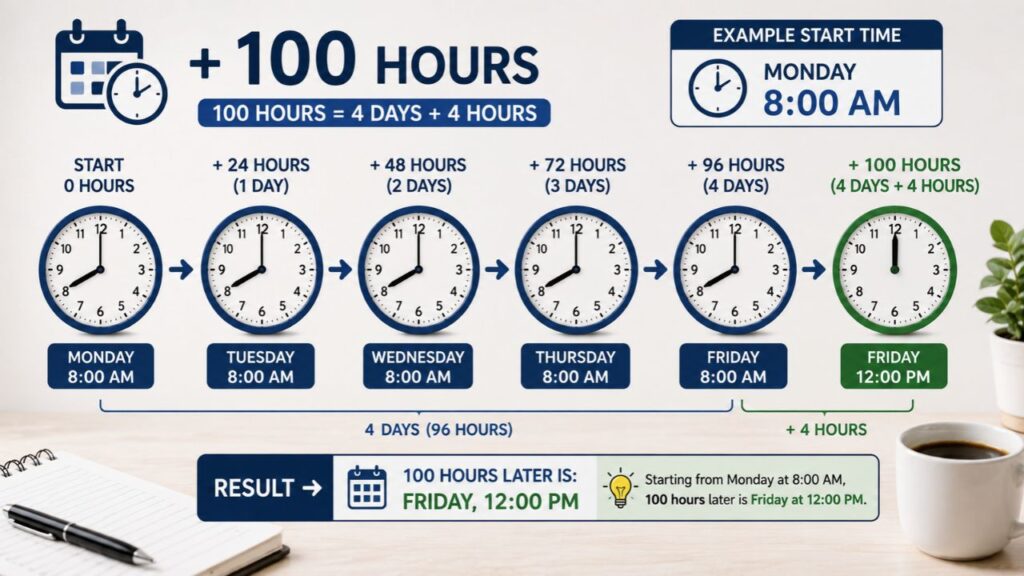
Imagine your starting point is Monday at 8:00 AM.
After 24 hours, you reach Tuesday at 8:00 AM.
After 48 hours, Wednesday at 8:00 AM.
After 72 hours, Thursday at 8:00 AM.
After 96 hours, Friday at 8:00 AM.
Then add four more hours.
Your final answer is Friday at 12:00 PM.
That is the basic meaning of Time after 100 hours. The clock itself only moves four hours beyond the same time on the fourth day.
If the starting point had instead been 10:30 PM, those additional four hours would take you to 2:30 AM on the next calendar date. This is where manual calculations start becoming sneaky.
The Role of the Current Time
The Current time is the foundation of any “from now” calculation. If the starting time changes by even one minute, the final answer changes by one minute.
That is why a result from an earlier calculation should not automatically be reused later. “Now” is always moving.
If you check an Hours from now calculator at 2:48 AM, the result will be different from the result you receive at 3:15 AM. The date may stay the same, but the exact Date and time certainly will not.
For exact planning, always use the actual starting timestamp rather than an approximate time such as “around 3 AM.”
Understanding Future Time Calculation
A Future time calculation is simply the process of moving forward from a known point. The amount you add could be hours, days, weeks, months, or even years.
For example, people may search:
- Minutes from now
- Days from today
- Weeks from today
- Months from today
- Years from today
- Hours ago from now
- Minutes ago from now
- Days ago from today
- Weeks ago from today
- Months ago from today
- Years ago from today
Each phrase asks a slightly different version of the same question: where does a particular point in time land after moving forward or backward?
The 100-hour example is especially useful because it sits between ordinary hour calculations and larger calendar calculations.
100 Hours and Midnight
Midnight is where many manual time calculations go wandering off the road.
Suppose it is 11:00 PM when you begin. Adding four hours gives 3:00 AM, not 3:00 PM. Since the clock passes midnight, the calendar date changes too.
This means a correct calculation needs to track two things simultaneously:
Clock time + calendar date
Ignoring either one can produce a wrong answer.
The same principle applies when calculating Hours and minutes calculation, Add hours to a date, or determining the Date after 100 hours.
If the calculation crosses midnight, mark the date change first, then continue with the clock. That tiny habit prevents a lot of unnecessary confusion.
100 Hours From Now for Planning Deadlines
Deadlines are one of the strongest reasons people want an exact future timestamp. “You have 100 hours” sounds simple, but the actual deadline might be Wednesday morning, Thursday afternoon, or another precise moment depending on when the countdown begins.
For a deadline, write down the starting date and time before calculating. Then add 96 hours, followed by four hours.
If the starting time is:
Saturday, August 15, 2026 at 2:48:12 AM
then the result is:
Wednesday, August 19, 2026 at 6:48:12 AM
That gives you an Exact date 100 hours from now and an Exact time 100 hours from now, rather than a vague “sometime next week.”
Manual Calculation vs. an Online Calculator
Manual calculation is excellent when you want to understand the process. An Online hours calculator, however, becomes useful when precision is important or when the calculation involves several moving parts.
A calculator can be especially helpful when:
- The starting time includes seconds.
- The calculation crosses midnight.
- Several dates are involved.
- You are checking a deadline.
- You need to compare two time zones.
- You want to verify your manual result.
There is no prize for making a simple calculation harder than it needs to be. Sometimes using a Future date calculator is simply the sensible option.
How 100 Hours Compares With Other Time Calculations

Once you understand 100 hours, other time intervals become easier to visualize.
100 hours is:
- 4 days and 4 hours
- 2 days longer than 52 hours
- 4 hours longer than 4 complete days
- Less than 5 full days
This makes 100 hours a useful mental benchmark. If someone tells you that an event is 100 hours away, you know immediately that it is slightly more than four days away.
You can then compare that interval with Weeks from today, Months from today, or Years from today when planning larger schedules.
Common Mistakes When Calculating 100 Hours
The first mistake is treating 100 hours as exactly four days. It is not. Four days contain only 96 hours, leaving four additional hours.
The second mistake is ignoring midnight. A four-hour addition can move the clock into another calendar date.
The third mistake is confusing “today” with “now.” Today is a date; now is a precise moment.
Another common problem is forgetting the starting seconds. If the starting point is 2:48:12 AM, the seconds remain :12 after adding whole hours. So the result becomes 6:48:12 AM, not simply 6:48 AM.
These details look tiny, but exact time calculations are built from tiny details.
A Simple Formula for 100 Hours From Now
You can use this straightforward formula:
Starting date and time + 100 hours = future date and time
Or break it down:
Starting date and time + 4 days + 4 hours = final result
For example:
Saturday, August 15, 2026, 2:48:12 AM
- 4 days
= Wednesday, August 19, 2026, 2:48:12 AM
Then:
+ 4 hours
= Wednesday, August 19, 2026, 6:48:12 AM
That’s your complete Calculate future date and time process in a nutshell.
Why Exact Time Matters
People sometimes think being off by a few minutes is no big deal. In casual life, maybe it isn’t. But for flights, medication schedules, online events, work deadlines, reservations, examinations, or timed submissions, those minutes can suddenly become very important.
An exact Time difference calculator can remove uncertainty when precision matters. It is especially useful when several people need to work from the same timestamp.
The more important the event, the less attractive guessing becomes. A calculator is cheaper than a missed deadline, which is one of those boring truths nobody likes until they need it.
Read more blog: 32 Weeks From Today
Frequently Asked Questions
100 hours from now
100 hours from now is 4 days and 4 hours after the current date and time.
what is 100 hours from now
100 hours from now means adding 4 days and 4 hours to the current date and time.
how long is 100 hours
100 hours equals 4 days and 4 hours, or about 4.17 days.
what time will it be in 100 hours
The time will be 4 hours later than the current time, with the date moving forward by 4 days.
when is 100 hours from now
It will be 4 days and 4 hours from the current date and time.
Conclusion
Understanding 100 Hours From Now is really about learning to see time as both a clock and a calendar. The calculation itself is simple: 100 hours equals four days and four hours. The challenge is making sure the starting date, starting time, midnight crossings, and exact details are handled correctly.
Using the example of Saturday, August 15, 2026 at 2:48:12 AM, the result is Wednesday, August 19, 2026 at 6:48:12 AM. Once you break the calculation into four days plus four hours, the whole thing becomes much easier to follow.
Whether you are checking What date is 100 hours from now, wondering What time will it be in 100 hours, or using a 100 hours from now calculator to confirm a deadline, the same basic method applies.
And perhaps that is the nicest thing about time calculation: a number that initially looks oddly large can become perfectly ordinary once you split it into pieces. Four days. Four hours. One future moment waiting quietly on the calendar.
If you have a favorite way to calculate future dates and times, share it with others. Sometimes the simplest little trick is exactly the thing another person has been trying to figure out all morning.