Time has a funny little habit of becoming important exactly when we need it. You may glance at a clock and suddenly wonder, what time was it less than an hour earlier, perhaps because you missed a call, checked a message late, or simply want to understand when something actually happened. It sounds like a tiny question, but sometimes a tiny question is carrying a surprisingly useful answer with it, you know.
If you are searching for 56 minutes ago, the basic idea is simple: take the Current time and move backward by 56 Minutes. This is a small example of Time calculation, but it can become confusing when the subtraction crosses an hour, midnight, or even a date boundary. A clock does not care that our brains sometimes do, which is mildly unfair.
For example, if the starting time is 8:29:53 AM on Sunday, August 16, 2026, subtracting 56 minutes gives 7:33:53 AM on the same day. So the answer to 56 minutes ago from now in this example is 7:33:53 AM. Nothing dramatic happened to the calendar; only the clock moved backward.
| Current Time | 56 Minutes Ago |
|---|---|
| 8:29 AM | 7:33 AM |
| 9:00 AM | 8:04 AM |
| 10:15 AM | 9:19 AM |
| 12:30 PM | 11:34 AM |
| 3:20 PM | 2:24 PM |
What Does 56 Minutes Ago From Now Mean?
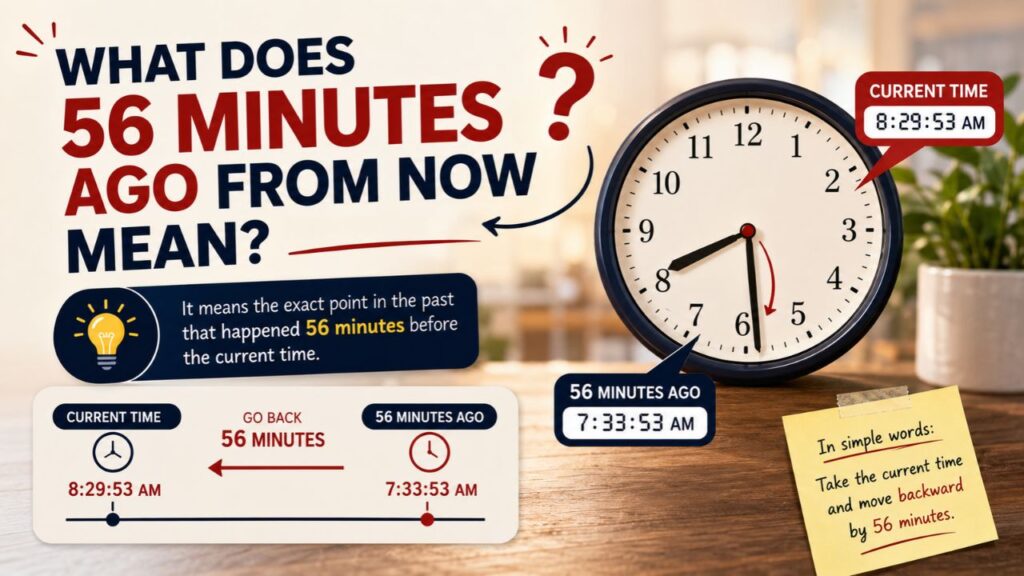
The phrase 56 minutes ago from now simply describes a point in the Past time that occurred exactly 56 minutes before the starting moment. It is not 56 minutes before the beginning of the day, nor 56 minutes before noon. It is measured from whatever moment you choose as the starting point, and thats the part people sometimes skip.
When someone asks, “What time was it 56 minutes ago?” they are really asking for the Previous time based on a known starting time. If your Current time is 8:29:53 AM, you subtract 56 minutes and arrive at 7:33:53 AM. The seconds stay the same when you subtract whole minutes, which makes this particular example pleasantly tidy.
This is why 56 minutes before now can be solved with basic time subtraction. Start with the hours and minutes, move backward 56 minutes, and check whether the hour changes. If it does, borrow one hour and turn that hour into 60 minutes. A little borrowing, but thankfully no paperwork.
What Time Was It 56 Minutes Ago?
Suppose your clock shows 8:29:53 AM. You want to know the exact time 56 minutes ago. The calculation can be written like this:
8:29:53 AM − 56 minutes = 7:33:53 AM
So, what time was it 56 minutes ago? In this example, it was 7:33:53 AM.
The Time difference between 7:33:53 AM and 8:29:53 AM is exactly 56 minutes. Notice that the seconds remain at 53 because we are only changing the minute portion. This is one of those small details that makes an exact time calculation more reliable, specially when you are checking records or timestamps.
If you only care about hours and minutes, you can simplify the same calculation:
8:29 AM − 56 minutes = 7:33 AM
Both results describe the same 56-minute interval, but the second version leaves out the seconds. For everyday scheduling, that is usually enough, and honestly most people are not living their breakfast according to the second hand.
56 Minutes Ago From Now: A Simple Calculation
The easiest method is to subtract 56 minutes from the starting time. If the minute value is large enough, the subtraction happens within the same hour. If the minute value is smaller than 56, you need to move back one hour first.
For example, imagine the starting time is 8:29 AM. Since 29 is smaller than 56, you borrow one hour. The 8 becomes 7, while the 29 minutes effectively become 89 minutes for the subtraction. Then:
89 − 56 = 33 minutes
That leaves 7:33 AM. This little borrowing trick is useful when you want to calculate 56 minutes ago without opening an online tool. It may feel old-fashioned, but old-fashioned sometimes works just fine.
Another way is to break 56 into smaller pieces. Subtract 30 minutes first, then 20, then 6. From 8:29 AM, subtracting 30 gives 7:59 AM, subtracting 20 gives 7:39 AM, and subtracting 6 gives 7:33 AM. Same answer, different road, and roads do not always need to be fancy.
Understanding the Current Time and Previous Time
The Current time is simply your chosen starting point. The Previous time is the moment before it. When we say 56 minutes ago, the current moment and previous moment are separated by exactly 56 minutes, no more and no less.
This distinction matters when timestamps are involved. A phone notification might say a message arrived 56 minutes ago, while a website may show a specific timestamp. If you compare the two, the displayed result can vary slightly because seconds keep moving while you are looking at the screen. Time is rude like that, it refuses to pause for our calculations.
For accurate records, always identify the starting Date and time before performing the calculation. If you only know that something happened “56 minutes ago,” you cannot produce an Exact time without knowing the reference moment. The phrase itself is relative, so the answer changes as the clock moves forward.
An Example Using Sunday, August 16, 2026
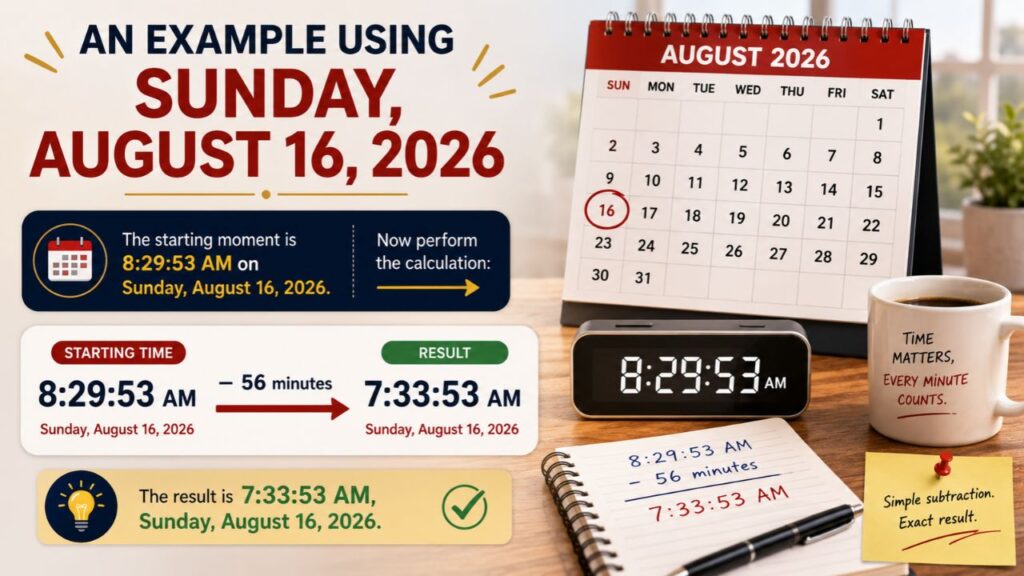
Consider this clear example: the starting moment is 8:29:53 AM on Sunday, August 16, 2026.
Now perform the calculation:
8:29:53 AM − 56 minutes = 7:33:53 AM
The result is therefore 7:33:53 AM, Sunday, August 16, 2026.
The date does not change because the calculation stays comfortably inside the same morning. If the starting time had been 12:20 AM, however, moving backward 56 minutes would cross midnight and produce a time on the previous calendar day. Thats when remembering the date becomes just as important as remembering the clock.
This is why a good Date calculator or Time calculator may display both the time and date. It prevents the common mistake of calculating the correct clock time while attaching it to the wrong day.
When 56 Minutes Ago Crosses Midnight
Crossing midnight is where an easy calculation can suddenly become slightly annoying. Imagine the starting time is 12:20 AM. Subtract 56 minutes, and you cannot simply write 11:64 PM because clocks don’t work that way.
Instead, move back across midnight. The result is 11:24 PM on the previous day. The clock moves from the first minutes of a new day into the final minutes of the previous one.
This matters for travel schedules, work logs, online activity, appointments, and messages. If something happened 56 minutes before 12:20 AM on Sunday, it actually happened late Saturday night. The Date and time must therefore be considered together, not separately.
A useful habit is to ask yourself whether your calculation crosses 12:00 AM. If yes, check the date as well. It takes a few extra seconds and can save a very silly mistake later.
Why People Search “What Time Was It 56 Minutes Ago?”
People search what time was it 56 minutes ago for all sorts of ordinary reasons. Maybe a message appeared on a phone and they want to know when it was actually sent. Maybe they are reviewing a work task, checking an appointment, or remembering when they left home.
Sometimes the reason is even more personal. Someone may be trying to reconstruct a morning from scattered timestamps, while another person simply wants to know how long they have been waiting. A 56-minute gap can feel tiny on a clock but strangely long when you are sitting around waiting for an answer.
There are also practical reasons connected with technology. Websites, security systems, delivery applications, cameras, and communication platforms often display activity using relative language such as “minutes ago.” Converting that relative statement into an Exact past time makes the information easier to understand.
Using a Time Calculator for 56 Minutes Ago
A Time calculator can perform the subtraction instantly. You enter the starting time, choose the number of minutes, and move backward. This is particularly useful when seconds, midnight, or different dates make manual calculations inconvenient.
A minutes ago calculator is essentially designed around this same idea. Rather than doing the arithmetic yourself, it handles the elapsed time calculation and gives you the corresponding previous moment.
For simple calculations, though, you do not really need a tool. If the time is 8:29 AM, you can mentally subtract 56 minutes and get 7:33 AM. The calculator becomes more useful when the calculation involves several intervals, unusual timestamps, or a date boundary. Human brains are excellent at many things; repeatedly subtracting minutes at 2 AM is perhaps not one of them.
56 Minutes Ago Compared With Other Time Expressions
The phrase minutes ago belongs to a larger family of relative-time expressions. We also commonly say Hours ago, Days ago, Weeks ago, Months ago, and Years ago. Each expression simply describes how far backward we are moving from a reference point.
For example, “56 minutes ago” refers to a short interval in the past. “Two hours ago” refers to a larger interval, while “three days ago” moves the calculation across multiple calendar dates. Weeks ago, Months ago, and Years ago can require calendar awareness because months do not all contain the same number of days.
The reverse idea is Time from now. Instead of moving backward, you move forward. You might ask how many minutes from now an appointment begins, or what time it will be several hours from now. The direction changes, but the basic principle of time arithmetic remains the same.
56 Minutes Ago Versus 56 Minutes From Now

These two phrases sound almost identical, yet they point in opposite directions. 56 minutes ago from now means move backward 56 minutes. 56 minutes from now means move forward 56 minutes.
If the starting time is 8:29 AM, then:
- 56 minutes ago → 7:33 AM
- 56 minutes from now → 9:25 AM
That contrast is worth remembering because one tiny phrase completely changes the answer. When someone gives you a time calculation, first identify whether they are asking about the Past time or future time. It saves the classic mistake of confidently giving yesterday’s answer to tomorrow’s question.
How to Calculate Time Without a Calculator
You can Calculate time manually with a simple three-step approach. First, write down the starting time. Second, decide whether you are moving backward or forward. Third, perform the minute calculation and check whether the hour or date changes.
For 8:29 AM minus 56 minutes, begin with 8:29. Borrow one hour because 29 is less than 56. That gives you 7 hours and 89 minutes. Subtract 56 from 89, leaving 33. The answer is 7:33 AM.
For people who prefer another method, split the number into manageable pieces. Subtract 50 minutes, then subtract 6 more. From 8:29 AM, 50 minutes earlier is 7:39 AM, and six more minutes takes you to 7:33 AM. Two paths, one destination, no dramatic mathematical adventure required.
Real-Life Situations Where 56 Minutes Matters
A 56-minute calculation can be useful in surprisingly ordinary situations. Imagine you are reviewing a work timeline and a task was completed 56 minutes before a meeting. Finding the exact starting time helps you understand what happened before the meeting rather than relying on a vague memory.
It can also help with travel. If a bus, train, or flight-related notification says an update occurred 56 minutes ago, converting the relative timestamp into a clock time can make the sequence of events much easier to follow. This is especially handy when several notifications arrive close together.
Students can use the same calculation for study sessions. If a break ended 56 minutes ago, you can determine exactly when it ended and estimate how long you have been working since then. Small pieces of time add up, and sometimes the difference between “I just started” and “I’ve been working for nearly an hour” is mostly psychological.
The Importance of Exact Time
An Exact time becomes especially valuable when the event matters. Casual activities rarely require second-level precision, but records, appointments, deadlines, and technical logs may depend on it.
Suppose an event occurred at 8:29:53 AM. Saying it happened around 7:33 AM after subtracting 56 minutes is fine for casual conversation, but the exact result is 7:33:53 AM. Keeping the seconds can be useful when comparing two timestamps that occurred close together.
This is also why a past time calculator may show seconds even when you only entered minutes. The tool is preserving information that was already present in your starting timestamp. It is not making the calculation more complicated; it is simply refusing to throw away useful details.
56 Minutes Ago and the Bigger Picture of Time
Learning to calculate 56 minutes ago is a small skill, but it belongs to a much bigger understanding of time. Once you become comfortable with minute subtraction, it becomes easier to work with hours, dates, schedules, and longer periods.
The same logic can be extended to hours from now, days from today, weeks from today, months from today, and even years from today. The numbers become larger, but the habit stays similar: identify your starting point, decide the direction, perform the calculation, then verify the result.
For longer periods, however, calendar rules become more important. A month is not always the same number of days, and a year can contain 365 or 366 days. That is why a Date calculator can be more appropriate than simply converting everything into minutes.
Common Mistakes When Calculating 56 Minutes Ago
One common mistake is subtracting the number 56 directly from the minute display without borrowing an hour. If the clock says 8:29, writing 8:-27 is obviously not a real time, but hurried calculations can produce equally strange results before we notice them.
Another mistake is forgetting the date when crossing midnight. A correct clock result paired with the wrong day is still an incorrect answer. This becomes particularly important when tracking events around midnight, because the calendar changes while the clock appears to keep moving normally.
A third mistake is confusing 56 minutes ago from now with 56 minutes from now. The first moves backward, the second moves forward. It sounds obvious, but when reading quickly, those two little words can slip past the eyes rather easily.
A Quick Reference for 56 Minutes Ago
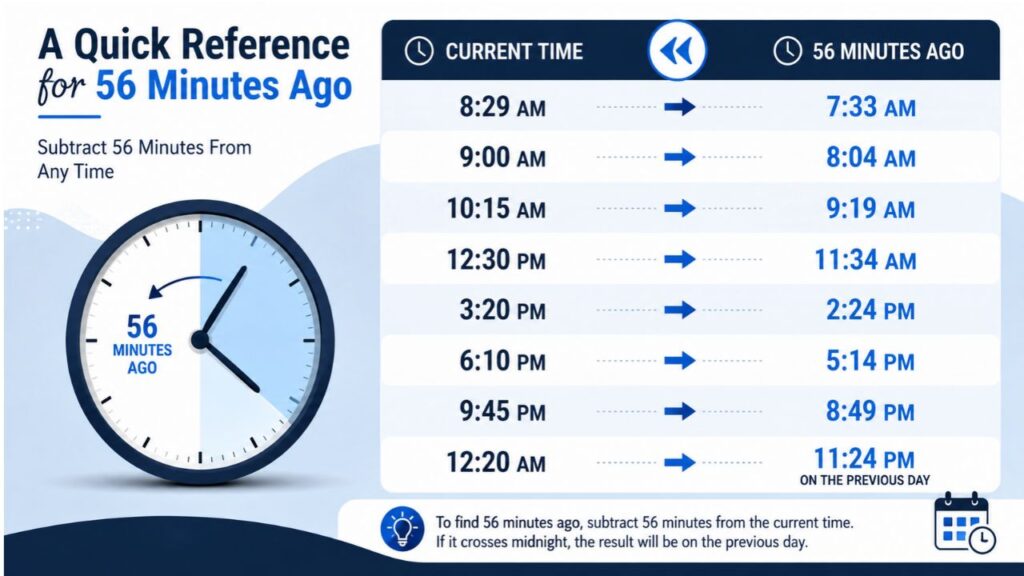
Here are a few examples showing how the calculation works across different starting times. These are simple reference points, and they can help you understand the pattern without reaching for a tool every time.
- 8:29 AM → 7:33 AM
- 9:00 AM → 8:04 AM
- 10:15 AM → 9:19 AM
- 12:30 PM → 11:34 AM
- 3:20 PM → 2:24 PM
- 6:10 PM → 5:14 PM
- 9:45 PM → 8:49 PM
- 12:20 AM → 11:24 PM on the previous day
Notice how the last example changes the date. That one deserves extra attention because it shows why time calculation is not always just about the numbers displayed on a clock.
What If You Need a Different Time Difference?
Once you understand 56 minutes, other calculations become much less intimidating. You might need to determine what happened 20 minutes ago, 90 minutes ago, or several Hours ago. The same basic method applies.
For longer periods, you may instead search for days ago from today, weeks ago from today, or months ago from today. When the period becomes calendar-based, it is better to use a tool that understands actual dates instead of assuming every month contains exactly 30 days.
For example, calculating a period between August 16 2026 and another calendar date requires more than simple minute subtraction. You need to account for the number of days in each month and possibly leap-year rules. Time gets more complicated as the measuring stick gets longer, naturally.
Why Relative Time Is Useful
Relative time expressions such as “56 minutes ago” are convenient because they tell us how recent something is without forcing us to read a timestamp. When a friend says, “I sent it 56 minutes ago,” you immediately understand the general timing.
The problem appears when you need an exact record. Relative time keeps changing as the present moment changes, while a timestamp remains fixed. Something that was 56 minutes ago will soon be 57 minutes ago, then 58 minutes ago, and eventually an hour ago.
That is why converting relative time into a clock time can be useful. It turns a moving description into a fixed reference point, which is much easier to compare with other events.
Read more blog: 100 Hours From Now
Frequently Asked Questions
what time was it 56 minutes ago
56 minutes ago means subtracting 56 minutes from the current time to find the exact past time.
56 minutes ago
56 minutes ago refers to the time that occurred exactly 56 minutes before the current time.
56 minutes ago from now
56 minutes ago from now is calculated by subtracting 56 minutes from the current time.
what time was 56 minutes ago
To find what time was 56 minutes ago, simply subtract 56 minutes from the current time.
Conclusion
The answer to 56 minutes ago from now is found by moving exactly 56 minutes backward from the chosen starting moment. Using the example of 8:29:53 AM on Sunday, August 16, 2026, the result is 7:33:53 AM on the same date.
The calculation is simple, but the idea behind it is useful far beyond one question. Understanding Current time, Previous time, Time difference, and Exact time helps with schedules, messages, work records, travel plans, study sessions, and everyday decisions.
So next time you wonder what time was it 56 minutes ago, pause for just a second, identify the starting time, subtract 56 minutes, and check the date if you cross midnight. You may use a Time calculator when convenience matters, or do the arithmetic yourself when the calculation is straightforward. Either way, the goal is the same: turning a vague “minutes ago” into a clear moment in time, which is sometimes exactly what we need.