Time has a funny little habit of becoming important exactly when we need it. One moment, you’re checking your phone casually, and the next you’re wondering what time was it a few minutes earlier because a message arrived, a meeting started, or you simply need to remember when something happened. That is where 24 Minutes Ago From Now becomes a surprisingly useful little calculation, even if it sounds almost too simple at first.
If your Current time is 9:56:00 AM, subtracting 24 minutes takes you back to 9:32:00 AM. So, in this example, the answer to what time was it 24 minutes ago is 9:32:00 AM. The calculation looks tiny, but it can matter when you’re checking appointments, messages, work records, reminders, or just trying to reconstruct the shape of a busy morning. Time does not wait around for us, sadly, and sometimes those small details are exactly what we need.
On Monday, August 17, 2026, for example, a simple time calculation can tell you the previous time without making you stare at a clock and count backwards on your fingers. It’s a small convenience, but small conveniences have a way of making a busy day feel slightly less tangled.
| Current Time | 24 Minutes Ago |
|---|---|
| 9:56 AM | 9:32 AM |
| 10:00 AM | 9:36 AM |
| 10:15 AM | 9:51 AM |
| 11:00 AM | 10:36 AM |
| 12:00 PM | 11:36 AM |
| 1:00 PM | 12:36 PM |
Understanding 24 Minutes Ago From Now
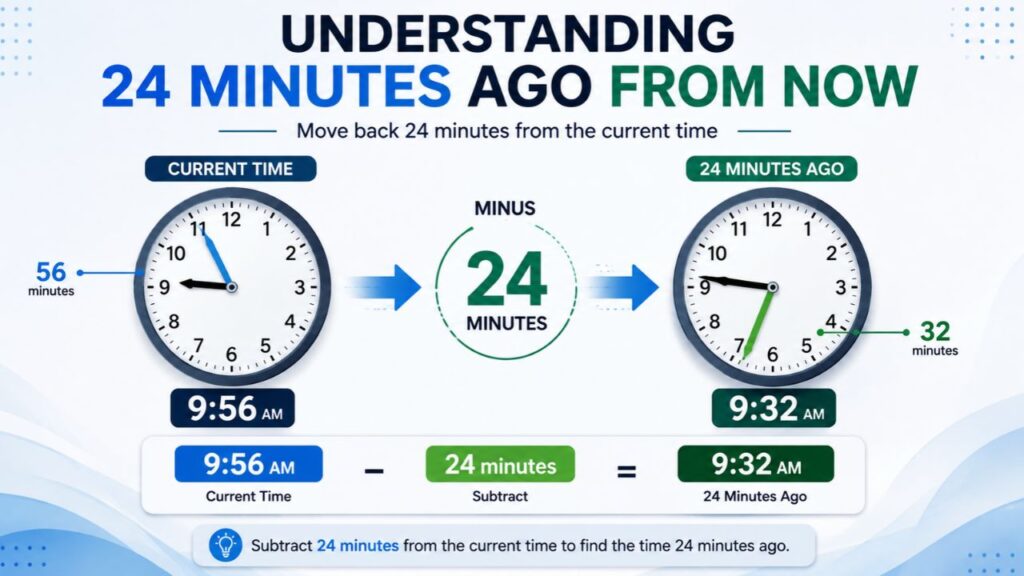
The phrase 24 minutes ago simply means a point in time that occurred 24 minutes before the present moment. Nothing mysterious hiding behind it, really. You take the Current time, move backward by 24 minutes, and the result is your earlier time.
For example, if the clock shows 9:56 AM, then:
9:56 AM − 24 minutes = 9:32 AM
That is the basic time subtraction involved. If you were searching for 24 minutes before now, this is the same idea expressed in slightly different words. The wording changes, but the little clock on the wall doesn’t care much about our phrasing.
This can also be called 24 minutes earlier, time 24 minutes ago, or the time before now. All of these expressions point toward the same simple Time reference.
What Time Was It 24 Minutes Ago?
So, what was the time 24 minutes ago if the current clock reads 9:56:00 AM? The answer is 9:32:00 AM. You can reach it by moving the minute hand backward 24 minutes, or by using a time calculator when you want the answer instantly.
The calculation is especially straightforward because both times remain within the same hour. If the starting time were 10:10 AM, however, subtracting 24 minutes would take you into the previous hour, giving 9:46 AM. That’s where people sometimes make a tiny mistake, usually because the clock behaves differently from ordinary decimal numbers.
If you need to calculate 24 minutes ago, remember that minutes run from 00 through 59. When subtraction crosses an hour, borrow one hour and continue the calculation. It sounds school-ish, but it saves you from those annoying little time mistakes.
24 Minutes Ago From Now: A Simple Example
Suppose your Current time is 9:56:00 AM on Monday, August 17, 2026. You want to know the exact time 24 minutes earlier.
Start with the current clock reading:
9:56:00 AM
Then subtract 24 minutes:
9:56:00 AM − 24 minutes = 9:32:00 AM
Therefore, the exact time 24 minutes ago was:
9:32:00 AM
This is a useful example because it shows exactly how a minutes ago calculator works without dressing the calculation up in complicated mathematics. Twenty-four minutes is simply removed from the current clock position, and the resulting time becomes the Previous time.
Why People Search for 24 Minutes Ago
People rarely search for a past time because they suddenly developed a deep philosophical relationship with clocks. Usually, there’s a practical reason. Maybe a text message came in and you want to know when it was sent, or perhaps you are checking when you started a task.
A person might also ask what time was it 24 minutes ago after looking at an online post, an email notification, a delivery update, or a meeting reminder. These little situations happen every day, and exact timing can sometimes matter more than expected.
For workers, students, parents, travelers, and anyone whose day is divided into small appointments, knowing minutes ago can provide useful context. Twenty-four minutes isn’t a huge amount of time, but it can be long enough for a meeting to begin, a bus to leave, dinner to cool down, or a deadline to sneak uncomfortably close.
How to Calculate Past Time Without a Calculator
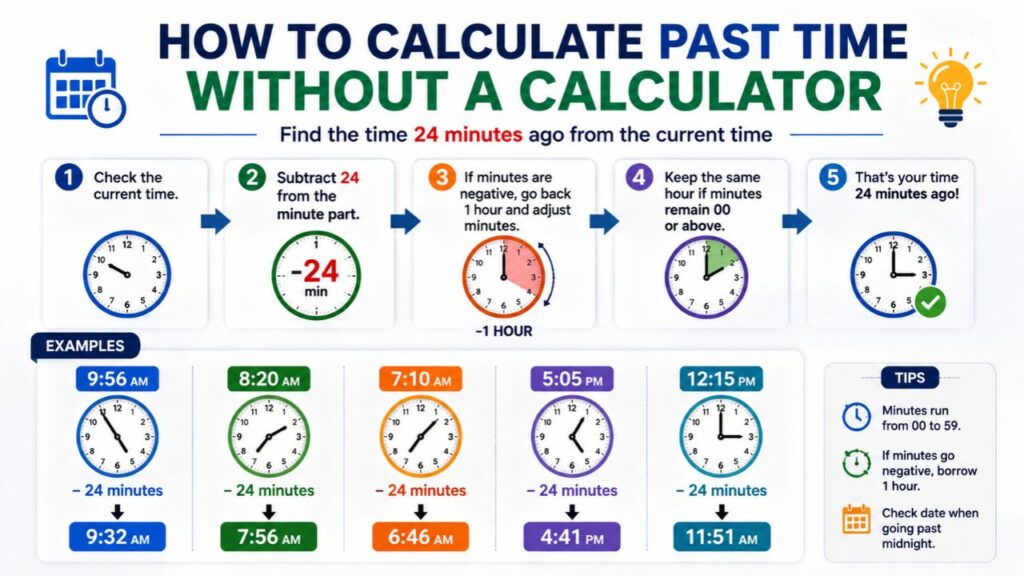
You don’t always need a digital time calculator to work out 24 minutes ago from now. Your own brain is perfectly capable of doing it, though it may complain a little if you’ve just woken up.
First, identify the Current time. Then subtract 24 from the minute portion when possible. If the result stays above zero, you’re finished. If it becomes negative, move back one hour and adjust the minutes.
For example:
- 9:56 AM − 24 minutes = 9:32 AM
- 8:20 AM − 24 minutes = 7:56 AM
- 7:10 AM − 24 minutes = 6:46 AM
- 5:05 PM − 24 minutes = 4:41 PM
- 12:15 PM − 24 minutes = 11:51 AM
The important thing is not to treat the clock like a regular number line. Time has its own slightly strange rules, and 60 minutes make an hour, not 100. That’s where a quick time calculation can become surprisingly easy to mess up.
Time Difference and Elapsed Time
The phrase Time difference can describe how far apart two clock readings are. If something happened at 9:32 AM and the current time is 9:56 AM, the difference between them is 24 minutes.
That gap is also the Elapsed time between the two moments. In everyday language, you might simply say, “It happened 24 minutes ago.” In a workplace or technical setting, you might instead describe the elapsed duration as 24 minutes.
An elapsed time calculator can be useful when you’re comparing longer periods, especially when hours or dates become involved. For a simple 24-minute calculation, though, the old-fashioned method works just fine.
When the Date and Time Also Matter
Sometimes calculating a past time is not only about the clock. The Date and time can matter too, particularly when subtraction crosses midnight.
Imagine the current time is 12:10 AM on Tuesday. Going back 24 minutes gives you 11:46 PM on Monday. Notice that the time changed and the date changed too. This is why an exact date and time calculation can be more important than simply looking at the hour and minute.
The same principle applies when working with days ago from today, weeks ago from today, or longer periods. Once a calculation stretches beyond a single day, a date and time calculator becomes much more useful because it keeps track of both parts together.
24 Minutes Ago and Daily Communication
In communication, knowing when something happened can prevent unnecessary confusion. Imagine someone says, “I sent it earlier,” and you’re trying to determine whether “earlier” means five minutes ago or nearly an hour ago. A specific Time reference such as 24 minutes ago makes the conversation clearer.
This matters with emails, work chats, customer messages, appointment reminders, and personal conversations. Precise timing can sometimes turn a vague story into a clear one.
For example, instead of saying, “I called you earlier,” you might say, “I called you 24 minutes ago.” That’s not exactly poetry, but it is much harder to misunderstand.
Using a Time Calculator for Quick Answers
A time calculator is helpful when you don’t want to perform the calculation manually. You simply provide the starting time and tell the calculator to move backward by 24 minutes.
A minutes ago calculator is particularly convenient for people who frequently need past-time calculations. It can reduce mental effort and help avoid mistakes involving hour changes, midnight, or dates.
For simple calculations, though, it’s still useful to understand the method yourself. Technology is wonderful, but knowing what the calculator is actually doing gives you a little more confidence when checking its answer.
The Difference Between Minutes Ago and Minutes From Now
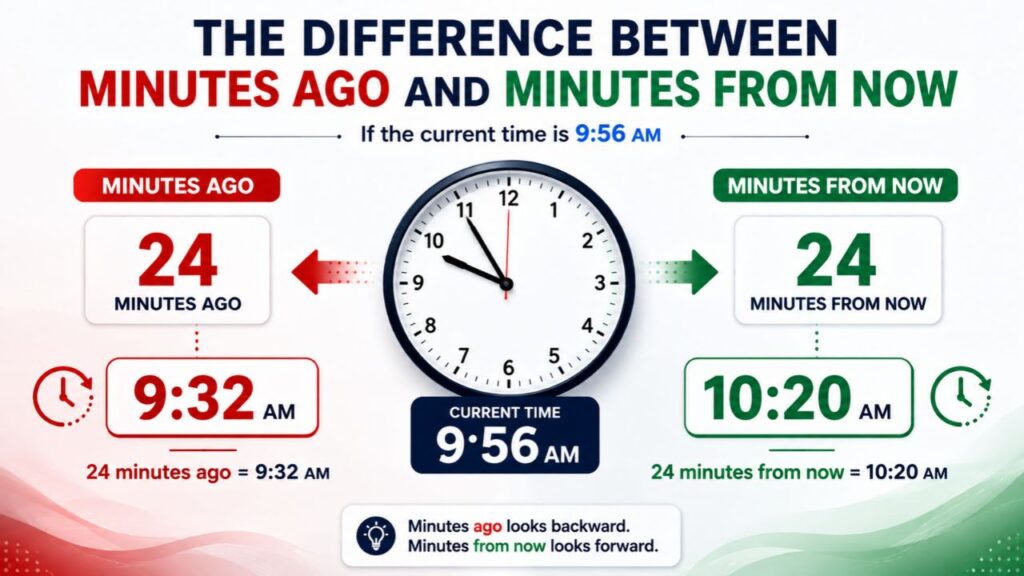
People sometimes confuse past and future calculations because the wording looks nearly identical. Minutes ago refers to the past, while minutes from now refers to the future.
If the current time is 9:56 AM:
24 minutes ago = 9:32 AM
But:
24 minutes from now = 10:20 AM
One moves backward and the other moves forward. The clock is basically standing in the same place while we choose which direction to walk around it.
The same distinction applies to hours from now, days from today, weeks from today, months from today, and years from today. The unit changes, but the basic idea remains: determine your starting point, choose a direction, and calculate the resulting time or date.
Common Mistakes When Calculating 24 Minutes Ago
One common mistake is simply subtracting 24 from the hour instead of the minutes. If the current time is 9:56 AM, subtracting 24 from 9 would obviously produce nonsense for this question. You need to work with the minute portion.
Another mistake is forgetting the hour boundary. If the time is 9:10 AM, subtracting 24 minutes does not give 8:86 AM. That isn’t a real clock time, although it looks like something a tired calculator might invent. Instead, 9:10 AM becomes 8:46 AM.
A third mistake happens around midnight. Going backward from an early-morning time can move you into the previous calendar day, so the Date and time should be checked together.
24 Minutes Ago in Real-Life Situations
There are dozens of ordinary moments where this calculation can help.
You might be checking when you last received a message before replying. You could be reviewing a work timeline and trying to identify when a task started. A student may want to remember when they began a study session, while a traveler might compare a departure update with the actual clock.
Even cooking can involve this sort of calculation. If you put something in the oven 24 minutes ago, knowing the exact starting point helps you decide whether it’s nearly ready. Nobody wants to discover that their “quick snack” has quietly become charcoal.
The calculation is also useful for reminders and productivity. If you know the Elapsed time since beginning a task, you can decide whether to continue, take a break, or move to something else.
Understanding the Exact Time Example
The supplied example of 9:56:00 AM and 9:32:00 AM gives us a clean illustration of the process.
The starting point is 9:56:00 AM. Going backward by 24 minutes produces 9:32:00 AM. The seconds remain at :00 because we are subtracting whole minutes rather than seconds.
So, if someone asks for the exact time 24 minutes ago using that starting point, the answer is 9:32:00 AM. The Time difference between the two clock readings is exactly 24 minutes.
This is also a good reminder that “exact” depends on the precision of the starting time. If you only know that the current time is approximately 9:56 AM, your answer is approximate too. If your clock gives 9:56:00 AM, then you can make a more precise calculation.
A Quick Reference for 24 Minutes Earlier
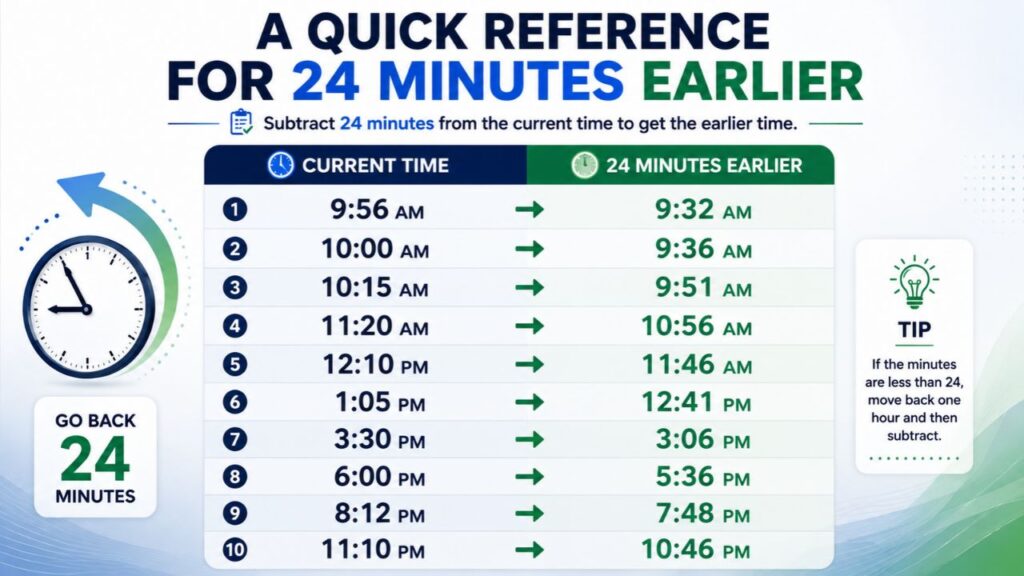
For people who prefer examples rather than explanations, these quick calculations make the pattern easier to see:
- 9:56 AM → 9:32 AM
- 10:00 AM → 9:36 AM
- 10:15 AM → 9:51 AM
- 11:20 AM → 10:56 AM
- 12:10 PM → 11:46 AM
- 1:05 PM → 12:41 PM
- 3:30 PM → 3:06 PM
- 6:00 PM → 5:36 PM
- 8:12 PM → 7:48 PM
- 11:10 PM → 10:46 PM
These examples show that the calculation itself stays consistent even though the clock moves through different hours. Once you understand the pattern, calculate past time becomes much less intimidating.
Time Conversion for Different Situations
Time conversion usually refers to changing a time from one format, unit, or time zone into another. It can also appear alongside past-time calculations when someone is comparing events across locations.
For instance, calculating 24 minutes ago is not the same as converting 24 minutes into hours. Twenty-four minutes is 0.4 hours, but that decimal representation isn’t how we normally read a clock. We say “24 minutes,” not “0.4 hours ago,” unless we’re doing a spreadsheet or some other slightly less human thing.
When time zones enter the picture, things become more complicated. A reliable calculator or clock should be used when the event involves different locations, because local clocks may have different offsets.
Why Exact Time Can Be Surprisingly Useful
We often think of time as something obvious. The clock is there, the day is moving, and surely everyone knows what happened when. Yet once you start comparing messages, appointments, deadlines, or records, vague timing becomes less useful.
Knowing the exact time can help establish a sequence. If one event happened at 9:32 AM and another at 9:56 AM, you immediately know there were 24 minutes between them.
That small interval can be meaningful. A 24-minute gap might represent a commute, a focused work session, a phone call, or simply the amount of time someone spent deciding whether to send a message. Time is ordinary until a particular moment makes it matter.
How to Use a Previous Time Calculator
A previous time calculator works by taking a known time and moving backward by a chosen duration. To calculate time 24 minutes ago, enter the current time, choose minutes as the unit, and subtract 24.
The same approach can be used for larger questions such as hours ago from now, days ago from today, or weeks ago from today. For months and years, however, calendar rules become more important because months do not all contain the same number of days.
If you’re trying to calculate a past date rather than just a past clock time, make sure the tool understands calendar dates. A simple minute subtraction and a full calendar calculation are cousins, not twins.
Time Calculation Without Overthinking It
There is something strangely satisfying about a problem that has one tiny answer. You don’t need a complicated formula, a spreadsheet, or a wall covered in sticky notes to determine 24 minutes ago from now.
Find the Current time.
Move backward by 24 minutes.
Check whether you crossed an hour or midnight.
Then verify the Date and time if necessary.
That’s basically it. Sometimes the easiest solution is the one we keep making complicated because our brains enjoy adding furniture to an empty room.
A Practical Way to Check Your Answer
If you calculate a previous time manually, you can reverse the calculation to verify it. Suppose you determine that 9:32 AM was the answer to what time was it 24 minutes ago.
Now add 24 minutes back:
9:32 AM + 24 minutes = 9:56 AM
You have returned to the starting point, so your answer checks out.
This reverse-check method is especially helpful when you’re calculating past times around an hour boundary. It takes only a few seconds and can catch an error before it becomes an awkward mistake in a schedule or record.
Read more blog: 56 Minutes Ago From Now
Frequently Asked Questions
what time was it 24 minutes ago
24 minutes ago means subtracting 24 minutes from the current time to find the exact earlier time.
24 minutes ago
If the current time is 9:56 AM, then 24 minutes ago it was 9:32 AM.
what time was 24 minutes ago
To find the previous time, simply subtract 24 minutes from the current clock time.
24 minutes ago from now
24 minutes ago from now is the time that occurred exactly 24 minutes before the present moment.
time 24 minutes ago
The time 24 minutes ago can be calculated quickly by moving the current time back by 24 minutes.
Conclusion
24 Minutes Ago From Now may look like a very small topic, but small calculations often sit underneath ordinary parts of daily life. We use time to organize work, conversations, appointments, travel, meals, study sessions, reminders, and those quiet moments when we suddenly realize we have no idea where the last half hour disappeared.
Using the example of 9:56:00 AM, the answer is clear: 24 minutes ago was 9:32:00 AM. The Time difference is 24 minutes, and the Elapsed time between the two moments is equally 24 minutes. On Monday, August 17, 2026, this simple example shows exactly how a past-time calculation works.
If you are ever unsure, don’t make the calculation harder than it needs to be. Start with the Current time, subtract 24 minutes, check for an hour or date change, and use a time calculator when you want a quick confirmation. That’s enough for most everyday situations.
And perhaps that’s the nicest thing about time calculations: they bring a little order to something that otherwise keeps rushing forward. Twenty-four minutes can disappear while you’re answering messages, making tea, waiting for someone, or staring out a window for reasons you don’t even fully understand. But once you calculate it, that vanished piece of the day has a place again.
Whether you’re checking 24 minutes before now, looking for the time before now, or simply wondering about 24 minutes earlier, the method remains wonderfully simple. Find where you are, count backward, and let the clock tell the rest of the story.