There is something oddly satisfying about looking at a calendar and asking a very simple question: what date will it be in 8 months? It sounds like the sort of thing you could answer without thinking, yet once you move across different month lengths, leap years, and changing weekdays, the calendar suddenly becomes a little more slippery than expected. A date that feels far away today can quietly become an important appointment, deadline, celebration, or family milestone before we even notice it.
For anyone checking 8 months from today, the answer is Monday, April 19, 2027, when today is Wednesday, August 19, 2026. In other words, the date 8 months from today lands on April 19, 2027. The calculation is straightforward, but understanding how the calendar arrives there makes the answer much easier to trust, especially when you’re planning something that matters.
There is also a surprisingly human side to future dates. We use calendars to mark birthdays, weddings, travel plans, school terms, business goals, holidays, and those tiny promises we make to ourselves. A future date is really a small doorway: today we can only point toward it, but eventually we will walk right through it.
| Today | 8 Months From Today |
|---|---|
| Wednesday, August 19, 2026 | Monday, April 19, 2027 |
What Is 8 Months From Today?

If today is August 19, 2026, then moving forward one month at a time gives us September 19, October 19, November 19, and so on. After eight complete calendar months, we arrive at April 19, 2027. The 8 months from today calculation therefore produces an exact calendar date rather than a rough estimate.
Here is the month-by-month movement, kept deliberately simple because calendars don’t need dramatic suspense, though they somehow create it anyway:
- August 19, 2026 → starting point
- September 19, 2026 → 1 month later
- October 19, 2026 → 2 months later
- November 19, 2026 → 3 months later
- December 19, 2026 → 4 months later
- January 19, 2027 → 5 months later
- February 19, 2027 → 6 months later
- March 19, 2027 → 7 months later
- April 19, 2027 → 8 months later
So, the date after 8 months is April 19, 2027. It is not necessary to count 240 days or make a complicated time calculation to reach the answer. Calendar months are best handled as calendar months when the question specifically asks for months.
8 Months From Today Is Monday, April 19, 2027
The most useful part of the calculation is the final answer: 8 months from today is Monday, April 19, 2027. The starting date is Wednesday, August 19, 2026, and the ending date is Monday, April 19, 2027. The day of the month stays the 19th while the month changes eight times.
The weekday changes naturally because each month contains a different number of days. August has 31 days, September has 30, February has 28 in this particular period, and those differences push the weekday forward at different rates. So while August 19, 2026 is a Wednesday, April 19, 2027 arrives on a Monday. Calendars, in their quiet little way, are always counting underneath us.
This is why simply saying “eight months is about 240 days” can be misleading. Some months have 30 days, some 31, and February has fewer. A month calculation should normally preserve the calendar date instead of pretending every month has exactly the same number of days.
How to Calculate 8 Months From Today
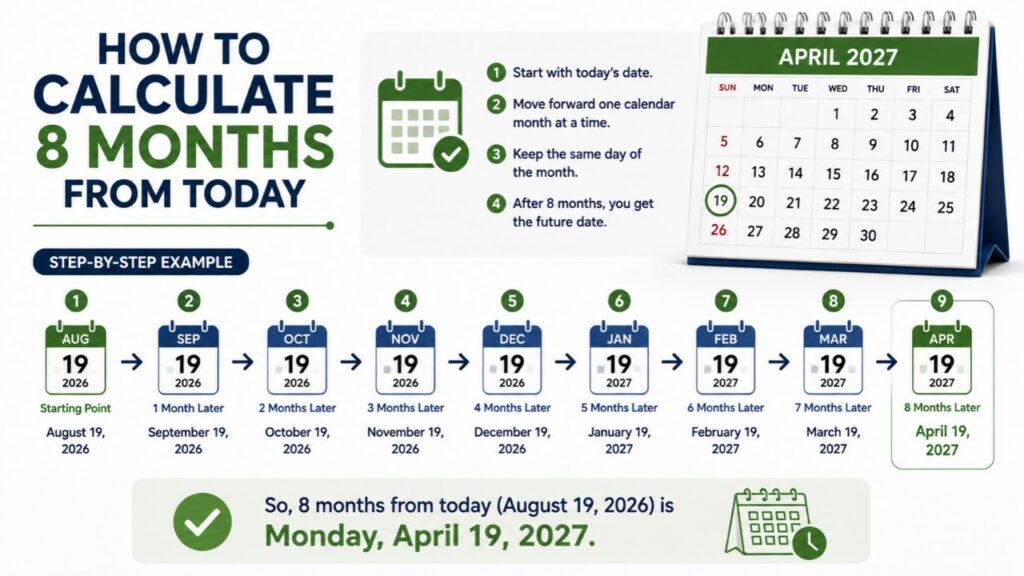
Learning how to calculate months from today is useful because you won’t always have a date calculator nearby. The easiest method is to keep the day number the same and move forward through the months.
Start with August 19, 2026. Count August as your starting point rather than as the first month of the eight-month journey. Then move one calendar month at a time: September is one, October is two, November is three, December is four, January is five, February is six, March is seven, and April is eight.
That gives you April 19, 2027. It’s a very ordinary calculation, but ordinary calculations are exactly where little mistakes like to hide. People sometimes count the starting month as “one,” accidentally producing a date that is one month too early. The better habit is to treat the starting date as zero months elapsed.
For example:
- Starting date: August 19, 2026
- After 1 month: September 19, 2026
- After 2 months: October 19, 2026
- After 3 months: November 19, 2026
- After 4 months: December 19, 2026
- After 5 months: January 19, 2027
- After 6 months: February 19, 2027
- After 7 months: March 19, 2027
- After 8 months: April 19, 2027
The method is almost boringly simple, which is actually a good thing. A reliable calculation doesn’t need to look clever.
Why the Exact Date Matters
Knowing the exact date can make a surprising difference when planning real events. “Sometime next spring” is a pleasant phrase, but it isn’t very useful when you need to book a venue, schedule a medical appointment, organize a trip, set a business deadline, or arrange a family gathering.
For example, someone planning an eight-month personal goal might use April 19, 2027 as a checkpoint. Instead of saying, “I’ll work on this for the next several months,” they can put the date directly into a planner. The vague future becomes something visible and measurable, and that little change can make a goal feel more real.
Dates also help people communicate clearly. If one person says “eight months from now,” another person may interpret that differently depending on the date they are using as their starting point. Saying April 19, 2027 removes the fog. There is no guessing involved then.
8 Months From Today for Planning and Milestones
A future date can be more than a mathematical answer. It can become a marker for progress. Someone beginning a course, preparing for a major event, saving money, building a project, or working toward a personal target might look at 8 months from today and suddenly realize there is a meaningful amount of time available.
Eight months is long enough for change to become visible, but short enough that the destination does not feel impossibly distant. A person could learn a skill, finish a substantial project, establish a routine, prepare for an important occasion, or simply become much more organized during that period. The calendar doesn’t promise success, of course, but it does provide a boundary.
One useful trick is to break the eight-month period into smaller pieces. Instead of staring at April 2027 as one giant block, consider the first month, then the second, and keep going. Big stretches of time become much less intimidating when they are given smaller names.
8 Months Later: Why Calendar Months Are Different From Days
People often mix up 8 months later with a fixed number of days later. They sound nearly identical, but they are not necessarily the same calculation. Eight calendar months after August 19 is April 19, whereas adding a fixed number of days would require counting the actual days in each month.
This distinction becomes especially important around February. February is the calendar’s little troublemaker, with fewer days than the other months and an extra day in leap years. In the period from August 2026 to April 2027, February 2027 has 28 days, but that doesn’t change the rule for this particular calculation because the target day, the 19th, exists in every month involved.
If you are using a future date calculator, check whether it asks for months or days. A good month date calculator should treat “8 months” as a calendar-month operation rather than automatically converting it into an assumed number of days.
What Date Will It Be in 8 Months for Different Purposes?
The question what date will it be in 8 months can have many practical meanings. The same date can serve as a deadline, a celebration, a reminder, or simply an interesting point in the future. The mathematics stays the same, but the emotional meaning can be completely different.
For a family, April 19, 2027 might become a birthday-related planning date or a special anniversary. For a student, it could represent the end of a study period. For a business owner, it might be a review date for a project or financial target. For someone planning travel, it could be the date around which reservations and documents need to be organized.
This is one reason calendar calculations are more useful than they first appear. We don’t calculate dates because dates are fascinating by themselves; we calculate them because our lives keep attaching meaning to them.
The Difference Between 8 Months, 8 Weeks, and 8 Days
The number eight appears in many date searches, but the unit completely changes the result. 8 days from today, 8 weeks from today, and 8 months from today are three very different calculations.
Eight days is a short jump that can be useful for reminders or near-term plans. Eight weeks is roughly two months, although it is more precise to describe it as 56 days. Eight months, however, is a calendar-based period that crosses from August 2026 into April 2027.
The same idea applies when people search for 8 minutes from now, 8 hours from now, or 8 years from now. Each phrase sounds similar, but the appropriate calculation method is different. A date and time calculator can be especially useful when both the date and clock time matter, while a basic date calculator is enough for a calendar-only question.
What About 8 Months Ago?
Looking backward can be just as useful as looking forward. An 8 months ago calculation starts from the same kind of calendar principle but moves backward rather than ahead. If you’re reviewing an old project, checking when something happened, or trying to reconstruct a timeline, past-date calculations can help establish a clearer sequence.
This is also different from phrases such as 8 days ago or 8 hours ago, which use shorter periods. The word “ago” tells us to move backward, while “from today” in a future-date context usually asks us to move forward.
The basic lesson is simple: first identify the direction, then identify the unit. It sounds obvious, but doing those two tiny checks can prevent quite a few calendar mistakes.
Why Date Calculators Are Helpful
A date calculator is useful when the calculation becomes more complicated than simply moving eight months from the same day number. You might need to calculate several months and days together, compare two dates, or determine the number of days between events. That’s when a calendar calculator can save time and reduce mental arithmetic.
A months from today calculator can also be helpful when you’re working with dates that fall near the end of a month. For example, adding months to dates such as January 31 can create special cases because not every month contains a 31st day. Software must then follow a defined calendar rule for handling the result.
For the current example, fortunately, there is no such complication. The 19th exists in every relevant month, so calculate future date becomes a very clean exercise.
Turning a Future Date Into a Personal Goal
There is a quiet psychological difference between saying “I’ll do it eventually” and writing “April 19, 2027” on a calendar. The first statement floats. The second one lands.
If you are using this date for a personal project, consider writing one small goal beside each month. September could be about starting, October about building, November about correcting mistakes, December about reviewing progress, and the new year could bring a fresh phase. By March, you might be preparing for the final checkpoint in April.
This approach makes the future date feel less like a distant wall and more like a path. Eight months can pass quickly, almost rudely quickly, so giving each portion a purpose helps you notice the progress while it’s happening.
Common Mistakes When Calculating 8 Months From Today
The most common mistake is counting the starting month incorrectly. If August 19 is the starting date, September 19 is one month later, not two. It sounds almost too simple to mention, yet this is exactly the sort of thing that causes date calculations to drift.
Another mistake is assuming every month has 30 days. That shortcut can work for rough estimates, but it does not produce a reliable calendar date. A third mistake is ignoring the difference between calendar months and a fixed number of days. They are related, but they are not interchangeable.
Finally, people sometimes forget to verify the weekday. In this case, Wednesday, August 19, 2026 becomes Monday, April 19, 2027. Checking the weekday is a useful second layer of verification, particularly for appointments or events where the day of the week matters.
A Quick Reference for the Calculation
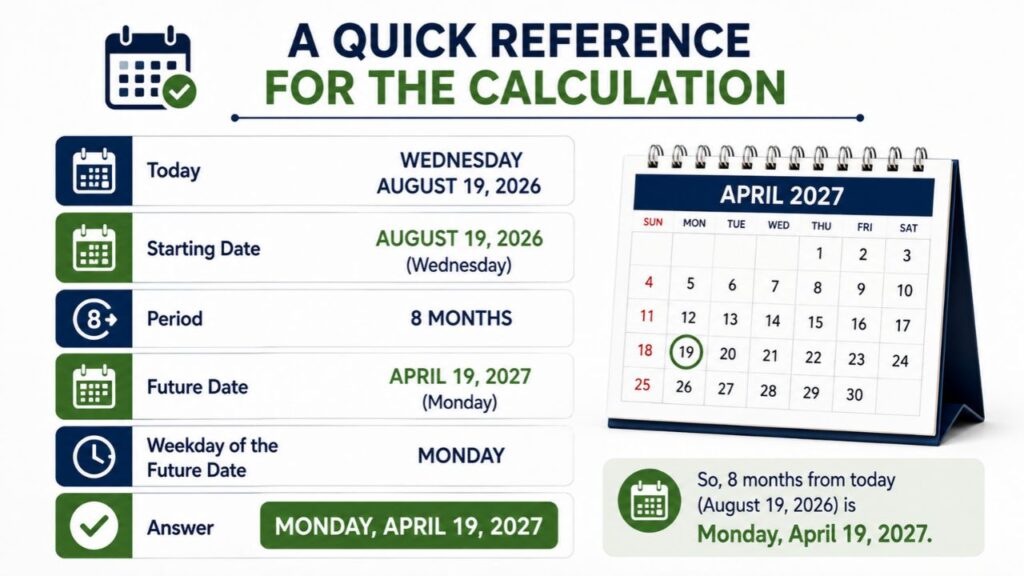
For readers who just need the answer without wandering through the whole calendar garden, here is the essential information:
- Today: Wednesday, August 19, 2026
- Starting date: August 19, 2026
- Period: 8 months
- Future date: April 19, 2027
- Weekday of the future date: Monday
- Answer: Monday, April 19, 2027
So if someone asks, “What is the 8 months from today date?” the clean answer is Monday, April 19, 2027. No mysterious calendar ritual required.
How to Make a Future Date More Useful
Once you’ve found a future date, don’t let it sit there looking pretty in your calendar and doing nothing. Give it a purpose. Add a reminder, write down why the date matters, and if the goal is important, create smaller checkpoints before reaching it.
You can also use the date as a conversation point. Tell a friend, colleague, partner, or family member what you hope to accomplish by April 19. A date becomes more powerful when another person knows what it represents, because suddenly there is a little accountability attached to it.
For larger plans, revisit the calculation every month. Not because the date changes it doesn’t but because your relationship with the date changes. What seemed far away in August may feel surprisingly close by February. Time has a strange habit of becoming faster whenever we’re not watching it.
Frequently Asked Questions
8 months from today
Eight months from today falls on the same date, eight calendar months later. The exact month depends on today’s date.
what month was it 8 months ago
Eight months ago was the month that came eight calendar months before the current month.
8 months from now
Eight months from now means the date exactly eight calendar months in the future from today.
what month was 8 months ago
The month 8 months ago can be found by counting backward eight months from the current month.
what is 8 months from today
Eight months from today is the date that occurs exactly eight calendar months after the current date.
Conclusion
The answer to 8 months from today is beautifully straightforward: Monday, April 19, 2027. Starting from Wednesday, August 19, 2026, we move through eight calendar months and arrive at April 19, 2027. The date calculation works because we are counting calendar months, not pretending that every month contains an identical number of days.
But there is something more interesting hiding behind the calculation. Future dates give shape to intentions. They turn “someday” into a point on the calendar. Whether April 19, 2027 becomes a deadline, celebration, personal milestone, travel date, or simply a date you were curious about, knowing exactly where it sits gives you something concrete to work with.
So keep the date somewhere useful if it matters to you. Put it in your planner, circle it on the calendar, or make a note about what you hope will be different by then. Eight months may look enormous when viewed all at once, yet it arrives one ordinary Wednesday, Thursday, Friday, and quiet little morning at a time.
And when April 19, 2027 finally appears, it won’t be “eight months from today” anymore. It will simply be today. That, perhaps, is the strangest and nicest thing about calendars: every future date eventually gets its turn to become the present.