There is something oddly satisfying about knowing exactly where a moment will land in the future. Maybe you are planning a meeting, setting a reminder, waiting for a delivery, or simply wondering, what time will it be in 35 hours? It sounds like a tiny question, but once midnight gets involved, even simple time calculation can become a little slippery.
If the current time is 11:49:40 AM on Thursday, August 20, 2026, then adding 35 hours takes us beyond one ordinary day and into the following evening. The result is 10:49:40 PM on Friday, August 21, 2026. That’s the interesting part: 35 hours is not merely “tomorrow at the same time.” It is one full day plus another 11 hours.
Understanding 35 Hours From Now is useful because it teaches a simple way to handle future time, date and time, and changes between AM and PM without relying on guesswork. Once you understand the pattern, similar questions become much easier.
What Time Will It Be in 35 Hours?

Starting with the example current time of 11:49:40 AM on Thursday, August 20, 2026, the easiest approach is to separate the calculation into 24 hours and 11 hours. One day contains 24 hours, so after the first 24 hours, the clock still reads 11:49:40 AM, but the date has moved forward by one day.
That brings us to 11:49:40 AM on Friday, August 21, 2026. Now there are 11 hours left. Adding those 11 hours moves the clock through the afternoon and into the evening, landing at 10:49:40 PM on Friday, August 21, 2026. Pretty neat, once you see it laid out.
So, the answer to 35 hours from now in this example is:
- Starting time: 11:49:40 AM
- Starting date: Thursday, August 20, 2026
- Hours added: 35 hours
- First 24 hours: Friday, August 21, 2026 at 11:49:40 AM
- Remaining time: 11 hours
- Final time: 10:49:40 PM
- Final date: Friday, August 21, 2026
The result is therefore 10:49:40 PM, Friday, August 21, 2026. If you are using a time calculator, this is the sort of calculation it performs instantly, though understanding the logic yourself is still handy when you dont have one nearby.
The Simple Math Behind 35 Hours From Now
A useful trick is to think of 35 hours as 24 hours + 11 hours. This breaks an apparently awkward calculation into two ordinary pieces.
Start at 11:49:40 AM on Thursday. Adding 24 hours gives you 11:49:40 AM on Friday. Nothing changes on the clock because exactly one day has passed; only the date changes.
Then add the remaining 11 hours:
- 11:49:40 AM + 1 hour = 12:49:40 PM
- 12:49:40 PM + 1 hour = 1:49:40 PM
- 1:49:40 PM + 1 hour = 2:49:40 PM
- 2:49:40 PM + 1 hour = 3:49:40 PM
- 3:49:40 PM + 1 hour = 4:49:40 PM
- 4:49:40 PM + 1 hour = 5:49:40 PM
- 5:49:40 PM + 1 hour = 6:49:40 PM
- 6:49:40 PM + 1 hour = 7:49:40 PM
- 7:49:40 PM + 1 hour = 8:49:40 PM
- 8:49:40 PM + 1 hour = 9:49:40 PM
- 9:49:40 PM + 1 hour = 10:49:40 PM
There are no extra minutes or seconds to adjust because the original time already contains 40 seconds. The seconds simply travel forward with the calculation, which is one of those small details people sometimes forget.
Why 35 Hours Is More Than “Tomorrow”
People often hear “35 hours” and instinctively think it means roughly tomorrow. In a broad sense, yes, but precise date calculation tells a more interesting story.
A full day is 24 hours. Once those 24 hours pass, another 11 hours remain. That means 35 hours in the future is equivalent to:
1 day + 11 hours
This distinction matters whenever you need an exact future time. If you only say “tomorrow,” you lose the actual hour. If you say “35 hours later,” you provide a precise interval, but the final answer depends on the starting date and time.
This is why phrases such as current time plus 35 hours, time after 35 hours, and exact time after 35 hours are really asking for the same basic operation. The wording changes, but the calculation doesnt.
35 Hours From Now and the Day Transition
The biggest source of confusion is usually the day transition. Adding hours can move the clock into a new date even when the change feels surprisingly small.
For example, imagine it is 8:00 PM on Thursday. After 24 hours, it becomes 8:00 PM on Friday. Add another 11 hours and the result becomes 7:00 AM on Saturday. So the same 35-hour interval can move you across one or even two calendar boundaries depending on your starting time.
In the example used here, however, the calculation begins at 11:49:40 AM on Thursday, August 20, 2026. After one day, it becomes 11:49:40 AM on Friday, August 21, 2026. The remaining 11 hours still keep the result on Friday.
That is why checking both the time and the date is important. A clock can look right while the calendar date is wrong, which is a sneaky little mistake.
35 Hours From Now: AM to PM Calculation
The change from AM to PM can make mental calculations feel more complicated than they really are. In this case, the first 24 hours preserve the AM time. The remaining 11 hours push it into PM.
Starting at 11:49:40 AM, adding 11 hours produces 10:49:40 PM. Notice that the minutes and seconds remain unchanged. Only the hour and AM/PM designation shift.
This is a good example of an AM to PM calculation where no minute rollover is involved. If you began at 11:55 AM and added 10 hours, the minutes would still be 55, but the hour would move into the evening. If you began at 11:55 AM and added 20 hours, the result would cross into the following morning.
The rule is simple: keep track of the hours separately from the minutes and seconds, then check whether the calculation crosses noon or midnight.
Using a 35 Hour Time Calculator

A 35 hour time calculator can save a few seconds when you need an exact answer. You enter the starting date and time, enter 35 hours, and the tool produces the corresponding future date and future time.
This is especially useful when the starting time includes minutes and seconds, or when the calculation crosses midnight. Humans are pretty good at simple arithmetic, but dates have a strange talent for making simple arithmetic look suspicious.
A future time calculator is also useful for planning:
- appointments
- medication reminders
- project deadlines
- travel schedules
- online events
- work shifts
- countdowns
- recurring tasks
- delivery windows
Still, calculators are best used as a verification tool when accuracy matters. Understanding how to calculate 35 hours from now means you can recognize whether an automated result makes sense.
How to Calculate 35 Hours From Now Manually
If you do not have an online hours from now calculator, use a three-step method.
First, add 24 hours. This advances the date by one day while keeping the clock time the same.
Second, add the remaining 11 hours. Watch carefully for the transition between AM and PM.
Third, confirm the final date and time together. Dont just look at the clock; check the calendar too.
For the example:
11:49:40 AM, Thursday, August 20, 2026
plus 35 hours
equals
10:49:40 PM, Friday, August 21, 2026
This method works because it converts a large-looking number into familiar chunks. You can use the same approach for 43 hours, 52 hours, 70 hours, or other intervals.
What If You Start at a Different Time?
The phrase 35 hours from now does not always produce the same clock time. The answer changes according to your starting point.
Suppose your starting time is 6:00 AM. Adding 24 hours gives 6:00 AM the next day, and another 11 hours gives 5:00 PM. So 35 hours later would be 5:00 PM on the following day.
If you start at 6:00 PM, however, 35 hours later becomes 5:00 AM two calendar days later. The interval is still exactly 35 hours; only the position of the starting time changes.
This is why a time calculation needs both a starting clock time and a starting date when you want a complete answer.
35 Hours From Today vs. 35 Hours From Now
There is a small but useful difference between 35 hours from now and 35 hours from today.
“35 hours from now” normally means 35 hours from the precise moment you are asking the question.
“35 hours from today” can be interpreted less precisely, because “today” identifies a date rather than a particular time. If someone says “35 hours from today,” it may be necessary to know what time they mean.
For an exact result, use the current time as the starting point. This removes ambiguity and gives you a definite future time.
The same distinction appears in searches for 35 days from today, 35 weeks from today, or 35 months from today. Those calculations are primarily calendar-based, while an hours calculation is strongly tied to the clock.
Understanding Related Time Calculations
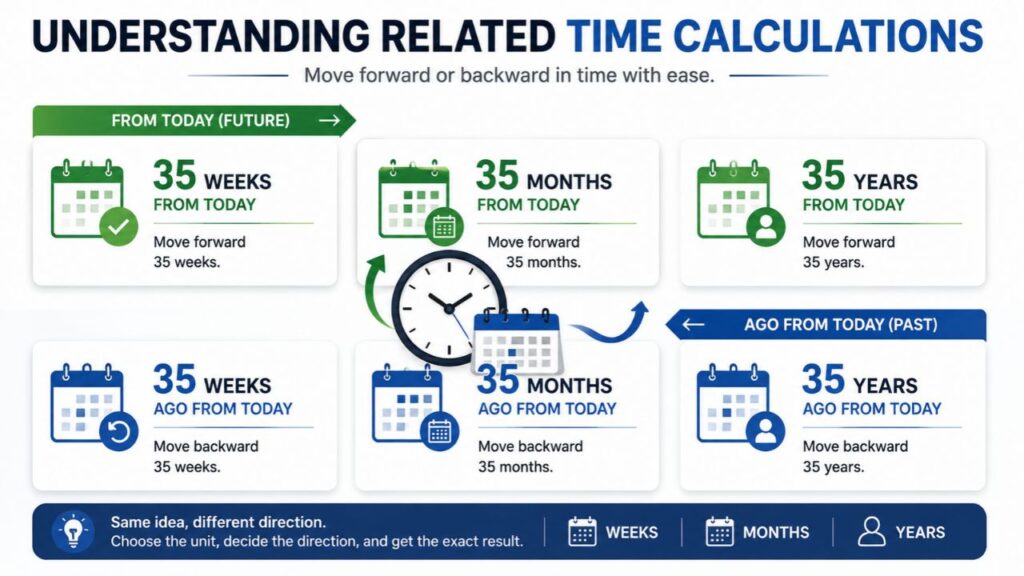
Once you understand 35 Hours From Now, other temporal searches become much easier to interpret.
For example, 35 Minutes From Now means adding 35 minutes to the current clock time. 35 Days From Today moves the calendar forward by 35 days. 35 Weeks From Today moves forward by 35 seven-day periods.
Then there are backward calculations, such as 35 Hours Ago From Now, 35 Minutes Ago From Now, and 35 Days Ago From Today. These use subtraction rather than addition.
You may also encounter:
- 35 Weeks From Today
- 35 Months From Today
- 35 Years From Today
- 35 Weeks Ago From Today
- 35 Months Ago From Today
- 35 Years Ago From Today
The underlying idea stays beautifully ordinary: determine the starting point, identify the unit, perform the calculation, and verify the resulting date.
The Importance of Exact Time
Sometimes “around 10 PM” is enough. Other times, it absolutely isnt.
If you are coordinating an international meeting, documenting an event, setting an automated task, or recording a deadline, the exact time can matter. In those situations, 10:49:40 PM is different from simply saying “10:50 PM.”
Seconds can matter in technical systems too. Digital records, server logs, online transactions, broadcasts, and automated workflows can all depend on precise timestamps.
That is where the combination of current date, current time, and time calculator becomes useful. Instead of estimating, you work from a definite point.
Why Online Time Calculators Are So Useful
An online time calculator can handle the annoying parts of temporal arithmetic almost instantly. You dont have to manually count through every hour, especially when the calculation crosses midnight or changes the date.
A good calculator may also help with time zones, elapsed time, date differences, and countdowns. For someone who regularly schedules meetings or manages deadlines, these tools can become surprisingly useful.
But there is a nice balance here. Use the calculator for speed, and understand the manual method for confidence. One gives convenience; the other gives you a way to catch mistakes.
Common Mistakes When Adding 35 Hours
One common error is adding 35 directly to the clock hour without accounting for the 24-hour cycle. For instance, starting at 11 AM and thinking “11 + 35 = 46” does not produce a meaningful clock time until you reduce it through the 24-hour cycle.
Another mistake is forgetting the date. A result such as 10:49:40 PM is incomplete if you need to know whether that occurs on Thursday or Friday.
People also sometimes confuse 35 hours with 35 minutes, especially when typing a quick search. Those are dramatically different intervals, despite sharing the same number.
Finally, watch for the AM and PM transition. It is one of the easiest places to make a mental slip, particularly when calculating late at night or early in the morning.
A Quick Reference for the 35-Hour Calculation
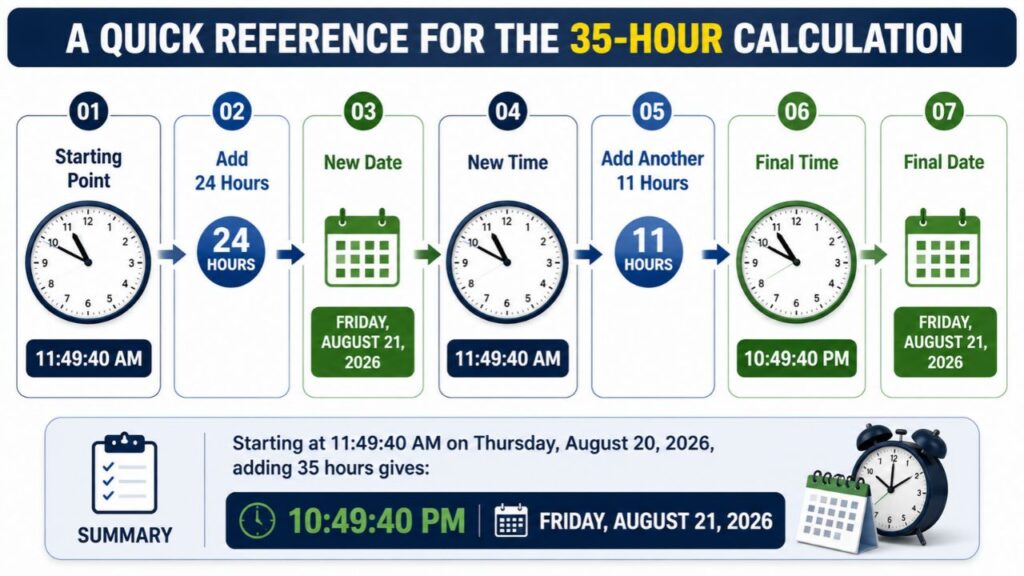
For the specific starting point of Thursday, August 20, 2026 at 11:49:40 AM, the calculation can be remembered like this:
- Starting point: 11:49:40 AM
- Add 24 hours
- New date: Friday, August 21, 2026
- New time: 11:49:40 AM
- Add another 11 hours
- Final time: 10:49:40 PM
- Final date: Friday, August 21, 2026
So if someone asks, what time will it be in 35 hours, the answer for this starting point is 10:49:40 PM on Friday, August 21, 2026.
When a 35-Hour Calculation Can Be Helpful
A 35-hour interval may sound oddly specific, but real life produces oddly specific schedules all the time. A work assignment might be due 35 hours after it begins. A traveler might want to know when a certain reservation window opens. Someone organizing a personal event may need to calculate an exact deadline.
It can also help when planning sleep, study, travel, or work cycles. Once you stop thinking of time only as “today” and “tomorrow,” you start seeing it as measurable intervals that can be moved forward or backward.
That perspective makes future time much less mysterious. Time is still going to move whether we calculate it or not, of course, but knowing where a particular interval lands can make planning feel a whole lot calmer.
Frequently Asked Questions
35 hours from now
35 hours from now means one full day plus 11 additional hours. The exact result depends on your current date and time.
what time will it be in 35 hours
To find the time in 35 hours, add 24 hours first and then add the remaining 11 hours. This also helps you correctly identify the future date.
35 hours from now is what time
The exact time 35 hours from now depends on the starting time. For example, 35 hours after 11:49:40 AM on Thursday, August 20, 2026, is 10:49:40 PM on Friday, August 21, 2026.
Conclusion
The answer to 35 Hours From Now is not difficult once the calculation is broken into sensible pieces. Starting from 11:49:40 AM on Thursday, August 20, 2026, add 24 hours to reach Friday morning, then add the remaining 11 hours to arrive at 10:49:40 PM on Friday, August 21, 2026.
The bigger lesson is that accurate time calculation is really about respecting both parts of the clock-and-calendar relationship. Hours move the clock, but enough hours also move the date. Forget either one, and your answer can quietly wander off course.
Whether you use a future date calculator, an hours calculator, or your own mental math, the process is dependable: identify the current time, add the required interval, check the day transition, and confirm the final date.
And perhaps thats the nicest thing about these little calculations. They turn an abstract question about the future into one very specific moment waiting on the other side of the clock: 10:49:40 PM, Friday, August 21, 2026. Not tomorrow exactly, not simply “later,” but a real point in time you can name.