Sometimes a question about time is tiny enough to fit inside a single sentence, yet somehow it refuses to leave your mind until you get the answer exactly right. “44 minutes ago from now” is one of those questions. Maybe you are checking when something happened, trying to remember when a message arrived, comparing two appointments, or simply wondering what time was it 44 minutes ago. It sounds simple, and it is, but a small mistake around an hour, midnight, or AM and PM can send the answer wandering into the wrong part of the day.
For the reference example used in this article, the current time is 3:14:46 AM on Friday, August 21, 2026. When we move backward by 44 minutes, the answer becomes 2:30:46 AM. That is the whole mystery, really: the clock does not travel backward dramatically; it just quietly removes 44 little pieces of a minute from the present.
Still, there is something oddly useful about understanding the process instead of merely seeing the result. A good time calculation teaches you how to handle other questions involving minutes, hours, days, and even larger stretches such as weeks, months, and years. So let’s take this seemingly modest question and give it the attention it deserves, because clocks are sneaky little things sometimes.
| Current Time | 44 Minutes Ago |
|---|---|
| 3:14:46 AM | 2:30:46 AM |
| Friday, August 21, 2026 | Friday, August 21, 2026 |
What Does 44 Minutes Ago From Now Mean?
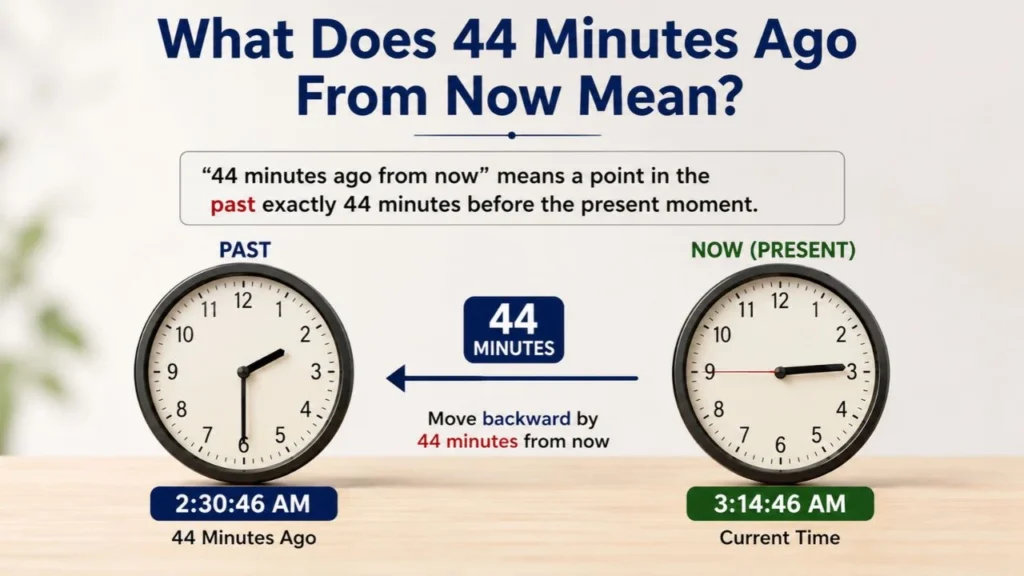
The phrase 44 minutes ago from now means a point in the past time exactly 44 minutes before the present moment. The important word is “before.” You are not adding time to the clock; you are taking time away from it, which is a small distinction but a very important one when you are doing mental arithmetic.
If the current time is 3:14:46 AM, you need to subtract 44 minutes from current time. Since 14 minutes is smaller than 44, you cannot simply write 14 − 44 and expect the clock to smile politely. You borrow one hour, turning 3:14 AM into 2:74 AM for the purpose of calculation, then remove 44 minutes. That leaves 2:30 AM, while the seconds remain 46.
So the exact time 44 minutes earlier is:
- Current/reference time: 3:14:46 AM
- Time difference: 44 minutes
- Previous time: 2:30:46 AM
- Date: Friday, August 21, 2026
- Time format: 12-hour format
- Result: 2:30:46 AM
It looks almost too neat, but that’s because time arithmetic often becomes easier once you stop treating the clock like an ordinary decimal number.
What Time Was It 44 Minutes Ago?
The direct answer to what time was it 44 minutes ago in our reference example is 2:30:46 AM. The calculation is simply 3:14:46 AM minus 44 minutes, giving 2:30:46 AM.
Notice that the date does not change here. The calculation stays comfortably inside the early morning of Friday, August 21, 2026. If the starting time had been 12:20 AM, however, moving backward by 44 minutes would cross into the previous date. That is where a basic-looking question starts wearing a slightly more complicated hat.
For everyday situations, you usually do not need seconds. If someone asks what was the time 44 minutes ago today, and the current time is 3:14 AM, you can reasonably answer 2:30 AM. But when an exact timestamp matters, retaining the seconds gives 2:30:46 AM, which is the more precise answer.
44 Minutes Ago From Now: The Simple Calculation
Let’s make the calculation almost ridiculously easy. Suppose the clock says:
3:14:46 AM
You want to go backward:
44 minutes
First, notice that 44 minutes is greater than the 14 minutes currently shown in the minute section. So borrow one hour.
That gives:
2 hours and 74 minutes
Now subtract 44 minutes:
74 − 44 = 30 minutes
The hour remains:
2
The seconds remain:
46
Therefore:
3:14:46 AM − 44 minutes = 2:30:46 AM
This is the heart of the 44 minutes ago time calculator idea. A calculator simply performs this little operation for you, while understanding the borrowing rule lets you do it yourself when your phone is somewhere inconvenient, perhaps beneath a cushion that has apparently become a black hole.
What Was the Time 44 Minutes Ago?
The answer depends on your actual starting point. There is no universal clock answer to what was the time 44 minutes ago, because “now” keeps changing.
If your present moment is 3:14:46 AM, the answer is 2:30:46 AM. If you read this article later at 10:00 AM, then 44 minutes ago would be 9:16 AM. This is why a current-time reference is essential whenever someone asks for an exact time lookup.
A useful rule is:
Past time = Current time − elapsed time
That tiny formula handles a surprisingly large number of real-life situations. It can tell you when a meeting began, when a notification appeared, when a timer started, or when you should have left the house if your memory is doing its usual selective editing.
How Do I Calculate 44 Minutes Ago?
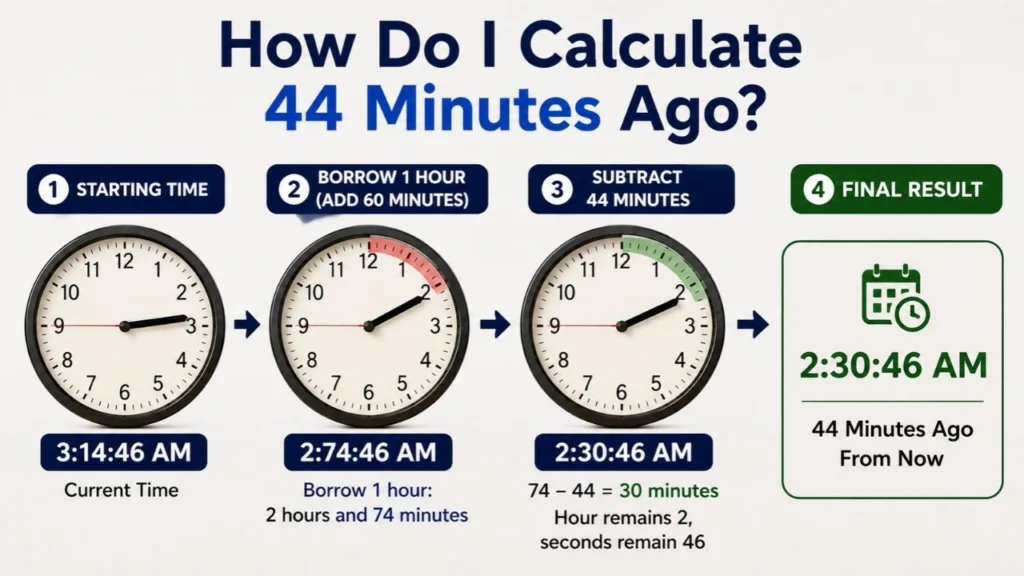
If you want to know how do I calculate 44 minutes ago, start with the hour and minute shown by your clock. Then subtract 44 from the minute portion. If the minutes are less than 44, borrow one hour and add 60 to the minutes before subtracting.
For example:
- Starting time: 3:14 AM
- Borrow one hour: 2 hours and 74 minutes
- Subtract 44 minutes: 74 − 44 = 30
- Final time: 2:30 AM
When seconds are included, they remain unchanged because we are subtracting whole minutes:
- Starting time: 3:14:46 AM
- Subtract: 44:00
- Result: 2:30:46 AM
This is a straightforward past-time calculation, and once you’ve done it two or three times, the process begins feeling less like mathematics and more like moving furniture around in a familiar room.
What Time Was It 44 Minutes Before Now?
The phrase what time was it 44 minutes before now means exactly the same thing as asking for the time 44 minutes ago. Both expressions describe the same time difference.
For our reference point:
Now: 3:14:46 AM
44 minutes before now: 2:30:46 AM
The word “before” tells us to move backward. If someone instead asks for 44 minutes from now, you would move forward, not backward. The two questions are mirror images, although clocks don’t bother showing which direction you were thinking.
This distinction is useful because people sometimes confuse “ago” with “from now.” One describes the previous time, while the other describes a future point.
44 Minutes Ago on Friday, August 21, 2026
Using the provided reference date and time, 44 minutes ago on August 21 2026 was 2:30:46 AM on Friday, August 21, 2026.
The calculation does not cross midnight, so the date stays the same. This is worth checking whenever you perform date and time calculation, especially around 12:00 AM.
For example, if the starting time were 12:15 AM on Friday, subtracting 44 minutes would produce 11:31 PM on Thursday. The time changes, but more importantly, the calendar changes too. A careless calculation could give you the right clock reading attached to the wrong day, which is a particularly annoying kind of correct.
When 44 Minutes Crosses Midnight
Crossing midnight is where time calculation from now becomes a little more interesting. Suppose your starting time is 12:20 AM.
Subtract 44 minutes:
12:20 AM − 44 minutes = 11:36 PM
But that 11:36 PM belongs to the previous calendar day. So if the starting date is Friday, August 21, 2026, the result is Thursday, August 20, 2026.
This is why an exact date and time can be more useful than a time alone. The clock says 11:36 PM, but the calendar tells you which 11:36 PM you mean. There are many 11:36 PM moments scattered across history, after all.
Why People Search “44 Minutes Ago”
Searches such as what time was 44 minutes ago, time 44 minutes ago, and 44 minutes earlier usually come from ordinary life rather than some grand scientific experiment. Someone may be checking a message timestamp, working out when an event began, confirming a travel schedule, or trying to remember when they last checked something.
There is also a psychological reason. Humans are decent at estimating broad periods but often surprisingly poor at exact intervals. “About an hour ago” can mean 48 minutes, 67 minutes, or whatever your tired brain has decided sounds believable.
A precise minutes ago calculator removes that uncertainty. It turns “I think it was sometime around then” into an actual timestamp, which can be rather satisfying.
Using a Time Calculator for Exact Results
A time calculator can be especially helpful when the calculation involves several operations. Subtracting 44 minutes once is easy. Subtracting 44 minutes from a time, then adding 2 hours, then checking a date change is where mental arithmetic starts asking for a cup of tea.
A useful time difference calculator can help you compare two timestamps directly. Meanwhile, a date calculator becomes more appropriate when the question involves longer periods, such as 44 days, 44 weeks, or 44 months.
For simple calculations, however, the basic method is enough. You don’t need technology every time a clock asks you a question.
The Difference Between Minutes, Hours, and Days

Forty-four minutes is less than one hour, which makes this calculation fairly compact. But understanding the relationship between units helps when the question grows.
- 60 minutes = 1 hour
- 24 hours = 1 day
- 7 days = 1 week
- Approximately 4 weeks = 1 month, though calendar months vary
- 12 months = 1 year
That means 44 hours ago from now is a completely different calculation from 44 minutes ago. Likewise, 44 days ago from today, 44 weeks ago from today, 44 months ago from today, and 44 years ago from today require increasingly careful attention to dates.
The clock is precise, but calendars have their own personalities. February, leap years, and months of different lengths make date arithmetic less obedient than minute arithmetic.
What About 44 Minutes From Now?
It is easy to accidentally reverse the direction. 44 minutes ago from now means subtract 44 minutes. 44 minutes from now means add 44 minutes.
Using the same reference time:
3:14:46 AM + 44 minutes = 3:58:46 AM
So the two results are:
- 44 minutes ago: 2:30:46 AM
- 44 minutes from now: 3:58:46 AM
The difference between them is 88 minutes. That little comparison makes the direction very obvious, and hopefully prevents the classic “I calculated it perfectly but backwards” problem.
Common Mistakes in 44-Minute Calculations
One common mistake is treating the clock like ordinary decimal subtraction. For example, someone may see 3:14 and attempt 14 − 44 directly, get a negative number, and decide time has betrayed them personally.
Another mistake is forgetting AM and PM. 2:30 AM and 2:30 PM are separated by twelve hours, so the label matters enormously. The third mistake is forgetting the date when a calculation crosses midnight.
You should also be careful when seconds are involved. If you subtract exactly 44 whole minutes from 3:14:46 AM, the seconds remain 46. But if the requested interval includes seconds, then the seconds must be calculated separately.
The safest approach is to identify the current time, identify the interval, determine whether you cross an hour or midnight, and then check the final date and time.
Real-Life Situations Where 44 Minutes Matters
Forty-four minutes is long enough to matter and short enough to disappear quickly. A commute can take 44 minutes. A lunch break can stretch to 44 minutes without anyone noticing. A phone call can begin before you realize the clock has quietly moved nearly three-quarters of an hour.
A student might ask what time was it 44 minutes ago after looking at the timestamp on a study session. A worker might calculate when a task started. A traveler could use the interval to reconstruct part of a journey. Someone waiting for a response might stare at a message timestamp and wonder whether it has really been that long.
These moments show why quick time arithmetic isn’t merely a puzzle. It is a practical everyday skill.
Quick Examples for Different Starting Times
Here are a few examples of 44 minutes before now using different starting times:
- 5:00 AM → 4:16 AM
- 6:15 AM → 5:31 AM
- 8:30 AM → 7:46 AM
- 10:10 AM → 9:26 AM
- 12:05 PM → 11:21 AM
- 2:20 PM → 1:36 PM
- 6:40 PM → 5:56 PM
- 11:15 PM → 10:31 PM
- 12:20 AM → 11:36 PM on the previous day
These examples reveal a useful pattern: when the starting minutes are at least 44, subtraction is direct. When they are smaller than 44, you borrow an hour.
A Fast Mental Trick for Subtracting 44 Minutes
If you want a quick mental method, remember that 44 minutes is one hour minus 16 minutes. So instead of subtracting 44 directly, you can subtract one hour and then add 16 minutes.
For 3:14 AM:
- Subtract one hour → 2:14 AM
- Add 16 minutes → 2:30 AM
Done.
This trick is particularly handy because 44 is close to 60. Your brain gets to use the familiar one-hour boundary instead of wrestling with a larger minute subtraction. It’s not magic, just arithmetic wearing a slightly nicer jacket.
44 Minutes Ago and Historical Time Lookup
Sometimes people search for an earlier timestamp because they need to reconstruct a sequence of events. This is essentially a small historical time lookup. The word “historical” may sound grand when we’re discussing less than an hour, but technically the moment has already happened, so the description fits.
If you have a known timestamp, subtract the elapsed interval. If you need to compare two timestamps, calculate their time difference. If the dates differ, include the calendar information rather than relying on the clock alone.
For records, appointments, logs, or other important information, use the original timestamp whenever possible. A calculated time is useful, but a recorded time is usually stronger evidence.
Why Exact Time Can Be More Useful Than “About an Hour Ago”
Imagine telling someone, “I sent it about an hour ago.” That could mean many things. Saying “I sent it at 2:30:46 AM” leaves considerably less room for imagination.
The value of an exact time becomes obvious when coordinating people or reconstructing events. Even a difference of ten minutes can matter in travel, work schedules, appointments, deadlines, and digital records.
Still, precision should serve the situation. If a friend asks when you went to bed, giving them a timestamp down to the second might be impressively unnecessary. Sometimes “around 11” is exactly enough.
How a 44-Minute Interval Feels in Daily Life
There is something peculiar about 44 minutes. It is not a round hour, so it feels more specific. Forty-four minutes can be almost a full movie trailer before the movie has even started, a respectable study session, or enough time to make tea, forget the tea, and rediscover it cold.
That makes 44 minutes ago an interesting interval for productivity too. If you look backward and ask what you were doing 44 minutes earlier, you may discover that a small block of time contains more activity than memory gives it credit for.
Time is not only something we measure. It is also something we experience, and those two versions do not always agree.
Practical Tips for Better Time Calculation
When you need to calculate past time, keep these habits nearby:
- Start with the current time.
- Identify whether you are moving forward or backward.
- Subtract minutes before worrying about larger units.
- Borrow an hour when the minute value is too small.
- Check whether the calculation crosses midnight.
- Keep AM and PM visible.
- Include the date when the day changes.
- Use a time calculator for complicated calculations.
- Use a date calculator for longer calendar-based intervals.
- Double-check important timestamps instead of trusting a rushed mental calculation.
These small habits make quick time calculation much less error-prone, particularly when you’re tired or doing several things at once.
The Bigger Lesson Behind 44 Minutes Ago
A question such as what time was 44 minutes ago today may look almost comically simple, but it points toward a bigger skill: understanding time as a sequence rather than merely reading numbers from a clock.
Once you understand one 44-minute calculation, you can apply the same reasoning to 17 minutes, 52 minutes, 3 hours, or longer intervals. You learn to recognize boundaries, understand calendar changes, and distinguish elapsed time from clock time.
That is why learning the method matters more than memorizing one answer. The answer changes every minute. The method doesn’t.
Read more blog: 35 Hours From Now
Frequently Asked Questions
What time was 44 minutes ago?
Using the reference time of 3:14:46 AM, 44 minutes ago was 2:30:46 AM on Friday, August 21, 2026.
What is 44 minutes ago from now?
It is the moment exactly 44 minutes before the present. With a reference time of 3:14:46 AM, that moment is 2:30:46 AM.
What time was 44 minutes ago in AM?
For the provided example, it was 2:30:46 AM. Both the starting time and the resulting time are in the morning.
What is the exact time 44 minutes ago?
With 3:14:46 AM as the current reference, the exact result is 2:30:46 AM. If your actual current time is different, your answer will naturally be different too.
What is current time minus 44 minutes?
For the stated reference:
3:14:46 AM − 44 minutes = 2:30:46 AM
Is 44 minutes a lot of time?
It depends. In a meeting, it can feel long. During a favorite conversation, it can vanish almost suspiciously fast. Mathematically, it is 44/60 of an hour, or about 0.733 hours.
Can I calculate 44 minutes ago without a calculator?
Yes. Subtract 44 minutes directly, or use the mental shortcut of subtracting one hour and adding 16 minutes. Both methods work well.
44 minutes from now
44 minutes from now means adding 44 minutes to the current time. It gives you the exact future time based on your current clock.
44 minutes ago from now
44 minutes ago from now means subtracting 44 minutes from the current time to find the exact time in the past.
44 minutes ago
“44 minutes ago” refers to a time that occurred exactly 44 minutes before the present moment.
what time was 44 minutes ago
To find what time was 44 minutes ago, simply subtract 44 minutes from the current time.
Conclusion
The answer to 44 minutes ago from now is simple when the reference point is known: from 3:14:46 AM on Friday, August 21, 2026, the earlier time is 2:30:46 AM on Friday, August 21, 2026.
But the more useful lesson is not the number 2:30:46. It is learning how to move backward through time without losing the hour, the AM/PM label, or the date along the way. Once that becomes familiar, questions like what time was it 44 minutes ago, 44 minutes before now, and calculate 44 minutes ago stop being little traps and become quick mental exercises.
And perhaps that’s the nicest thing about time: even a tiny interval can teach you something. Forty-four minutes disappears, then another forty-four arrives, and the clock keeps going as if none of this required permission. So whether you are checking a timestamp, planning your day, reconstructing an event, or simply wondering where the last chunk of your morning went, knowing how to calculate the past time gives you one small piece of control over an otherwise slippery thing.
If you have a favorite method for calculating time, or a funny situation where being 44 minutes late or early actually mattered, share it. Someone else may discover that their little clock problem isn’t quite as little as they thought.