There is something oddly satisfying about knowing exactly where a moment sits on the clock. Maybe you looked at the time, got distracted by a message, finished a small task, and suddenly wondered, what time was it 42 minutes ago? It sounds like a tiny question, almost too ordinary to deserve much thought, yet exact moments matter more than we usually admit. A missed call, a work note, a cooking timer, a conversation, or even a memory can make one particular minute feel important.
Suppose the reference time is 9:53:06 PM on Wednesday, August 12, 2026. If you want to find 42 minutes ago, the calculation is pleasantly simple: subtract 42 minutes from the current time. The answer is 9:11:06 PM. Nothing dramatic happened to the clock; it simply walked backward, quietly doing its little job.
This kind of time calculation becomes useful whenever “roughly an hour ago” is not good enough. You may need the exact time, the past time, or the precise time difference between two events. And honestly, clocks are much less mysterious when we stop treating them like mysterious little boxes and just do the subtraction.
| Current Time | Calculation | 42 Minutes Ago |
|---|---|---|
| 9:53:06 PM | 9:53:06 PM − 42 minutes | 9:11:06 PM |
What Time Was It 42 Minutes Ago?
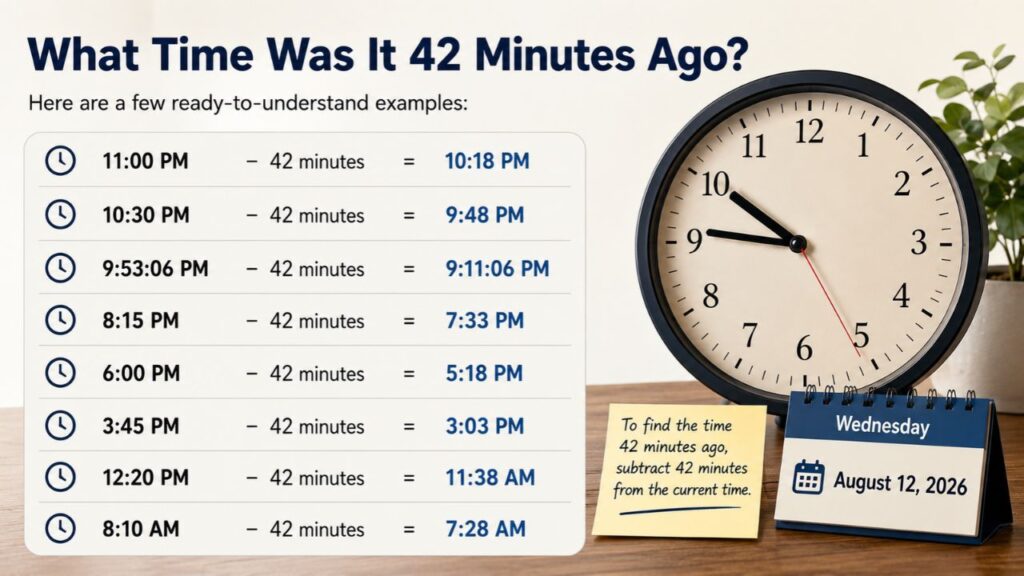
If the current or reference time is 9:53:06 PM, finding 42 minutes ago from now means moving backward by 42 minutes. The seconds remain unchanged because only the minutes are being reduced. So, 9:53:06 PM − 42 minutes = 9:11:06 PM.
That gives us the straightforward answer: 42 minutes ago was 9:11:06 PM on Wednesday, August 12, 2026. This is a simple example of relative time, where an event is described in relation to a reference point called now. It sounds technical, but people use relative time all day without thinking about it much.
Here are a few ready-to-understand examples:
- 11:00 PM − 42 minutes = 10:18 PM
- 10:30 PM − 42 minutes = 9:48 PM
- 9:53:06 PM − 42 minutes = 9:11:06 PM
- 8:15 PM − 42 minutes = 7:33 PM
- 6:00 PM − 42 minutes = 5:18 PM
- 3:45 PM − 42 minutes = 3:03 PM
- 12:20 PM − 42 minutes = 11:38 AM
- 8:10 AM − 42 minutes = 7:28 AM
The useful trick is not really a trick at all. Just subtract 42 minutes from current time, and pay attention if the subtraction crosses an hour, midnight, or even a date boundary.
42 Minutes Ago From Now: The Simple Calculation
When somebody asks, “what was the time 42 minutes ago?” the safest approach is to identify the starting point before touching the numbers. Otherwise, it is surprisingly easy to calculate from the wrong time, specially when you have several clocks or devices around you.
Using our reference example, begin with 9:53:06 PM. Subtract 42 minutes from 53 minutes, giving 11 minutes. The hour stays at 9 because the result is still inside the same hour.
So the calculation is:
9:53:06 PM − 42 minutes = 9:11:06 PM
The seconds remain 06, because no seconds were added or removed. That little detail matters when an exact timestamp is needed for records, logs, schedules, or a detailed personal timeline.
A quick mental method is also possible. Move back 40 minutes first, then another 2 minutes. From 9:53 PM, 40 minutes earlier is 9:13 PM; two more minutes takes you to 9:11 PM. It feels almost like walking backward through a hallway and counting doors, only less dramatic.
Why Exact Time Can Matter in Ordinary Life
People sometimes assume that knowing the previous time is only useful for computers or office records. In real life, exact minutes can settle little questions that otherwise keep bouncing around in your head.
Imagine you received a message at 9:53 PM and remembered doing something 42 minutes earlier. You might want to know whether that event happened before another message, appointment, or phone call. A precise time interval can make the sequence obvious.
The same thing happens with work. A person might write down that they began a task at 9:11 PM and checked the result at 9:53 PM. The elapsed time is 42 minutes. Suddenly the number has meaning; it describes not just a clock reading but a piece of lived time.
Cooking, studying, exercising, commuting, and project tracking all use this same idea. We constantly compare a current date and time with a previous moment, even when we never call it a temporal calculation.
42 Minutes Ago and the Meaning of “Ago”

The word ago always points backward from a reference moment. When someone says “42 minutes ago,” they do not mean a fixed clock time for every situation. The answer changes depending on now.
For example, 42 minutes ago at 9:53 PM is 9:11 PM. But if the current time were 2:00 PM, then 42 minutes ago would be 1:18 PM. The phrase remains the same while the actual clock time moves around.
That is why 42 minutes ago from now is different from a fixed timestamp. Relative expressions depend on their reference point. It is a small distinction, but understanding it prevents a lot of confusion when people compare messages, schedules, appointments, or records.
The same logic applies to:
- hours ago
- days ago
- weeks ago
- months ago
- years ago
- 42 hours ago
- 42 days ago
- 42 weeks ago
- 42 months ago
- 42 years ago
Each one describes distance from a reference moment rather than naming a permanent time on the clock.
What Time Was It 42 Minutes Ago When the Hour Changes?
The calculation becomes slightly more interesting when 42 minutes takes you into the previous hour. Suppose the current time is 9:20 PM. Subtracting 42 minutes cannot simply produce “9 minus 42,” because minutes have their own sixty-minute cycle.
One easy method is to move back to the previous hour first. From 9:20 PM, 20 minutes takes you to 9:00 PM. You still need to go back 22 minutes, which lands at 8:38 PM.
Therefore:
9:20 PM − 42 minutes = 8:38 PM
This is where a time calculator can be useful, particularly when seconds or date changes are involved. But knowing how the calculation works yourself is still valuable. A calculator can give you an answer; understanding the calculation lets you check whether the answer makes sense.
When 42 Minutes Ago Crosses Midnight
Midnight is where a simple subtraction can suddenly change the date. Imagine the current time is 12:20 AM. Forty-two minutes earlier is 11:38 PM on the previous calendar day.
So the clock time changes, but more importantly, the previous date changes too.
This matters when an exact timestamp is connected to a transaction, appointment, digital record, travel schedule, or event log. Saying “11:38 PM” without mentioning the date might be enough in casual conversation, but it can be ambiguous in formal records.
That is why date and time should sometimes be treated as one complete piece of information. The clock tells you where you are in the day; the date tells you which day you are actually standing in.
How to Calculate 42 Minutes Ago Without a Calculator

You do not need an app for every tiny question. Sometimes the quickest calculate 42 minutes ago method is mental arithmetic.
Start with the current minutes. If there are at least 42 minutes, simply subtract 42. If there are fewer than 42 minutes, borrow one hour, turn that hour into 60 minutes, and continue.
For instance, with 7:15 PM:
- Start with 7:15 PM.
- Borrow one hour, giving 6:75 PM in calculation terms.
- Subtract 42 minutes.
- The result is 6:33 PM.
The “75 minutes” is only a temporary calculation step, not a real clock display. Your actual answer is 6:33 PM. It looks a little funny on paper, but maths does not mind funny-looking temporary numbers.
Using a Time Calculator for Exact Results
A time difference calculator, minutes ago calculator, or date and time calculator can be handy when the calculation involves several units. This is especially true when you are comparing hours, minutes, seconds, and dates together.
For a basic question like current time minus 42 minutes, mental arithmetic is usually enough. But if you are working with a complicated schedule, an hours ago calculator can reduce the chance of a small mistake.
The important part is entering the correct reference time. A perfect calculator cannot rescue an incorrect starting time, which is a slightly annoying truth about calculators in general.
42 Minutes From Now: Looking Forward Instead
The opposite of 42 minutes ago is 42 minutes from now. Instead of moving backward, you move forward.
If the reference time is 9:53:06 PM, adding 42 minutes gives:
9:53:06 PM + 42 minutes = 10:35:06 PM
This is useful when planning something shortly ahead. Maybe a break begins then, a timer ends, a meeting starts, or you simply want to know where the clock will land.
The distinction is simple:
- 42 minutes ago means move backward.
- 42 minutes from now means move forward.
- ago describes the past.
- from now describes the future.
- now acts as the reference point.
Once you see that pattern, many other time questions become almost boringly easy, which is actually a good thing.
42 Hours, 42 Days, 42 Weeks, and Beyond

The number 42 does not belong only to minutes. The same relative-time structure can be used with larger intervals.
42 hours from now is a little less than two days later, while 42 days from today moves several weeks into the future. 42 weeks from today is much farther ahead, and 42 months from today reaches several years into the future.
You can also look backward:
- 42 hours ago
- 42 days ago
- 42 weeks ago
- 42 months ago
- 42 years ago
These calculations demonstrate why “ago” and “from now” are relationships rather than fixed dates. The reference point controls the answer.
When someone says “42 years ago,” for example, you immediately need to know what year they are talking from. Without that reference, the phrase is incomplete. Time is a bit fussy like that.
Common Mistakes When Finding 42 Minutes Ago
One common mistake is subtracting 42 from the hour instead of the minutes. If the starting time is 9:53 PM, the correct operation is not “9 − 42.” The hour remains 9 because the minute subtraction does not cross the hour boundary.
Another mistake is forgetting the date when the calculation passes midnight. A result such as 11:38 PM could belong to today or yesterday, depending on the starting point.
A third mistake is confusing 42 minutes with 42 hours. The units look similar when someone is moving quickly through a calculation, but they represent very different time intervals.
Finally, people sometimes use an old reference time while thinking they are using now. Before calculating, always confirm the reference clock. It takes two seconds and can save a surprisingly silly correction later.
A Real-Life Example of Tracking Previous Time
Consider someone working late on a personal project. At 9:53 PM, they look at their notes and wonder when they started the previous task. Their record says the task began 42 minutes earlier.
They calculate 9:53:06 PM − 42 minutes and get 9:11:06 PM. Now they know exactly when that earlier work period began.
That tiny calculation can become useful for productivity tracking. If the person repeats the process across several sessions, they can see how much elapsed time they actually spend working rather than relying on the vague feeling that “I worked for quite a while.”
Time awareness has a strange way of making ordinary routines visible. Forty-two minutes can feel short while you are absorbed in something, then look surprisingly substantial once written beside a timestamp.
Why Relative Time Is Useful for Schedules and Records
Relative time appears everywhere: messaging apps, calendars, fitness trackers, project software, security logs, browser histories, and personal notes. Phrases such as “15 minutes ago” or “2 hours ago” give people immediate context without forcing them to remember a full timestamp.
But when precision matters, relative descriptions can be converted into exact clock readings. That is where exact time, exact timestamp, and time difference calculations become valuable.
For example, “42 minutes ago” is easy for a human to understand. “9:11:06 PM, Wednesday, August 12, 2026” is more useful when somebody needs a permanent record. Both expressions describe the same moment, but they serve slightly different purposes.
Practical Ways to Check Your Calculation
If you calculate what time was it 42 minutes ago, it is worth checking the answer when accuracy matters.
You can reverse the operation. If your answer is 9:11:06 PM, add 42 minutes. You should arrive back at 9:53:06 PM. This reverse-check is one of the simplest ways to catch an arithmetic mistake.
You can also estimate before calculating. Forty-two minutes is less than an hour, so the answer should normally be less than one hour behind the starting point. If your result is several hours away, something has obviously wandered off.
For important records, check the date, time zone, seconds, and reference clock too. A correct calculation based on the wrong time zone is still the wrong answer, sadly.
How Relative Time Helps With Everyday Productivity
Time calculations are not just mathematical exercises. They can support better daily habits. Knowing how long a task actually took can help you plan tomorrow more realistically.
Suppose you expected a writing session to take 30 minutes but discover that the previous session lasted 42 minutes. That difference tells you something useful. Maybe the task is more demanding than expected, or perhaps interruptions are stretching the work.
You can use a time calculator or simple notes to track these patterns. Over several days, those small measurements can reveal where your time disappears.
The point is not to turn every minute into a spreadsheet. That would make ordinary life rather exhausting. The point is to understand your routine well enough to make better choices.
A Quick Reference for 42-Minute Calculations

Here is a compact set of examples for people who want to check the idea quickly:
- 12:00 PM → 11:18 AM
- 1:00 PM → 12:18 PM
- 2:00 PM → 1:18 PM
- 3:00 PM → 2:18 PM
- 4:00 PM → 3:18 PM
- 5:00 PM → 4:18 PM
- 6:00 PM → 5:18 PM
- 7:00 PM → 6:18 PM
- 8:00 PM → 7:18 PM
- 9:53:06 PM → 9:11:06 PM
These examples make one thing clear: subtracting 42 minutes often changes the hour, but the exact outcome depends entirely on the starting minutes.
The Difference Between “42 Minutes Ago” and “42 Minutes Before”
The expressions 42 minutes ago and 42 minutes before now usually communicate the same basic idea. Both point toward a moment 42 minutes in the past.
However, “before” can sometimes require another reference event. For example, “42 minutes before the meeting” means the meeting is the reference point. “42 minutes ago” normally uses the present moment as its reference.
That tiny linguistic difference can matter in schedules and written records. Relative time is partly mathematics and partly language, and the two quietly work together.
Why Exact Timestamps Are Better for Important Events
If something matters enough to remember precisely, writing down the complete timestamp can be worthwhile. Instead of recording only “42 minutes ago,” you might record 9:11:06 PM, Wednesday, August 12, 2026.
This removes ambiguity later. The reference point might change, but the timestamp remains stable.
For ordinary conversations, “42 minutes ago” is perfectly natural. For technical records, appointments, financial events, or documentation, an exact date and time is usually much clearer.
Read more blog: 43 Minutes Ago From Now
Frequently Asked Questions
42 minutes from now
To find the time 42 minutes from now, add 42 minutes to the current time.
For example, 9:53 PM + 42 minutes = 10:35 PM.
42 minutes ago from now
To find the time 42 minutes ago from now, subtract 42 minutes from the current time.
For example, 9:53 PM − 42 minutes = 9:11 PM.
what time was it 42 minutes ago
The answer depends on the current time, so subtract 42 minutes from the exact current time.
For example, if it is 9:53:06 PM, 42 minutes ago was 9:11:06 PM.
42 minutes ago
“42 minutes ago” means a moment exactly 42 minutes before now.
You can calculate it by subtracting 42 minutes from the current time.
what time was 42 minutes ago
To calculate what time was 42 minutes ago, count backward by 42 minutes from the current time.
For example, 7:15 PM − 42 minutes = 6:33 PM.
Conclusion
The answer to what time was it 42 minutes ago depends on the reference time, but with the example 9:53:06 PM, the result is clearly 9:11:06 PM on Wednesday, August 12, 2026.
The calculation is simply:
9:53:06 PM − 42 minutes = 9:11:06 PM
What makes the question interesting is not the subtraction itself, but the way we use relative time in everyday life. A few minutes can separate one task from another, one message from a reply, or one memory from the next. Sometimes knowing the exact minute gives an otherwise fuzzy moment a proper place.
Whether you calculate it mentally, use a minutes ago calculator, or check a date and time calculator, the principle stays the same: identify now, subtract the correct time interval, and verify the result.
And if you are curious about 42 minutes from now, simply reverse the direction and add 42 minutes instead. Time keeps moving either way, of course, while we keep giving names to the pieces we need to remember. Maybe that is the real charm of a small question like this: even an ordinary 42-minute stretch can become meaningful once you know exactly where it began.